
空气污染与心血管疾病:对包括森林火灾烟雾在内的空气污染对心血管疾病影响的系统评价。
Air pollution and cardiovascular disease: a systematic review of the effects of air pollution, including bushfire smoke, on cardiovascular disease.
作者信息
Islam Fariha, Nukala Sai Keerthana, Shrestha Pallavi, Badgery-Parker Tim, Foo Fiona
机构信息
Faculty of Medicine, Health and Human Sciences, Macquarie University 2109, NSW, Australia.
出版信息
Am Heart J Plus. 2025 Apr 19;54:100546. doi: 10.1016/j.ahjo.2025.100546. eCollection 2025 Jun.
OBJECTIVE
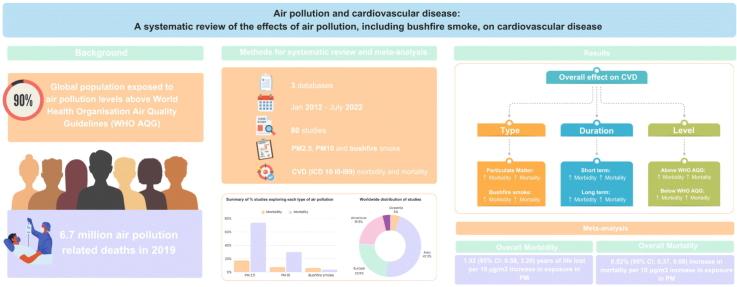
Particulate matter (PM) with diameter ≤ 2.5 μm (PM) and ≤ 10 μm (PM), including from bushfire smoke, is associated with cardiovascular disease (CVD) morbidity and mortality. This systematic review assesses how CVD morbidity and mortality is affected by type, duration, and level of air pollution exposure.
DATA SOURCES
A search was conducted on Ovid Medline, Embase and Scopus, spanning across 1 January 2012 to 30 July 2022. Primary quantitative studies exploring the effect of PM, PM or bushfire smoke on CVD were included. Studies without adjustment for confounding factors were excluded. The Newcastle-Ottawa Scale was used to assess the risk of bias (ROB) in the studies, and meta-analysis was conducted on relevant outcomes.
FINDINGS
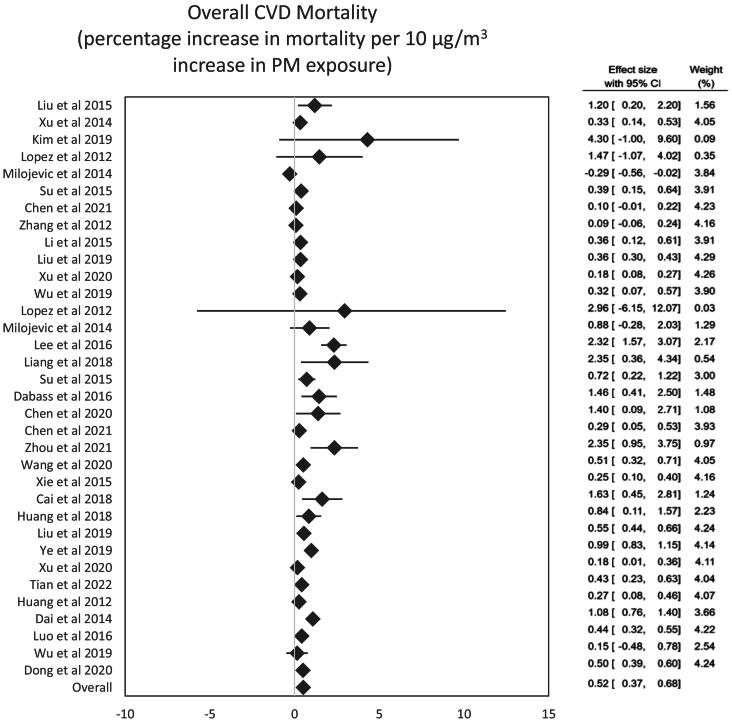
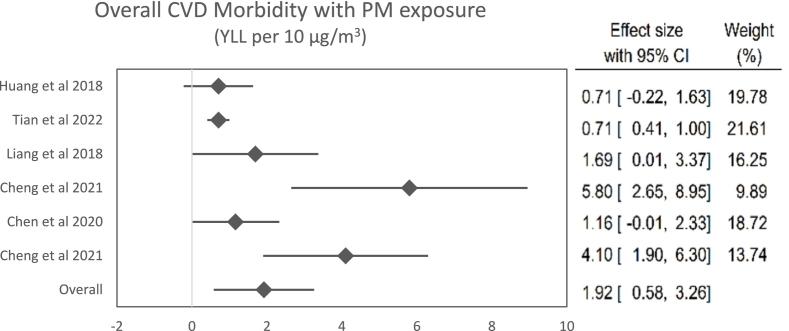
A total 275 studies were obtained, and 80 studies were analysed with diseases ranging from ICD-10 I00-I99. For CVD morbidity, increased PM and PM was associated with 1.92 (95 % CI: 0.58,3.26) years of life lost per 10 μg/m increase in exposure. Increased PM and PM was associated with a 0.52 % (95 % CI: 0.37,0.68) increase in mortality per 10 μg/m increase in exposure. Bushfire smoke also presented similar trends. Two studies had high ROB, 42 had medium ROB, and 36 had low ROB. There was high heterogeneity between the studies, with I values ranging between 88.09 % and 94.25 %.
CONCLUSION
Air pollution including bushfire smoke is associated with increased CVD morbidity and mortality. This effect ranges across different types, durations, and levels of air pollution exposure, making stringent climate change and air pollution mitigation strategies imperative.
目的
直径≤2.5μm(PM2.5)和≤10μm(PM10)的颗粒物,包括丛林大火烟雾中的颗粒物,与心血管疾病(CVD)的发病率和死亡率相关。本系统评价评估了空气污染暴露的类型、持续时间和水平如何影响心血管疾病的发病率和死亡率。
数据来源
对Ovid Medline、Embase和Scopus进行了检索,时间跨度为2012年1月1日至2022年7月30日。纳入了探索PM2.5、PM10或丛林大火烟雾对心血管疾病影响的主要定量研究。未对混杂因素进行调整的研究被排除。使用纽卡斯尔-渥太华量表评估研究中的偏倚风险(ROB),并对相关结果进行荟萃分析。
研究结果
共获得275项研究,其中80项研究分析了国际疾病分类第10版(ICD-10)I00-I99范围内的疾病。对于心血管疾病发病率,每增加10μg/m³的暴露量,PM2.5和PM10增加与每10μg/m³暴露量增加导致的1.92年(95%CI:0.58,3.26)寿命损失相关。每增加10μg/m³的暴露量,PM2.5和PM10增加与死亡率增加0.52%(95%CI:0.37,0.68)相关。丛林大火烟雾也呈现出类似趋势。两项研究有高偏倚风险,42项有中偏倚风险,36项有低偏倚风险。研究之间存在高度异质性,I²值在88.09%至94.25%之间。
结论
包括丛林大火烟雾在内的空气污染与心血管疾病发病率和死亡率增加相关。这种影响在不同类型、持续时间和空气污染暴露水平中都存在,因此必须制定严格的气候变化和空气污染缓解策略。

 Zotero 插件