
基于网络的癌症症状自我管理系统:一项随机临床试验。
Web-Based Cancer Symptom Self-Management System: A Randomized Clinical Trial.
作者信息
Cella David, Lancki Nicola, Kuharic Maja, Yanez Betina, Bass Michael, Garcia Martha G, Webster Kimberly A, Smith Justin D, O'Connor Mary, Coughlin Ava, Cahue September, Kircher Sheetal, Flores Ann Marie, Penedo Frank J, Jensen Roxanne E, Wilder Smith Ashley, Richardson Kimberly, Barnard Cynthia, George Christopher M, Tsarwhas Dean G, Scholtens Denise, Garcia Sofia F
机构信息
Department of Medical Social Sciences, Northwestern University Feinberg School of Medicine, Chicago, Illinois.
Department of Preventive Medicine, Division of Biostatistics, Northwestern University Feinberg School of Medicine, Chicago, Illinois.
出版信息
JAMA Netw Open. 2025 May 1;8(5):e258353. doi: 10.1001/jamanetworkopen.2025.8353.
IMPORTANCE
Patients with cancer and cancer survivors frequently experience symptoms that increase the need for health care services and impair quality of life. Effective symptom management is critical for comprehensive patient-centered cancer care.
OBJECTIVE
To evaluate the effectiveness of adding a bilingual (English and Spanish), web-based self-management program to an electronic health record (EHR)-integrated patient-reported outcome for cancer (cPRO) assessment in reducing symptom burden and health care resource use (HCRU).
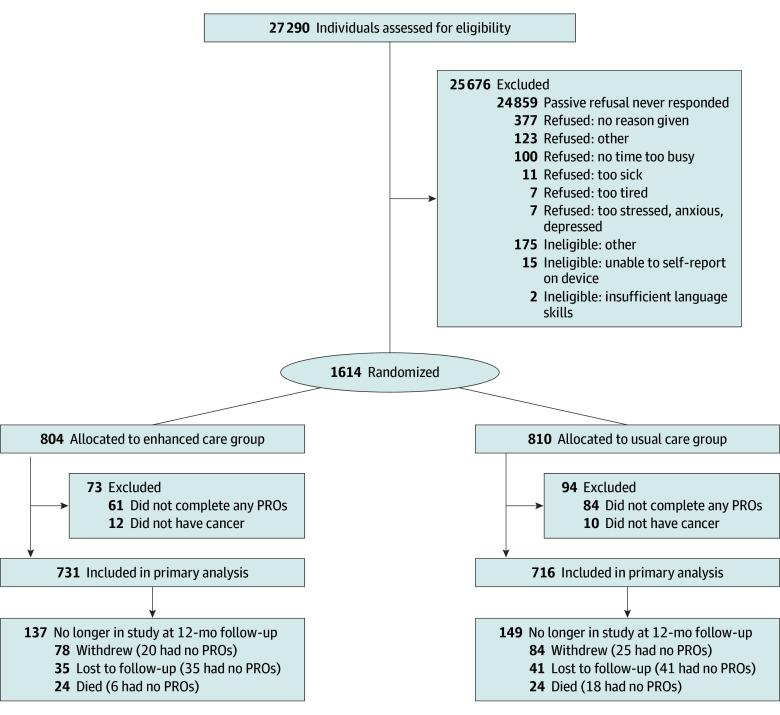
DESIGN, SETTING, AND PARTICIPANTS: This patient-level randomized clinical trial was performed at the Northwestern Memorial HealthCare system in Chicago, Illinois. Participants included 1614 adult patients with cancer or cancer survivors in 30 clinics who were enrolled between April 1, 2020, and April 8, 2023, and followed up for 12 months until May 8, 2024.
INTERVENTIONS
Usual care (UC) consisting of an EHR-integrated cPRO assessment or enhanced care (EC), which offered an additional tailored web-based self-management program.
MAIN OUTCOMES AND MEASURES
Patient-Reported Outcomes Measurement Information System measures of anxiety, depression, fatigue, pain interference, and physical function collected at baseline and monthly for 12 months. Secondary outcomes included HCRU measures (inpatient and/or observation visits and days, emergency department and/or urgent care visits, and days of hospital stay).
RESULTS
A total of 1614 patients were included in the analysis, with 804 randomized to EC and 810 to UC. The mean (SD) age was 61 (13) years; 1095 patients (67.8%) were female. Only 419 EC participants (52.1%) accessed the website, with only 197 (47%) returning; the median time per visit was 45 seconds (IQR, 45-105 seconds). There were no statistically significant differences between EC and UC across the cPRO outcomes over 12 months. The mean change from baseline at each assessment time point for treatment effects (EC vs UC) ranged from -0.19 (95% CI, -0.86 to 0.33; P = .64) for physical function to 0.11 (95% CI, -0.75 to 0.79; P = .87) for fatigue. Zero-inflated negative binomial and logistic regression models showed no significant differences in HCRU outcomes: inpatient and/or observation visits (incidence rate ratio [IRR], 0.90; 95% CI, 0.72-1.12), emergency department and/or urgent care visits (IRR, 0.99; 95% CI, 0.84-1.16), and days of hospital stay (IRR, 1.05; 95% CI, 0.83-1.33).
CONCLUSIONS AND RELEVANCE
In this randomized clinical trial, adding a bilingual web-based self-management program to EHR-integrated cPRO did not reduce symptom burden or HCRU compared with cPRO alone. Low engagement with the web-based program highlights the need for strategies to enhance engagement and tailor interventions to those who would benefit most.
TRIAL REGISTRATION
ClinicalTrials.gov Identifier: NCT03988543.
重要性
癌症患者和癌症幸存者经常出现一些症状,这些症状增加了对医疗服务的需求并损害生活质量。有效的症状管理对于以患者为中心的全面癌症护理至关重要。
目的
评估在电子健康记录(EHR)集成的癌症患者报告结局(cPRO)评估中添加基于网络的双语(英语和西班牙语)自我管理计划对减轻症状负担和医疗资源使用(HCRU)的有效性。
设计、设置和参与者:这项患者层面的随机临床试验在伊利诺伊州芝加哥的西北纪念医疗系统进行。参与者包括2020年4月1日至2023年4月8日期间在30个诊所登记的1614名成年癌症患者或癌症幸存者,并随访12个月直至2024年5月8日。
干预措施
常规护理(UC)包括EHR集成的cPRO评估,或强化护理(EC),后者提供额外的量身定制的基于网络的自我管理计划。
主要结局和测量指标
在基线时以及之后12个月每月收集患者报告结局测量信息系统中关于焦虑、抑郁、疲劳、疼痛干扰和身体功能的测量指标。次要结局包括HCRU指标(住院和/或观察就诊次数和天数、急诊科和/或紧急护理就诊次数以及住院天数)。
结果
共有1614名患者纳入分析,804名随机分配至EC组,810名随机分配至UC组。平均(标准差)年龄为61(13)岁;1095名患者(67.8%)为女性。只有419名EC参与者(52.1%)访问了该网站,其中只有197名(47%)回访;每次访问的中位时间为45秒(四分位间距,45 - 105秒)。在12个月的cPRO结局方面,EC组和UC组之间无统计学显著差异。治疗效果(EC组与UC组)在每个评估时间点相对于基线的平均变化范围为身体功能方面为 -0.19(95%置信区间,-0.86至0.33;P = 0.64),疲劳方面为0.11(95%置信区间,-0.75至0.79;P = 0.87)。零膨胀负二项式和逻辑回归模型显示HCRU结局无显著差异:住院和/或观察就诊(发病率比[IRR],0.90;95%置信区间,0.72 - 1.12)、急诊科和/或紧急护理就诊(IRR,0.99;95%置信区间,0.84 - 1.16)以及住院天数(IRR,1.05;95%置信区间,0.83 - 1.33)。
结论及相关性
在这项随机临床试验中,与单独的cPRO相比,在EHR集成的cPRO中添加基于网络双语自我管理计划并未减轻症状负担或减少HCRU。对基于网络计划的低参与度凸显了需要采取策略来提高参与度,并针对最能受益的人群量身定制干预措施。
试验注册
ClinicalTrials.gov标识符:NCT03988543。

 Zotero 插件