
早晨起床情况及生物钟类型与多囊卵巢综合征的关系:一项孟德尔随机化和横断面研究。
Getting Up in the Morning and Chronotype in Relation to Polycystic Ovarian Syndrome: A Mendelian Randomization and Cross-Sectional Study.
作者信息
Dilimulati Diliqingna, Lu Jiayi, Li Jinghua, Cai Meili, Zhang Yuqin, Shao Xiaowen, Chen Haibing, Wan Qian, He Fang, Yue Chaoyan, Zhang Manna, Qu Shen
机构信息
Department of Endocrinology and Metabolism, Shanghai Tenth People's Hospital, Tongji University School of Medicine, Shanghai, 200072, People's Republic of China.
Department of Clinical Laboratory, Shanghai Tenth People's Hospital, Tongji University School of Medicine, Shanghai, 200072, People's Republic of China.
出版信息
Nat Sci Sleep. 2025 May 1;17:779-790. doi: 10.2147/NSS.S511467. eCollection 2025.
BACKGROUND
Although a connection between circadian rhythm and polycystic ovarian syndrome (PCOS) has been shown in previous studies, the exact cause of this association is not well understood.
PURPOSE
This study aimed to use Mendelian randomization (MR) method to analyze the potential association between getting up in the morning and chronotype with PCOS, and a cross-sectional study was conducted to further validate these results.
METHODS
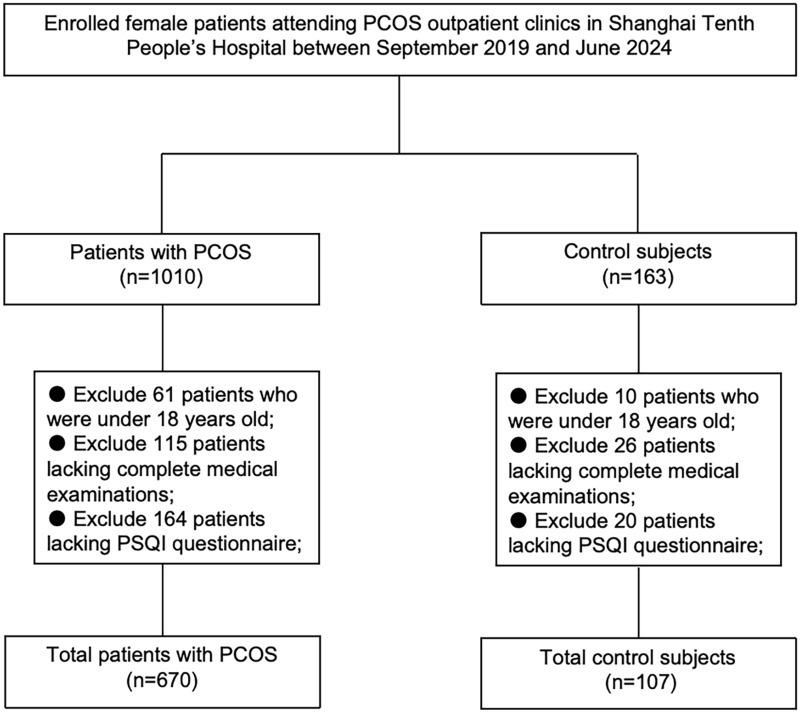
Using summary information from large-scale genome-wide association studies (GWASs) in people of European ancestry, we conducted univariable MR (UVMR) and multivariable MR (MVMR) analyses to examine the causal effect of genetically determined getting up in the morning and chronotype on PCOS. We also investigated the association between wake-up time and sleep midpoint with the risk of PCOS and total testosterone (TT) levels in a cohort of 777 women of reproductive age.
RESULTS
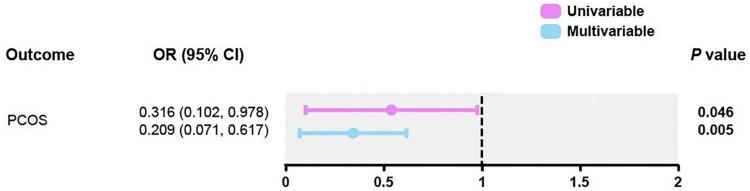
Our findings indicate a causal relationship between the genetic prediction of getting up in the morning and chronotype with a reduced incidence of PCOS. In a cross-sectional study, a sleep midpoint of > 4:00 was linked to a higher risk of PCOS and increased TT levels than a sleep midpoint of < 3:30. In women with a BMI < 24 kg/m, earlier wake-up times and sleep midpoints were associated with a lower risk of PCOS and decreased TT levels.
CONCLUSION
This study indicates that a genetic predisposition to getting up in the morning and chronotype are linked to a reduced risk of PCOS. Additionally, earlier wake-up times and sleep midpoints are associated with a lower risk of PCOS and decreased TT levels.
背景
尽管先前的研究已表明昼夜节律与多囊卵巢综合征(PCOS)之间存在关联,但这种关联的确切原因尚不清楚。
目的
本研究旨在使用孟德尔随机化(MR)方法分析早晨起床时间和昼夜节律类型与PCOS之间的潜在关联,并进行横断面研究以进一步验证这些结果。
方法
利用欧洲血统人群大规模全基因组关联研究(GWAS)的汇总信息,我们进行了单变量MR(UVMR)和多变量MR(MVMR)分析,以检验基因决定的早晨起床时间和昼夜节律类型对PCOS的因果效应。我们还在一个由777名育龄妇女组成的队列中,研究了起床时间和睡眠中点与PCOS风险及总睾酮(TT)水平之间的关联。
结果
我们的研究结果表明,早晨起床时间和昼夜节律类型的基因预测与PCOS发病率降低之间存在因果关系。在横断面研究中,睡眠中点>4:00比睡眠中点<3:30与更高的PCOS风险和升高的TT水平相关。在体重指数(BMI)<24 kg/m²的女性中,较早的起床时间和睡眠中点与较低的PCOS风险及降低的TT水平相关。
结论
本研究表明,早晨起床的遗传易感性和昼夜节律类型与较低的PCOS风险相关。此外,较早的起床时间和睡眠中点与较低的PCOS风险及降低的TT水平相关。


 Zotero 插件