
用于评估癌症免疫疗法的类器官模型的突破与挑战:推进个性化治疗的前沿工具
Breakthroughs and challenges of organoid models for assessing cancer immunotherapy: a cutting-edge tool for advancing personalised treatments.
作者信息
Wang Qian, Yuan Fangwei, Zuo Xianglin, Li Ming
机构信息
Department of Thoracic Surgery, The Affiliated Cancer Hospital of Nanjing Medical University & Jiangsu Cancer Hospital & Jiangsu Institute of Cancer Research, Jiangsu Key Laboratory of Molecular and Translational Cancer Research, Collaborative Innovation Center for Cancer Personalized Medicine, Nanjing, 210009, Jiangsu, PR China.
The Fourth Clinical College of Nanjing Medical University, Nanjing, 210009, Jiangsu, PR China.
出版信息
Cell Death Discov. 2025 May 7;11(1):222. doi: 10.1038/s41420-025-02505-w.
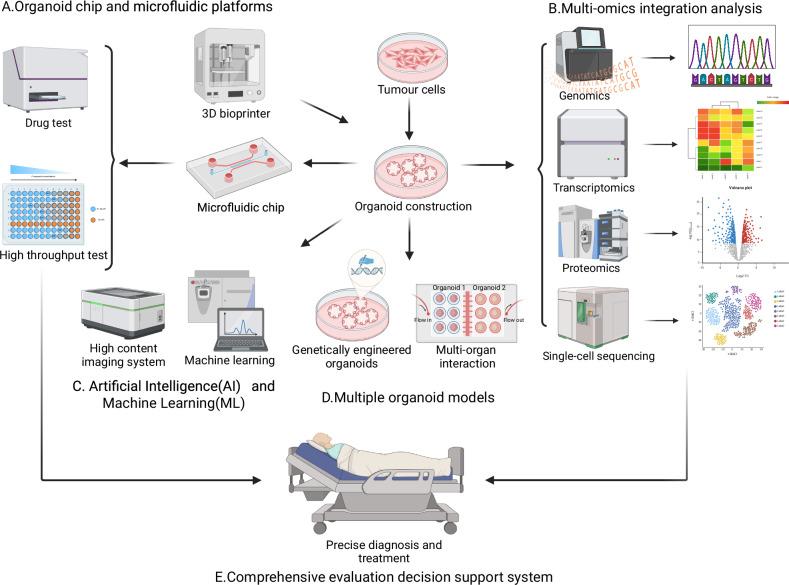
Organoid models are powerful tools for evaluating cancer immunotherapy that provide a more accurate representation of the tumour microenvironment (TME) and immune responses than traditional models. This review focuses on the latest advancements in organoid technologies, including immune cell co-culture, 3D bioprinting, and microfluidic systems, which enhance the modelling of TME and facilitate the assessment of immune therapies such as immune checkpoint inhibitors (ICIs), CAR-T therapies, and oncolytic viruses. Although these models have great potential in personalised cancer treatment, challenges persist in immune cell diversity, long-term culture stability, and reproducibility. Future developments integrating artificial intelligence (AI), multi-omics, and high-throughput platforms are expected to improve the predictive power of organoid models and accelerate the clinical translation of immunotherapy.
类器官模型是评估癌症免疫疗法的强大工具,与传统模型相比,它能更准确地呈现肿瘤微环境(TME)和免疫反应。本综述聚焦于类器官技术的最新进展,包括免疫细胞共培养、3D生物打印和微流控系统,这些技术增强了TME的建模,并有助于评估免疫疗法,如免疫检查点抑制剂(ICIs)、嵌合抗原受体T细胞(CAR-T)疗法和溶瘤病毒。尽管这些模型在个性化癌症治疗中具有巨大潜力,但在免疫细胞多样性、长期培养稳定性和可重复性方面仍存在挑战。预计未来整合人工智能(AI)、多组学和高通量平台的发展将提高类器官模型的预测能力,并加速免疫疗法的临床转化。

 Zotero 插件