
接受cfDNA检测的视网膜母细胞瘤患者中RB1嵌合体的检测与特征分析
Detection and Characterization of RB1 Mosaicism in Patients With Retinoblastoma Receiving cfDNA Test.
作者信息
Gao Chuan, Patel Juber, Robbins Melissa, Gedvilaite Erika, Bowman Anita S, Arora Kanika, Vanderbilt Chad, Brannon A Rose, Friedman Danielle N, Kennedy Jennifer, Fiala Elise, Ceyhan-Birsoy Ozge, Dunkel Ira J, Weigelt Britta, Francis Jasmine H, Reis-Filho Jorge S, Abramson David H, Mandelker Diana
机构信息
Department of Pathology and Laboratory Medicine, Memorial Sloan Kettering Cancer Center, New York, New York.
Department of Surgery, Memorial Sloan Kettering Cancer Center, New York, New York.
出版信息
JAMA Ophthalmol. 2025 May 8. doi: 10.1001/jamaophthalmol.2025.1079.
IMPORTANCE
Plasma cell-free DNA (cfDNA) testing is increasingly used for disease diagnosis and monitoring in retinoblastoma, with RB1 allele fraction in cfDNA actively corresponding to disease status and treatment response. However, while RB1 mosaicism has been reported in retinoblastoma, its clinical implications and potential impact on cfDNA testing remain unclear.
OBJECTIVES
To identify RB1 mosaicism using paired plasma and buffy coat (containing lymphocytes, monocytes, granulocytes, and platelets) DNA testing, and to characterize the implications of RB1 mosaicism on cfDNA testing outcomes.
DESIGN, SETTING, AND PARTICIPANTS: In this cross-sectional study, participants with retinoblastoma underwent testing with MSK-ACCESS (Memorial Sloan Kettering-Analysis of Circulating cfDNA to Examine Somatic Status), a clinical assay that combines plasma cfDNA and buffy coat genomic DNA sequencing, enabling the detection and differentiation of somatic, heterozygous, and mosaic variants, between July 2020 and April 2024 at the Memorial Sloan Kettering Cancer Center. Mosaic findings from MSK-ACCESS were correlated with those from a subgroup of patients who concurrently underwent testing using the MSK-IMPACT germline assay. Data analysis was performed from April to September 2024.
EXPOSURE
RB1 mosaicism in retinoblastoma.
MAIN OUTCOMES AND MEASURES
The RB1 variant allele fractions in cfDNA and buffy coat genomic DNA were used to detect RB1 mosaicism.
RESULTS
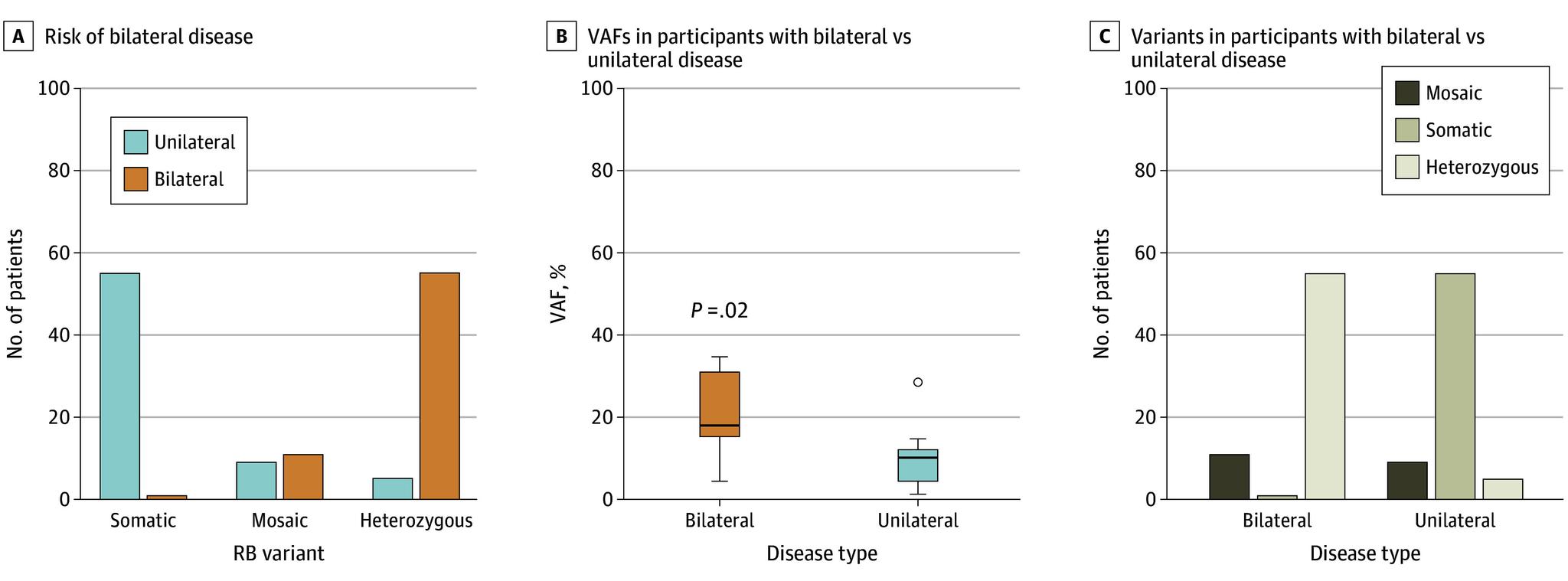
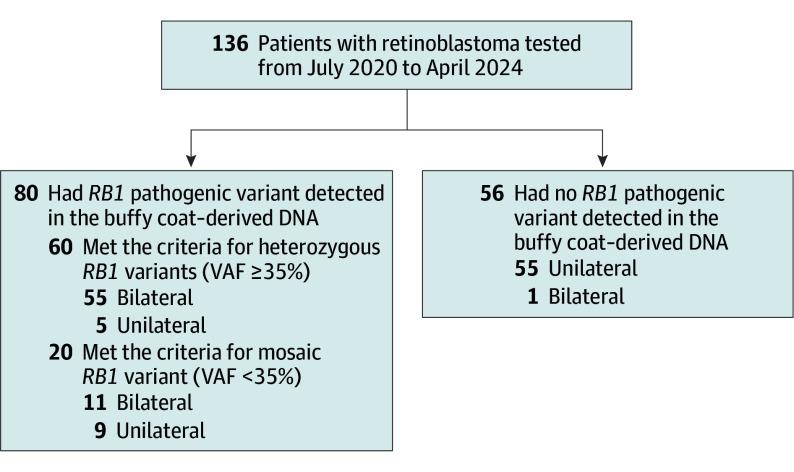
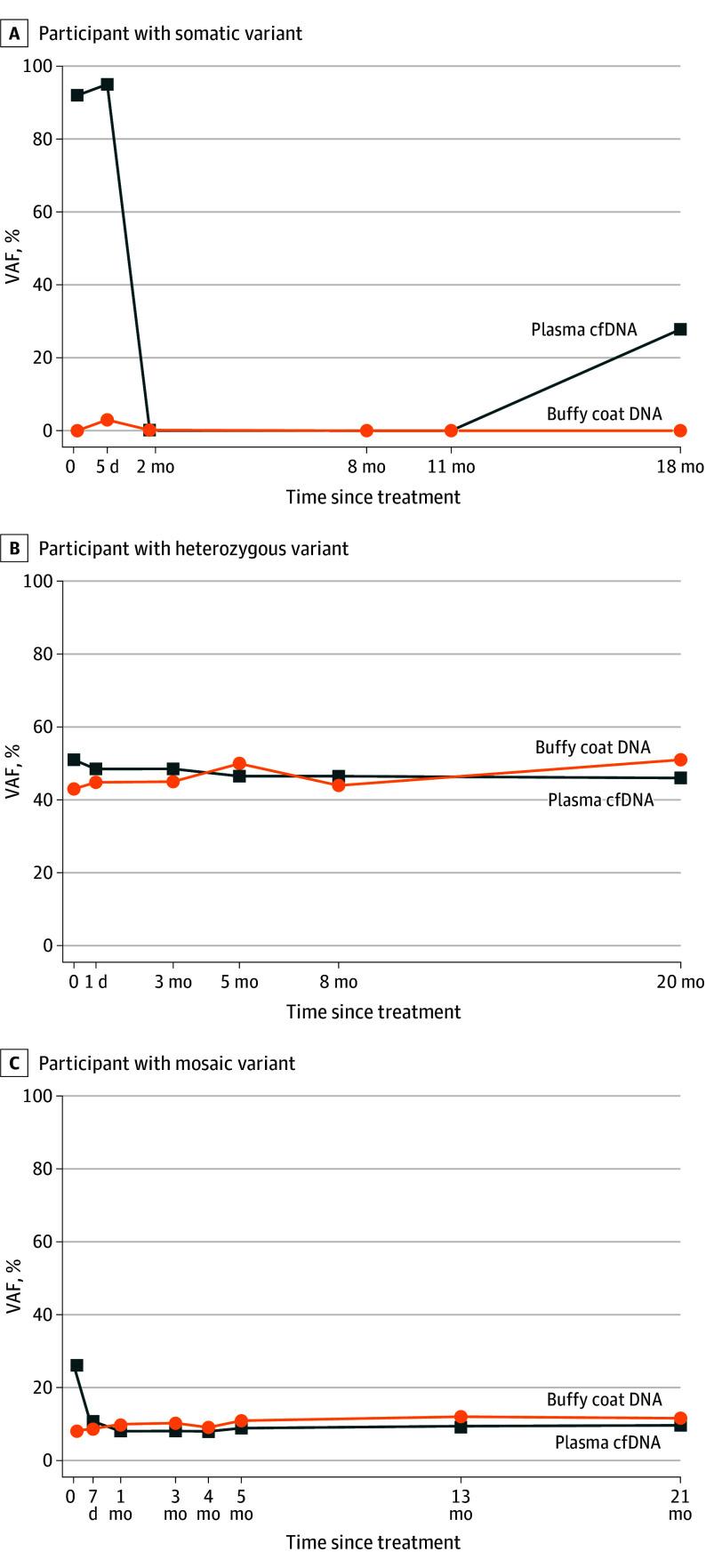
A total of 136 consecutive patients with retinoblastoma (median age at diagnosis, 1.0 year [IQR, 0.4-1.7 years]; 74 [54.4%] female; 67 with bilateral disease and 69 with unilateral disease) who underwent testing with the MSK-ACCESS assay were included. RB1 mosaicism was identified in buffy coat DNA from 20 patients (14.7%), with consistent results detected in all 11 participants tested concurrently by the MSK-IMPACT (Memorial Sloan Kettering-Integrated Mutation Profiling of Actionable Cancer Targets) germline assay. Four participants with RB1 mosaicism previously tested negative for germline RB1 variants by external laboratories. Compared with heterozygous participants, participants with RB1 mosaicism had a lower risk of developing bilateral disease (91.7% vs 55.0%, respectively; difference, 36.7% [95% CI, 13.8%-59.6%]; P = .002). In cfDNA, the mosaicism variant was detected both before and after treatment, with variant allele fraction initially decreasing after treatment but then stabilizing at levels consistent with mosaicism, despite the absence of clinical disease.
CONCLUSIONS AND RELEVANCE
The accurate detection and quantification of RB1 mosaicism are crucial. RB1 mosaicism should be considered when RB1 variants persist in cfDNA after treatment without evidence of disease; failure to do so may lead to false-positive results and overtreatment in patients with RB1 mosaicism. Identifying RB1 mosaicism may improve patient counseling, inform treatment decisions, and enhance surveillance efforts.
重要性
血浆游离DNA(cfDNA)检测在视网膜母细胞瘤的疾病诊断和监测中应用日益广泛,cfDNA中的RB1等位基因分数与疾病状态和治疗反应密切相关。然而,虽然视网膜母细胞瘤中已报道存在RB1嵌合体,但尚不清楚其临床意义以及对cfDNA检测的潜在影响。
目的
通过配对的血浆和血沉棕黄层(含淋巴细胞、单核细胞、粒细胞和血小板)DNA检测来识别RB1嵌合体,并描述RB1嵌合体对cfDNA检测结果的影响。
设计、地点和参与者:在这项横断面研究中,2020年7月至2024年4月期间,视网膜母细胞瘤患者在纪念斯隆凯特琳癌症中心接受了MSK-ACCESS(纪念斯隆凯特琳循环cfDNA分析以检查体细胞状态)检测,这是一种结合血浆cfDNA和血沉棕黄层基因组DNA测序的临床检测方法,能够检测和区分体细胞、杂合子和嵌合变异。MSK-ACCESS的嵌合结果与同时使用MSK-IMPACT种系检测的患者亚组的结果相关。数据分析于2024年4月至9月进行。
暴露因素
视网膜母细胞瘤中的RB1嵌合体。
主要结局和测量指标
使用cfDNA和血沉棕黄层基因组DNA中的RB1变异等位基因分数来检测RB1嵌合体。
结果
共有136例连续的视网膜母细胞瘤患者(诊断时的中位年龄为1.0岁[四分位间距,0.4 - 1.7岁];74例[54.4%]为女性;67例双侧患病,69例单侧患病)接受了MSK-ACCESS检测。在20例患者(14.7%)的血沉棕黄层DNA中鉴定出RB1嵌合体,在同时接受MSK-IMPACT(纪念斯隆凯特琳可操作癌症靶点综合突变分析)种系检测的所有11名参与者中均检测到一致结果。4例RB1嵌合体参与者之前经外部实验室检测种系RB1变异为阴性。与杂合子参与者相比,RB1嵌合体参与者患双侧疾病的风险较低(分别为91.7%和55.0%;差异为36.7%[95%置信区间,13.8% - 59.6%];P = 0.002)。在cfDNA中,治疗前后均检测到嵌合变异,治疗后变异等位基因分数最初下降,但随后稳定在与嵌合体一致的水平,尽管此时无临床疾病。
结论及相关性
准确检测和定量RB1嵌合体至关重要。在治疗后cfDNA中RB1变异持续存在但无疾病证据时,应考虑RB1嵌合体;否则可能导致RB1嵌合体患者出现假阳性结果和过度治疗。识别RB1嵌合体可能改善患者咨询、为治疗决策提供信息并加强监测工作。
 Zotero 插件