
脊椎动物中分子速率的独特纬度模式。
Distinct latitudinal patterns of molecular rates across vertebrates.
作者信息
Cai Tianlong, Wen Zhixin, Jiang Zhongguan, Zhen Ying
机构信息
Westlake Laboratory of Life Sciences and Biomedicine, Hangzhou, Zhejiang 310024, China.
Research Center for Industries of the Future and School of Life Sciences, Westlake University, Hangzhou, Zhejiang 310030, China.
出版信息
Proc Natl Acad Sci U S A. 2025 May 13;122(19):e2423386122. doi: 10.1073/pnas.2423386122. Epub 2025 May 8.
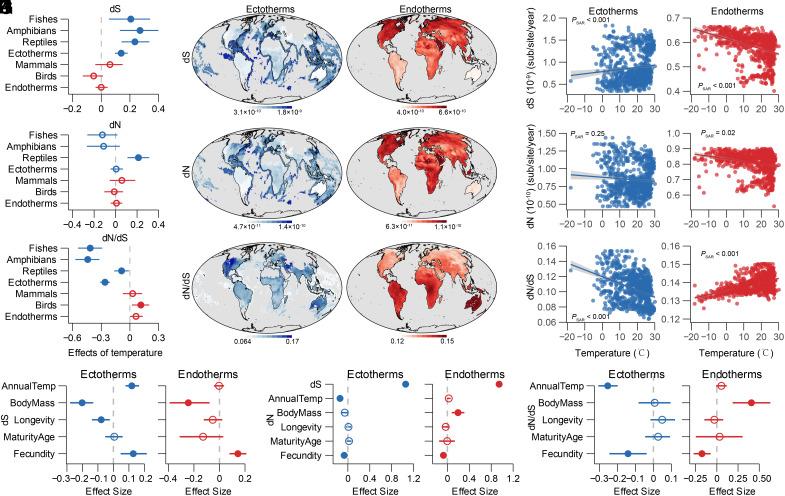
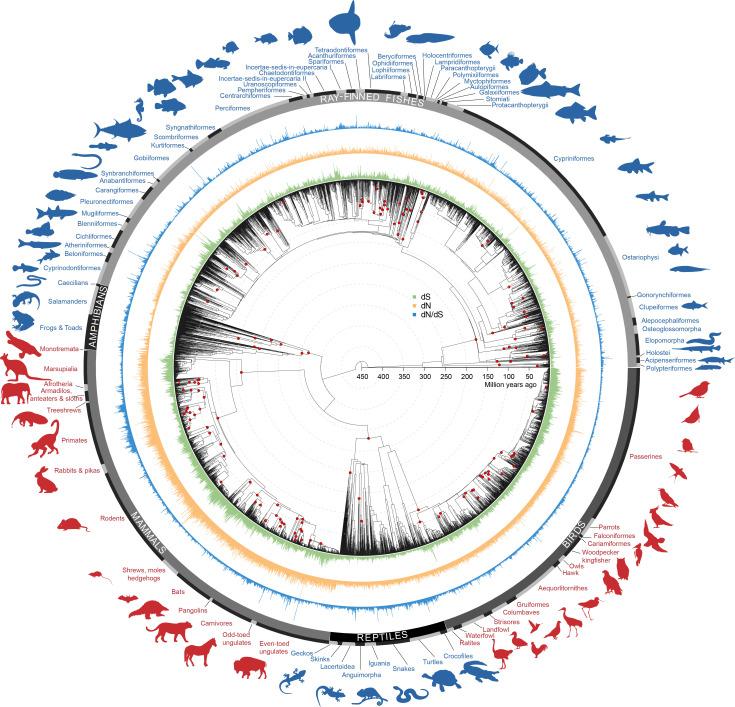
The latitudinal diversity gradient (LDG) is the most notable global biodiversity pattern, but its underlying mechanisms remain unresolved. The evolutionary speed hypothesis (ESH) posits that molecular rates play a crucial role in shaping the LDG, suggesting that higher temperatures accelerate molecular rates, thereby facilitating rapid speciation and accumulation of biodiversity in the tropics. However, whether ESH can explain the LDG across diverse taxonomic groups remains debated, and systematic examinations of its two key predictions using consistent datasets and methodologies across vertebrates are lacking. Here, we tested ESH using molecular rates from mitochondrial (5,424 species) and nuclear (1,512 species) genomes across major vertebrate groups, including fishes, amphibians, reptiles, mammals, and birds. Our findings revealed distinct latitudinal patterns in the absolute synonymous substitution rate (dS), which were influenced by thermoregulatory strategies. Specifically, the dS increases with ambient temperature and decreases with latitude in ectotherms but shows no correlation in most endotherms. These distinct patterns are likely attributed to different key predictors of dS between thermogroups, with temperature playing a major role only in ectotherms. For mitochondrial genes, absolute nonsynonymous substitution rates (dN) increase with temperature, likely driven by mutation rates in ectotherms and purifying selection in endotherms. However, neither mitochondrial dS nor dN correlates with diversification rates across vertebrates, contradicting the second prediction of ESH. For nuclear rates, the ESH was supported in reptiles and amphibians but not in mammals, birds, or fishes. In conclusion, our results provide limited support for ESH in vertebrates, underscoring the intricate processes that shape the LDG.
纬度多样性梯度(LDG)是最显著的全球生物多样性模式,但其潜在机制仍未得到解决。进化速度假说(ESH)认为分子速率在塑造LDG中起着关键作用,这表明较高的温度会加速分子速率,从而促进热带地区生物多样性的快速物种形成和积累。然而,ESH是否能够解释不同分类群中的LDG仍存在争议,并且缺乏使用一致的数据集和方法对脊椎动物进行系统检验其两个关键预测。在这里,我们使用来自包括鱼类、两栖动物、爬行动物、哺乳动物和鸟类在内的主要脊椎动物类群的线粒体(5424种)和核(1512种)基因组的分子速率来检验ESH。我们的研究结果揭示了绝对同义替换率(dS)中不同的纬度模式,这些模式受到体温调节策略的影响。具体而言,dS在变温动物中随环境温度升高而增加,随纬度降低而降低,但在大多数恒温动物中没有相关性。这些不同的模式可能归因于不同热调节类群之间dS的不同关键预测因子,温度仅在变温动物中起主要作用。对于线粒体基因,绝对非同义替换率(dN)随温度升高而增加,可能是由变温动物的突变率和恒温动物的纯化选择驱动的。然而,线粒体dS和dN均与脊椎动物的多样化速率无关,这与ESH的第二个预测相矛盾。对于核速率,ESH在爬行动物和两栖动物中得到支持,但在哺乳动物、鸟类或鱼类中则不然。总之,我们的结果为脊椎动物中的ESH提供了有限的支持,强调了塑造LDG的复杂过程。

 Zotero 插件