
泛素样修饰因子1(UFM1)化在细胞中的功能作用研究(综述)
Studies on the functional role of UFMylation in cells (Review).
作者信息
Qin Rong, Tang Yu, Yuan Yuhang, Meng Fangyu, Zheng Kepu, Yang Xingyu, Zhao Jiumei, Yang Chuanhua
机构信息
Yunan Key Laboratory of Breast Cancer Precision Medicine, School of Biomedical Engineering, Kunming Medical University, Kunming, Yunnan 650500, P.R. China.
Yunan Key Laboratory of Breast Cancer Precision Medicine, The Third Affiliated Hospital of Kunming Medical University, Kunming Medical University, Kunming, Yunnan 650500, P.R. China.
出版信息
Mol Med Rep. 2025 Jul;32(1). doi: 10.3892/mmr.2025.13556. Epub 2025 May 9.
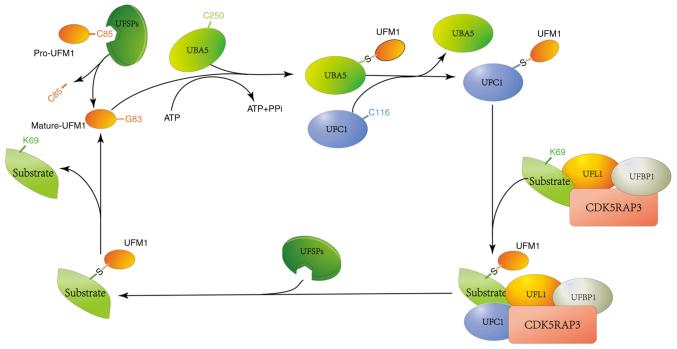
Protein post‑translational modifications (PTMs) play crucial roles in various life activities and aberrant protein modifications are closely associated with numerous major human diseases. Ubiquitination, the first identified protein modification system, involves the covalent attachment of ubiquitin molecules to lysine residues of target proteins. UFMylation, a recently discovered ubiquitin‑like modification, shares similarities with ubiquitination. The precursor form of ubiquitin fold modifier 1 (UFM1) undergoes synthesis and cleavage by UFM1‑specific protease 1 or UFM1‑specific protease 2 to generate activated UFM1‑G83. Subsequently, UFM1‑G83 is activated by a specific E1‑like activase, UFM1‑activating enzyme 5. UFM1‑conjugating enzyme 1 and an E3‑like ligase, UFM1‑specific ligase 1, recognize the target protein and facilitate UFMylation, leading to the degradation of the target protein. Current knowledge regarding UFMylation remains limited. Previous studies have demonstrated that defects in the UFMylation pathway can result in embryonic lethality in mice and various human diseases, highlighting the critical biological functions of UFMylation. However, the precise mechanisms underlying UFMylation remain elusive. This present review aimed to summarize recent research advances in UFMylation, with the aim of providing novel insights and perspectives for future investigations into this essential protein modification system.
蛋白质翻译后修饰(PTMs)在各种生命活动中发挥着关键作用,异常的蛋白质修饰与众多主要人类疾病密切相关。泛素化是首个被鉴定出的蛋白质修饰系统,涉及泛素分子与靶蛋白赖氨酸残基的共价连接。UFMylation是最近发现的一种类泛素修饰,与泛素化有相似之处。泛素折叠修饰因子1(UFM1)的前体形式经UFM1特异性蛋白酶1或UFM1特异性蛋白酶2合成并切割,生成活化的UFM1-G83。随后,UFM1-G83由一种特异性类E1激活酶UFM1激活酶5激活。UFM1结合酶1和一种类E3连接酶UFM1特异性连接酶1识别靶蛋白并促进UFMylation,导致靶蛋白降解。目前关于UFMylation的认识仍然有限。先前的研究表明,UFMylation途径的缺陷可导致小鼠胚胎致死和多种人类疾病,突出了UFMylation的关键生物学功能。然而,UFMylation的确切机制仍然难以捉摸。本综述旨在总结UFMylation的最新研究进展,为今后对这一重要蛋白质修饰系统的研究提供新的见解和视角。

 Zotero 插件