
利用环境DNA对植被上昆虫多样性进行机器人辅助测量。
Robot-Aided Measurement of Insect Diversity on Vegetation Using Environmental DNA.
作者信息
Koubínová Darina, Kirchgeorg Steffen, Geckeler Christian, Thurnheer Sarah, Lüthi Martina, Sanchez Théophile, Mintchev Stefano, Pellissier Loïc, Albouy Camille
机构信息
Ecosystems and Landscape Evolution, Department of Environmental Systems Science ETH Zürch Zürich Switzerland.
Swiss Federal Institute for Forest Snow and Landscape Research WSL Birmensdorf Switzerland.
出版信息
Ecol Evol. 2025 May 7;15(5):e71391. doi: 10.1002/ece3.71391. eCollection 2025 May.
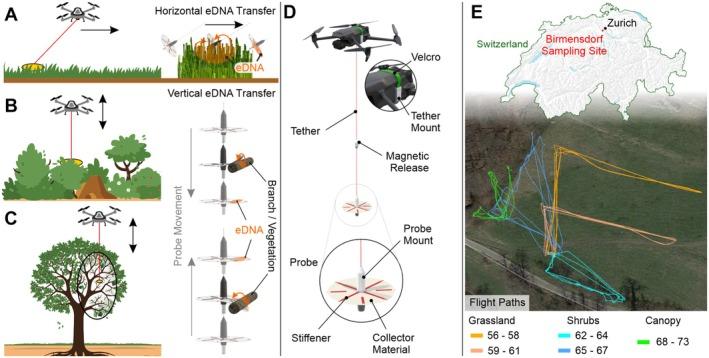
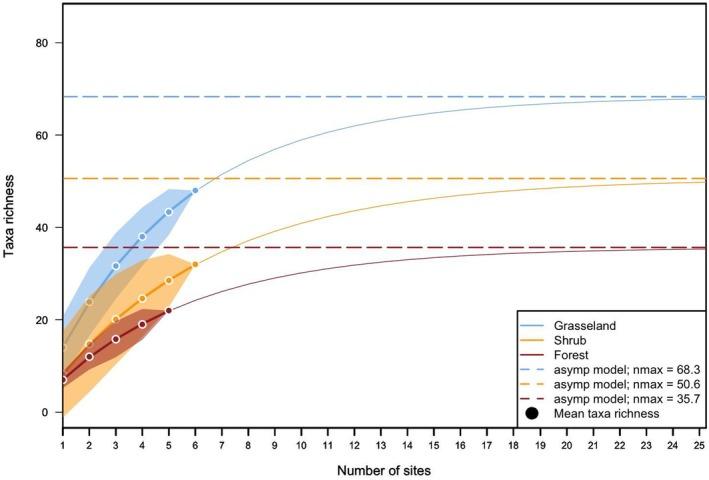
Traditional methods of biodiversity monitoring are often logistically challenging, time-consuming, require experienced experts on species identification, and sometimes include destruction of the targeted specimens. Here, we investigated a non-invasive approach of combining the use of drones and environmental DNA (eDNA) to monitor insect biodiversity on vegetation. We aimed to assess the efficiency of this novel method in capturing insect diversity and comparing insect composition across different vegetation types (grassland, shrub and forest) in Switzerland. A commercial, off-the-shelf drone was equipped with a specialised probe that autonomously swabbed vegetation and collected eDNA. Then, samples were processed using rapid third-generation Oxford Nanopore sequencing. The obtained data were analysed for insect diversity, comparing taxonomic richness, evenness and community composition across the three habitat types using statistical techniques. Sequencing of the samples yielded 76 hexapod taxa, revealing an insect community with notable differences in taxonomic richness but not in evenness across grassland, shrub and forest habitats. Our study demonstrates the potential of drone-based sampling integrated with eDNA and nanopore sequencing for biodiversity monitoring, offering a non-destructive method for detecting insect occurrence on plant surfaces. Integrating robotics and eDNA technology provides a promising solution for fast, large-scale, non-invasive biodiversity monitoring, potentially improving conservation efforts and ecosystem management.
传统的生物多样性监测方法在后勤保障方面往往具有挑战性,耗时较长,需要有经验的物种鉴定专家,而且有时还包括对目标标本的破坏。在此,我们研究了一种将无人机的使用与环境DNA(eDNA)相结合的非侵入性方法,以监测植被上的昆虫生物多样性。我们旨在评估这种新方法在捕捉昆虫多样性以及比较瑞士不同植被类型(草地、灌木和森林)的昆虫组成方面的效率。一架商用现货无人机配备了一个专门的探头,该探头可自动擦拭植被并收集eDNA。然后,使用快速第三代牛津纳米孔测序对样本进行处理。利用统计技术对获得的数据进行昆虫多样性分析,比较三种栖息地类型的分类丰富度、均匀度和群落组成。样本测序产生了76个六足类分类单元,揭示了一个昆虫群落,其分类丰富度在草地、灌木和森林栖息地之间存在显著差异,但均匀度没有差异。我们的研究证明了基于无人机的采样与eDNA和纳米孔测序相结合在生物多样性监测方面的潜力,提供了一种检测植物表面昆虫出现情况的非破坏性方法。将机器人技术和eDNA技术相结合为快速、大规模、非侵入性的生物多样性监测提供了一个有前景的解决方案,有可能改善保护工作和生态系统管理。


 Zotero 插件