
超加工食品摄入量的十年轨迹及其与心血管疾病和全因死亡率的前瞻性关联:怀特霍尔二世队列研究的结果
Ten-year trajectories of ultra-processed food intake and prospective associations with cardiovascular diseases and all-cause mortality: findings from the Whitehall II cohort study.
作者信息
Wang Mengmei E, LIewellyn Clare H, Katsoulis Michail, Akbaraly Tasnime N, Dicken Samuel J, Liu Jiahao, Brown Adrian, Britton Annie
机构信息
Research Department of Epidemiology and Public Health, University College London, London, UK.
Research Department of Behavioural Science and Health, University College London, London, UK.
出版信息
Nutr J. 2025 May 11;24(1):79. doi: 10.1186/s12937-025-01144-2.
BACKGROUND
Ultra-processed food (UPF) intake has been associated with adverse health outcomes; however, research on UPF intake and cardiovascular disease (CVD) prognosis has largely neglected its longitudinal pattern over time. This study investigated trajectories of UPF intake over a decade and their prospective associations with the risk of fatal and non-fatal CVD, as well as all-cause mortality, using data spanning from 16 to 19 years.
METHODS
This study utilized data from the British Whitehall II cohort study, including 7,138 participants (68.3% male; median baseline age 60.4 years), all free of CVD at baseline. Dietary intake was assessed using a validated 127-item food frequency questionnaire at three time points: phase 3 (1991-1994), phase 5 (1997-1999), and phase 7 (2002-2004). UPF intake was estimated using the Nova classification, and group-based trajectory modelling identified different longitudinal consumption patterns. Phase 7 (2002-2004) was the baseline for subsequent monitoring of cardiovascular events and mortality outcomes until 2019/2021. Multivariate Cox proportional hazards models were used to estimate the hazard ratios (HRs) and 95% confidence intervals (CIs), adjusting for socio-demographics, lifestyle, diet quality, energy intake, and clinical factors.
RESULTS
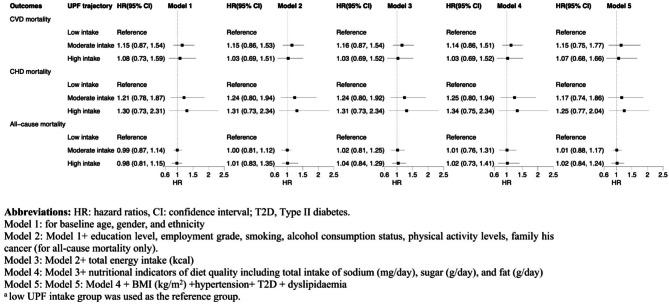
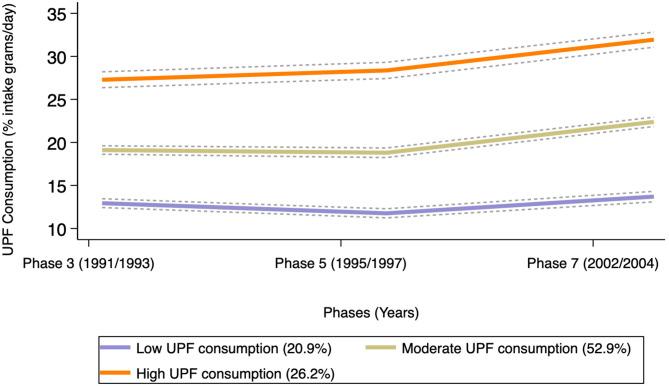
Three distinct UPF trajectory groups were identified: high (26.2% of participants), moderate (52.9%) and low UPF intake (20.9%). All groups showed a slight increase in UPF intake over time. Over the median follow-up of 16 years for incident cases and 19 years for mortality, we observed 1,128 incident CVD events, 859 CHD cases and 1,314 deaths. The highest vs. lowest UPF intake group had a 23% higher risk of CVD (HR 1.23, 95% CI 1.01 to 1.40), and a 32% higher risk of CHD (HR 1.32, 95% CI 1.06 to 1.65). No significant associations were observed between UPF trajectory groups and CVD mortality, CHD mortality, or all-cause mortality.
CONCLUSIONS
Sustained high UPF intake over 10 years was associated with increased risks of non-fatal CVD and CHD but not with CVD-specific, CHD-specific, or all-cause mortality. These findings suggest that sustained high intake of UPF may be a modifiable risk factor for preventing non-fatal cardiovascular risks.
背景
超加工食品(UPF)的摄入与不良健康后果相关;然而,关于UPF摄入与心血管疾病(CVD)预后的研究在很大程度上忽略了其随时间的纵向模式。本研究利用16至19年的数据,调查了十年间UPF摄入的轨迹及其与致命和非致命CVD风险以及全因死亡率的前瞻性关联。
方法
本研究使用了英国白厅II队列研究的数据,包括7138名参与者(68.3%为男性;基线年龄中位数为60.4岁),所有参与者在基线时均无CVD。在三个时间点使用经过验证的127项食物频率问卷评估饮食摄入量:第3阶段(1991 - 1994年)、第5阶段(1997 - 1999年)和第7阶段(2002 - 2004年)。使用诺瓦分类法估计UPF摄入量,并通过基于组的轨迹模型确定不同的纵向消费模式。第7阶段(2002 - 2004年)作为后续监测心血管事件和死亡率结局直至2019/2021年的基线。使用多变量Cox比例风险模型估计风险比(HR)和95%置信区间(CI),并对社会人口统计学、生活方式、饮食质量、能量摄入和临床因素进行调整。
结果
确定了三个不同的UPF轨迹组:高摄入量组(26.2%的参与者)、中等摄入量组(52.9%)和低摄入量组(20.9%)。所有组的UPF摄入量均随时间略有增加。在事件病例的中位数随访期为16年,死亡率随访期为19年期间,我们观察到1128例CVD事件、859例冠心病病例和1314例死亡。UPF摄入量最高组与最低组相比,CVD风险高23%(HR 1.23,95% CI 1.01至1.40),冠心病风险高32%(HR 1.32,95% CI 1.06至1.65)。未观察到UPF轨迹组与CVD死亡率、冠心病死亡率或全因死亡率之间存在显著关联。
结论
持续10年的高UPF摄入量与非致命CVD和冠心病风险增加相关,但与CVD特异性、冠心病特异性或全因死亡率无关。这些发现表明,持续高摄入UPF可能是预防非致命心血管风险的一个可改变的风险因素。

 Zotero 插件