
轻度认知障碍老年人认知功能的非药物多模式干预:范围综述
Nonpharmacological Multimodal Interventions for Cognitive Functions in Older Adults With Mild Cognitive Impairment: Scoping Review.
作者信息
Chan Raffy Chi-Fung, Zhou Joson Hao-Shen, Cao Yuan, Lo Kenneth, Ng Peter Hiu-Fung, Shum David Ho-Keung, Wong Arnold Yu-Lok
机构信息
Department of Rehabilitation Sciences, Hong Kong Polytechnic University, Hong Kong, China (Hong Kong).
Department of Social Work and Social Administration, University of Hong Kong, Hong Kong, China (Hong Kong).
出版信息
JMIR Aging. 2025 May 12;8:e70291. doi: 10.2196/70291.
BACKGROUND
As the global population ages, the prevalence of dementia is expected to rise significantly. To alleviate the burden on health care systems and the economy, it is essential to develop effective strategies to enhance cognitive function in older adults. Previous studies have shown that combined nonpharmacological interventions can improve cognition across various domains in older individuals. However, there is no established gold standard for the exact combination and duration of these interventions, which makes it challenging to assess their overall effectiveness.
OBJECTIVE
Given the diversity of nonpharmacological multimodal interventions aimed at preventing cognitive decline in older adults with mild cognitive impairment (MCI), this scoping review sought to identify and summarize the characteristics and outcomes of these interventions.
METHODS
We adhered to the Arksey and O'Malley methodological framework and the PRISMA-ScR (Preferred Reporting Items for Systematic Reviews and Meta-Analyses Extension for Scoping Reviews) and searched 4 electronic databases (MEDLINE, PsycINFO, CINAHL, and Web of Science) systematically on July 6, 2023, and updated the search on April 17, 2024, using specific terms and keywords.
RESULTS
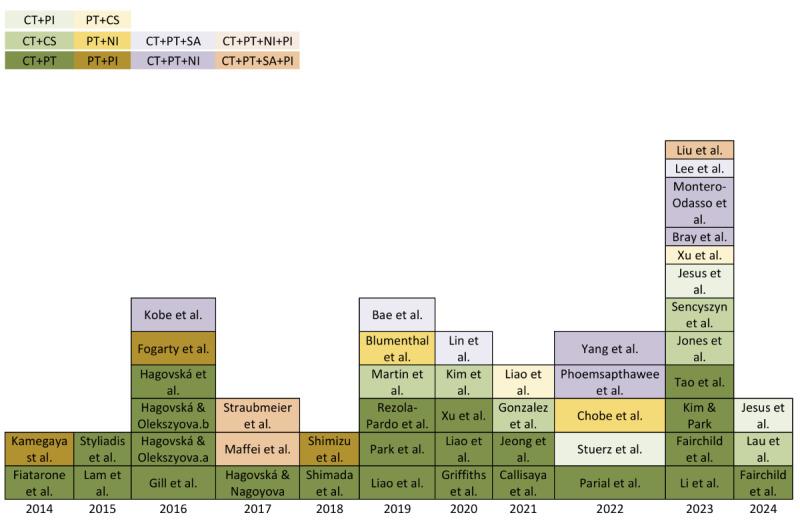
This review included 45 studies from 18 countries with 4705 participants from 2014 to 2024 encompassing different combinations of physical training (PT), cognitive training (CT), nutrition intervention, psychosocial intervention, social activities, and electrical stimulation. There is a growing numbers of studies combining PT and CT for MCI treatment, with additional modalities often added to address various aspects of the condition. Compared to single-modal interventions and usual care, multimodal approaches demonstrated significantly better improvements in cognition domains such as attention, global cognition, executive function, memory, processing speed, and verbal fluency. Technology has been instrumental in delivering these interventions and enhancing the effects of PT and CT. Multimodal interventions also show promise in terms of acceptability and user experience, which can improve treatment adherence.
CONCLUSIONS
Research is limited regarding the cost-effectiveness and optimal dosage of these interventions, making it difficult to assess the additional benefits of incorporating more modalities. Future research should examine the long-term effects of incorporating multiple modalities, using standardized MCI criteria and outcome measures.
背景
随着全球人口老龄化,预计痴呆症的患病率将显著上升。为减轻医疗保健系统和经济的负担,制定有效的策略来提高老年人的认知功能至关重要。先前的研究表明,联合非药物干预可以改善老年人各个领域的认知。然而,这些干预的确切组合和持续时间尚无既定的金标准,这使得评估其总体有效性具有挑战性。
目的
鉴于旨在预防轻度认知障碍(MCI)老年人认知衰退的非药物多模式干预的多样性,本范围综述旨在识别和总结这些干预的特征和结果。
方法
我们遵循阿克斯和奥马利的方法框架以及PRISMA-ScR(系统评价和元分析扩展的范围综述的首选报告项目),于2023年7月6日系统地搜索了4个电子数据库(MEDLINE、PsycINFO、CINAHL和Web of Science),并于2024年4月17日使用特定术语和关键词更新了搜索。
结果
本综述纳入了来自18个国家的45项研究,2014年至2024年期间有4705名参与者,涵盖体育锻炼(PT)、认知训练(CT)、营养干预、心理社会干预、社交活动和电刺激的不同组合。越来越多的研究将PT和CT联合用于MCI治疗,通常还会添加其他模式以解决病情的各个方面。与单模式干预和常规护理相比,多模式方法在注意力、整体认知、执行功能、记忆、处理速度和语言流畅性等认知领域表现出显著更好的改善。技术在提供这些干预措施和增强PT和CT的效果方面发挥了重要作用。多模式干预在可接受性和用户体验方面也显示出前景,这可以提高治疗依从性。
结论
关于这些干预措施的成本效益和最佳剂量的研究有限,难以评估纳入更多模式的额外益处。未来的研究应使用标准化的MCI标准和结果指标来研究纳入多种模式的长期效果。

 Zotero 插件