
了解社会应激对生长育肥猪血清代谢组和唾液生物标志物的影响。
Understanding the Impact of Social Stress on Serum Metabolome and Saliva Biomarkers in Growing-Finishing Pigs.
作者信息
Bagaria Marc, Tous Núria, Torrallardona David, Cerón Jose Joaquín, Pérez-Calvo Estefanía, Ren Wen, Argamasilla Rosa, Fàbrega Emma
机构信息
Animal Welfare Program, Institute of Agrifood Research and Technology (IRTA), 17121 Monells, Spain.
Animal Nutrition Program, Institute of Agrifood Research and Technology (IRTA), 43120 Constantí, Spain.
出版信息
Animals (Basel). 2025 Apr 27;15(9):1228. doi: 10.3390/ani15091228.
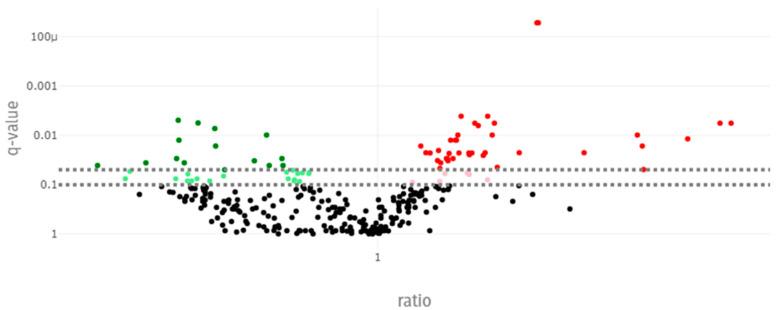
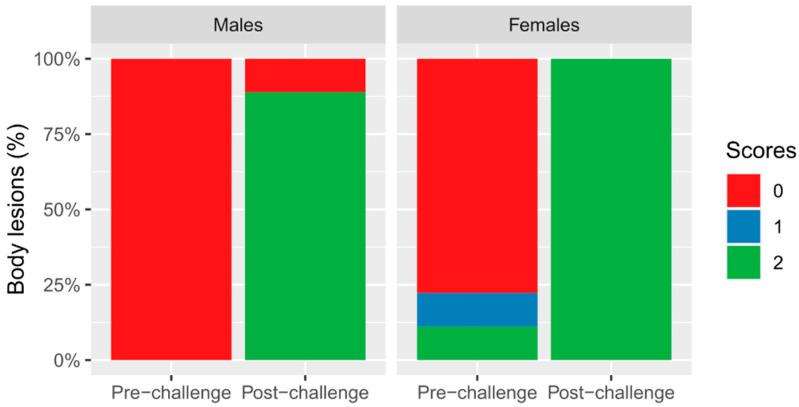
High levels of social stress are known to negatively impact pig welfare. The aim of this study was to evaluate the impact of social stress in growing-finishing pigs by measuring serum metabolome changes and saliva biomarkers. Seventy-two undocked pigs (thirty-six males and thirty-six females) were housed in single-sex pens of four, with the second dominant pig in each pen selected as the focal pig. A social challenge was conducted by mixing the focal pig with three new pigs in its home pen on two consecutive days on trial days 62-64. Saliva and blood samples were collected, and the pigs' behaviour and body lesions were evaluated pre- and post-challenge. A total of 630 serum metabolites were analysed, 292 of which could be statistically compared using Biocrates WebIDQ v5 software. Salivary haptoglobin concentrations and the number of body lesions significantly increased after the challenge ( < 0.001), whereas the average daily weight gain decreased ( < 0.05). The serum showed decreases in essential amino acids (Thr, Met, and Phe), non-essential amino acids (Glu, Asn, Asp, Pro, and Tyr), betaine, ornithine, indoxyl sulphate, taurine, and some blood di- and triacylglycerols (q < 0.05), and increases in oleic, eicosanoic, eicosadienoic, and dihomo-gamma-linolenic acids; EPA; and DHA post-challenge (q < 0.05). Overall, the results suggest the potential of metabolomics as a tool providing a more holistic view of the impact of social stress.
众所周知,高水平的社会应激会对猪的福利产生负面影响。本研究的目的是通过测量血清代谢组变化和唾液生物标志物来评估生长育肥猪社会应激的影响。72头未断尾猪(36头雄性和36头雌性)以每4头为一组饲养在单性别猪栏中,每组中第二占主导地位的猪被选为焦点猪。在试验第62至64天,连续两天将焦点猪与栏内三头新猪混养,进行社会挑战。采集唾液和血液样本,并在挑战前后评估猪的行为和身体损伤情况。共分析了630种血清代谢物,其中292种可使用Biocrates WebIDQ v5软件进行统计学比较。挑战后唾液中触珠蛋白浓度和身体损伤数量显著增加(<0.001),而平均日增重下降(<0.05)。血清中必需氨基酸(苏氨酸、蛋氨酸和苯丙氨酸)、非必需氨基酸(谷氨酸、天冬酰胺、天冬氨酸、脯氨酸和酪氨酸)、甜菜碱、鸟氨酸、硫酸吲哚酚、牛磺酸以及一些血液二酰甘油和三酰甘油减少(q<0.05),而油酸、二十烷酸、二十碳二烯酸和二高-γ-亚麻酸、二十碳五烯酸(EPA)和二十二碳六烯酸(DHA)在挑战后增加(q<0.05)。总体而言,结果表明代谢组学作为一种工具,有可能更全面地了解社会应激的影响。

 Zotero 插件