
大豆基因家族成员的全基因组鉴定及对生物和非生物胁迫响应的表达分析
Genome-wide identification of gene family members in soybean and expression analysis in response to biotic and abiotic stresses.
作者信息
Liu Zhixian, Yang Jiahui, Yan Ziyu, Huang Lexiang, Xing Chengshun, Zhao Miaoyu, Du Haiping, He Milan, Kong Fanjiang, Liu Baohui, Zhao Xiaohui
机构信息
Guangdong Provincial Key Laboratory of Plant Adaptation and Molecular Design/Innovative Center of Molecular Genetics and Evolution, School of Life Sciences, Guangzhou University, Guangzhou, China.
出版信息
Front Plant Sci. 2025 Apr 29;16:1554399. doi: 10.3389/fpls.2025.1554399. eCollection 2025.
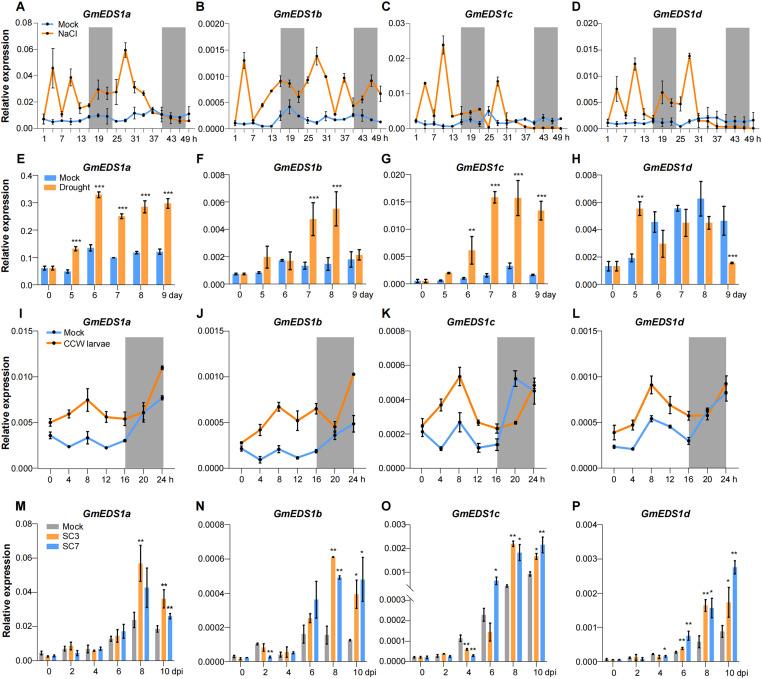
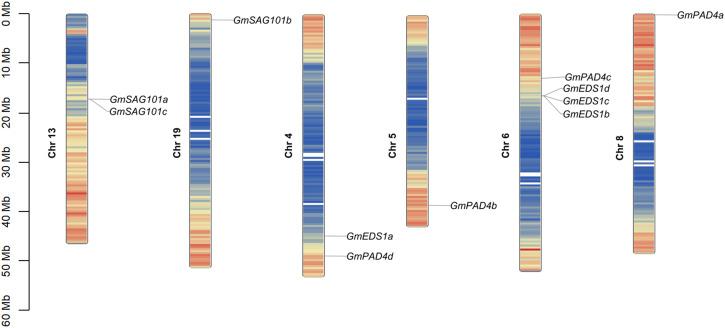
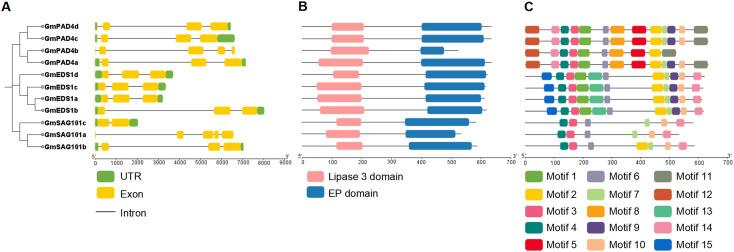
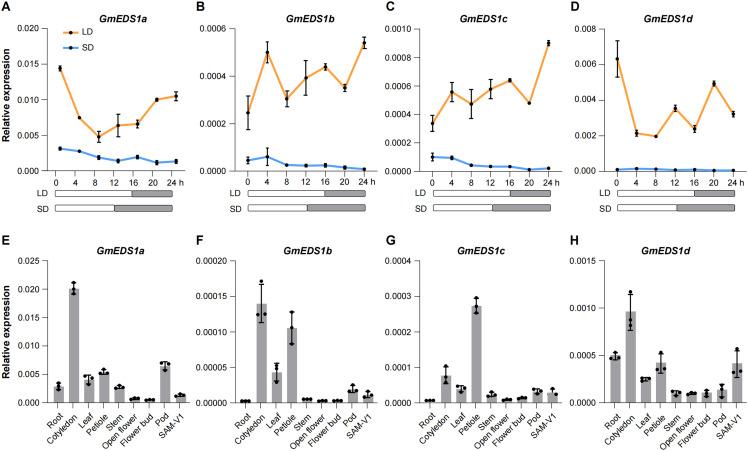
(), a key regulator in plant defense responses, plays central roles in resistance to stresses. Therefore, the identification and characterization of soybean family genes and verification of how these genes are associated with stresses are the focus of this study. We identified 11 genes, which all have lipase-like and EP (EDS1-PAD4-specific) conserved domains, they are unevenly distributed across six chromosomes, including tandem repetitions. Whole-genome duplication and segmental duplication events were the main reason for family expansion, and the family underwent purification selection during evolution. We detected 25 types of -regulatory elements, which enable s to respond to multiple signals. s are rapidly and strongly induced by drought, salt, the common cutworm, and soybean mosaic virus, indicating that they have important biological functions in coping with both abiotic and biological stresses. Furthermore, the expression levels of s differed between long-day and short-day conditions: it was very low under short-day conditions, which may increase the sensitivity of soybean to pathogens under short-day conditions. Overall, this study identified and characterized the members of the gene family in the soybean genome, and determined that s respond to both abiotic and biotic stresses, providing new key genes for soybean breeders.
()作为植物防御反应中的关键调节因子,在抗逆过程中发挥着核心作用。因此,大豆 家族基因的鉴定与特征分析以及这些基因与胁迫关联方式的验证是本研究的重点。我们鉴定出11个 基因,它们均具有脂肪酶样和EP(EDS1 - PAD4特异性)保守结构域,在六条染色体上分布不均,包括串联重复。全基因组复制和片段重复事件是 家族扩张的主要原因,且该家族在进化过程中经历了纯化选择。我们检测到25种 -调控元件,使 能够响应多种信号。 受干旱、盐、小地老虎和大豆花叶病毒快速且强烈地诱导,表明它们在应对非生物和生物胁迫中具有重要生物学功能。此外, 在长日和短日条件下的表达水平存在差异:在短日条件下表达水平非常低,这可能增加大豆在短日条件下对病原体的敏感性。总体而言,本研究鉴定并表征了大豆基因组中 基因家族的成员,确定 对非生物和生物胁迫均有响应,为大豆育种者提供了新的关键基因。



 Zotero 插件