
血浆蛋白质组学技术的技术评估
Technical Evaluation of Plasma Proteomics Technologies.
作者信息
Beimers William F, Overmyer Katherine A, Sinitcyn Pavel, Lancaster Noah M, Quarmby Scott T, Coon Joshua J
机构信息
Department of Biomolecular Chemistry, University of Wisconsin, Madison, Wisconsin 53506, United States.
Morgridge Institute for Research, Madison, Wisconsin 53515, United States.
出版信息
J Proteome Res. 2025 Jun 6;24(6):3074-3087. doi: 10.1021/acs.jproteome.5c00221. Epub 2025 May 14.
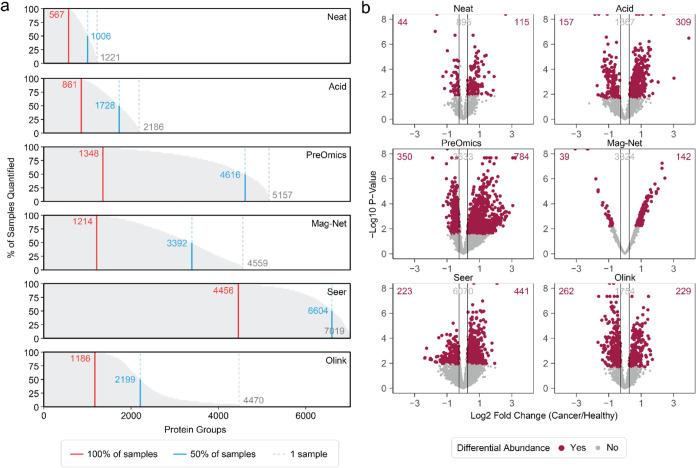
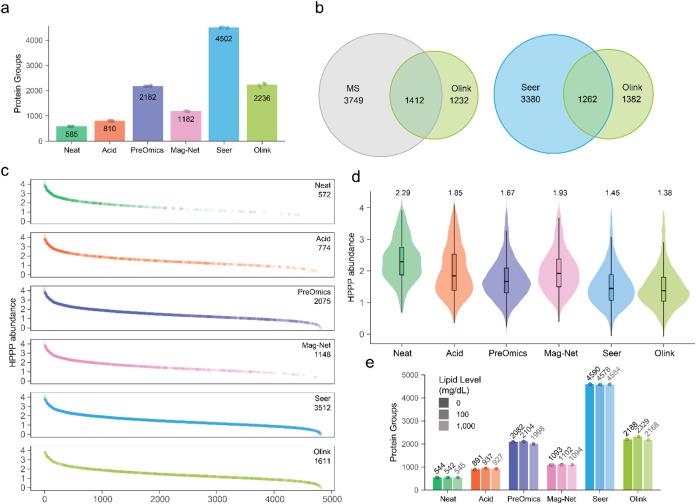
Plasma proteomics technologies are rapidly evolving and of critical importance to the field of biomedical research. Here, we report a technical evaluation of six notable plasma proteomics technologies─unenriched (Neat), acid depletion, PreOmics ENRICHplus, Mag-Net, Seer Proteograph XT, and Olink Explore HT. The methods were compared on proteomic depth, reproducibility, linearity, tolerance to lipid interference, and limit of detection/quantification. In total, we performed 618 LC-MS/MS experiments and 93 Olink Explore HT assays. The Seer method achieved the greatest proteomic depth (∼4500 proteins detected), while Olink detected ∼2600 proteins. Other MS-based methods ranged from ∼500-2200 proteins detected. In our analysis, Neat, Mag-Net, Seer, and Olink had good reproducibility, while PreOmics and Acid had higher variability (>20% median coefficient of variation). All MS methods showed good linearity with spiked-in C-reactive protein (CRP); CRP was surprisingly not in the Olink assay. None of the methods were affected by lipid interference. Seer produced the highest number of quantifiable proteins with a measurable LOD (4407) and LOQ (2696). Olink had the next highest number of quantifiable proteins, with 2002 having an LOD and 1883 having an LOQ. Finally, we tested the applicability of these methods for detecting differences between healthy and cancer groups in a nonsmall cell lung cancer (NSCLC) cohort. All six methods detected differentially abundant proteins between the cancer and healthy samples but disagreed on which proteins were significant, highlighting the contrast between each method.
血浆蛋白质组学技术正在迅速发展,对生物医学研究领域至关重要。在此,我们报告了对六种著名血浆蛋白质组学技术的技术评估——未富集(纯样)、酸去除、PreOmics ENRICHplus、Mag-Net、Seer Proteograph XT和Olink Explore HT。对这些方法在蛋白质组深度、重现性、线性、对脂质干扰的耐受性以及检测/定量限方面进行了比较。我们总共进行了618次液相色谱-串联质谱(LC-MS/MS)实验和93次Olink Explore HT分析。Seer方法实现了最大的蛋白质组深度(检测到约4500种蛋白质),而Olink检测到约2600种蛋白质。其他基于质谱的方法检测到的蛋白质数量在约500-2200种之间。在我们的分析中,纯样、Mag-Net、Seer和Olink具有良好的重现性,而PreOmics和酸去除法具有较高的变异性(中位变异系数>20%)。所有质谱方法与添加的C反应蛋白(CRP)均显示出良好的线性;令人惊讶的是,CRP不在Olink分析中。所有方法均未受脂质干扰的影响。Seer产生的可定量蛋白质数量最多,有可测量的检测限(LOD,4407)和定量限(LOQ,2696)。Olink的可定量蛋白质数量次之,有2002种具有检测限,1883种具有定量限。最后,我们测试了这些方法在非小细胞肺癌(NSCLC)队列中检测健康组和癌症组之间差异的适用性。所有六种方法均检测到癌症样本和健康样本之间存在差异丰富的蛋白质,但对于哪些蛋白质具有显著性存在分歧,凸显了每种方法之间的差异。


 Zotero 插件