
基于生物信息学的海洋源吲哚衍生物合成:抑制革兰氏阴性菌生物膜形成及毒力
Bio-informed synthesis of marine-sourced indole derivatives: suppressing gram-negative bacteria biofilm and virulence.
作者信息
Golberg Karina, Elouarzaki Kamal, Kagan Bat-El, Shagan Marilou, Shemesh Netta, Kramarsky-Winter Esti, Ben-Zvi Anat, Nebenzahl Yaffa Mizrachi, Marks Robert S, Kushmaro Ariel
机构信息
Department of Biotechnology Engineering, Avram and Stella Goldstein-Goren, Ben-Gurion University of the Negev, Beer-Sheva, 84105, Israel.
School of Materials Science and Engineering and Center for Advanced Catalysis Science and Technology, Nanyang Technological University, 50 Nanyang Avenue, Singapore, 639798, Singapore.
出版信息
BMC Biol. 2025 May 15;23(1):134. doi: 10.1186/s12915-025-02234-7.
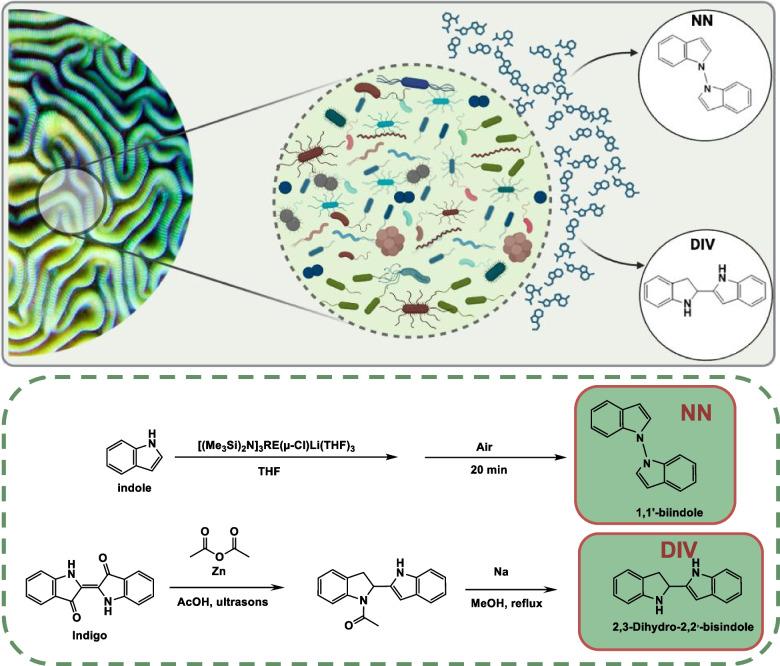
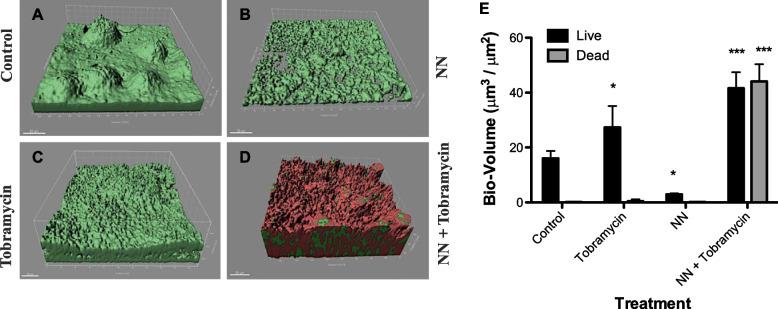
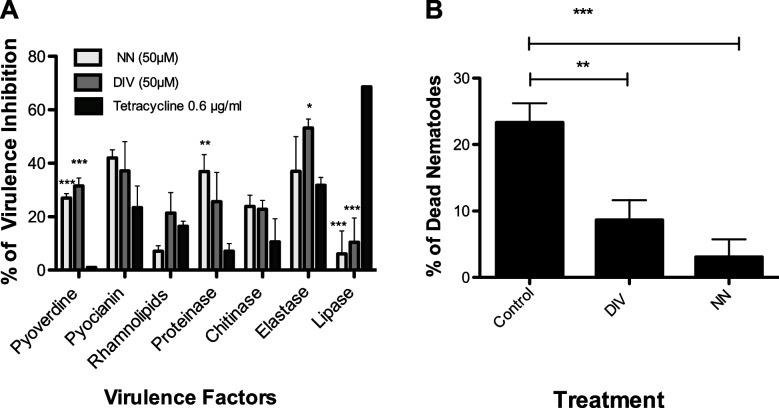
Biofilms cling to surfaces to form complex architectures allowing their bacterial creators to acquire multidrug resistance and claiming countless lives worldwide. Therefore, finding novel compounds that affect virulence and biofilm-forming capacity of resistant pathogenic bacteria is imperative. Recently, we identified indole-based compounds that possess anti-biofilm properties in coral-associated bacteria. We succeeded in efficiently synthesizing two of these compounds, 1,1'-bisindole (NN) and 2,3-dihydro-2,2'-bisindole (DIV). They were found to attenuate biofilms of gram-negative bacterial pathogens, including Pseudomonas aeruginosa and Acinetobacter baumannii. Combining these compounds with the antibiotic tobramycin resulted in significant biofilm inhibition, particularly in the eradication of mature P. aeruginosa biofilms. Both of the bisindole derivatives, suppressed a number of bacterial virulence factors, reduced bacterial adhesion, and improved survival rates in infected Caenorhabditis elegans and human lung epithelial cell models. Transcriptome analyses of the bacteria treated with these compounds revealed that NN repressed or upregulated 307 genes when compared to untreated P. aeruginosa. These bacteria-derived molecules act in resistance-quenching and are potentially important candidates for inclusion in treatment protocols. The use of compounds that prevent the biofilm from accumulating the high cell densities critical to its structural and functional maintenance represents significant progress in the management of bacterial persistence. Therefore, a possible clinical implementation of these innovative compounds holds a promising future.
生物膜附着于表面形成复杂结构,使其细菌创造者获得多重耐药性,并在全球范围内夺走无数生命。因此,寻找能影响耐药病原菌毒力和生物膜形成能力的新型化合物势在必行。最近,我们在珊瑚相关细菌中鉴定出具有抗生物膜特性的吲哚类化合物。我们成功高效合成了其中两种化合物,1,1'-双吲哚(NN)和2,3-二氢-2,2'-双吲哚(DIV)。发现它们能减弱革兰氏阴性细菌病原体的生物膜,包括铜绿假单胞菌和鲍曼不动杆菌。将这些化合物与抗生素妥布霉素联合使用可显著抑制生物膜,尤其是在根除成熟的铜绿假单胞菌生物膜方面。这两种双吲哚衍生物均抑制了多种细菌毒力因子,降低了细菌黏附,并提高了感染秀丽隐杆线虫和人肺上皮细胞模型中的存活率。对用这些化合物处理过的细菌进行转录组分析显示,与未处理的铜绿假单胞菌相比,NN抑制或上调了307个基因。这些源自细菌的分子具有耐药淬灭作用,可能是治疗方案中重要的潜在候选物。使用能防止生物膜积累对其结构和功能维持至关重要的高细胞密度的化合物,在细菌持续性管理方面取得了重大进展。因此,这些创新化合物的临床应用前景广阔。




 Zotero 插件