
与新冠疫苗相关的月经紊乱:一项全面的系统评价和荟萃分析。
Menstrual disturbance associated with COVID-19 vaccines: A comprehensive systematic review and meta-analysis.
作者信息
Dorjee Kunchok, Sadoff R C, Mansour Farima Rahimi, Dorjee Sangyal, Binder Eli M, Stetson Maria, Yuen Regina, Kim Hyunju
机构信息
Center for Tuberculosis and AIDS Research, Division of Infectious Diseases, Johns Hopkins University School of Medicine, Baltimore, Maryland, United States of America.
Department of Epidemiology, Johns Hopkins Bloomberg School of Public Health, Baltimore, Maryland, United States of America.
出版信息
PLoS One. 2025 May 16;20(5):e0320162. doi: 10.1371/journal.pone.0320162. eCollection 2025.
BACKGROUND
The relationship between COVID-19 vaccines and menstrual disturbance is unclear, in part because researchers have measured different outcomes (e.g., delays vs. changes to cycle length) with various study designs. Menstrual disruption could be a decisive factor in people's willingness to accept the COVID-19 vaccine.
METHODS
We searched Medline, Embase, and Web of Science for studies investigating menstrual cycle length, flow volume, post-menopausal bleeding, and unexpected or intermenstrual bleeding. Data were analyzed using fixed-effects meta-analysis with Shore's adjusted confidence intervals for heterogeneity.
FINDINGS
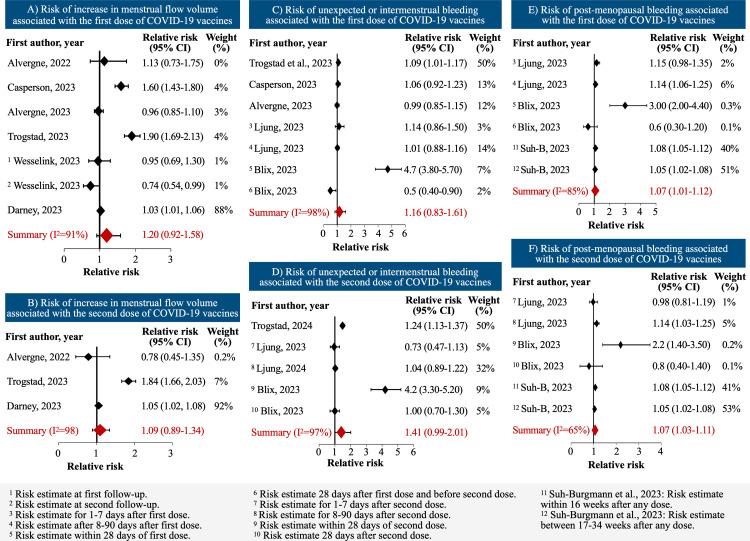
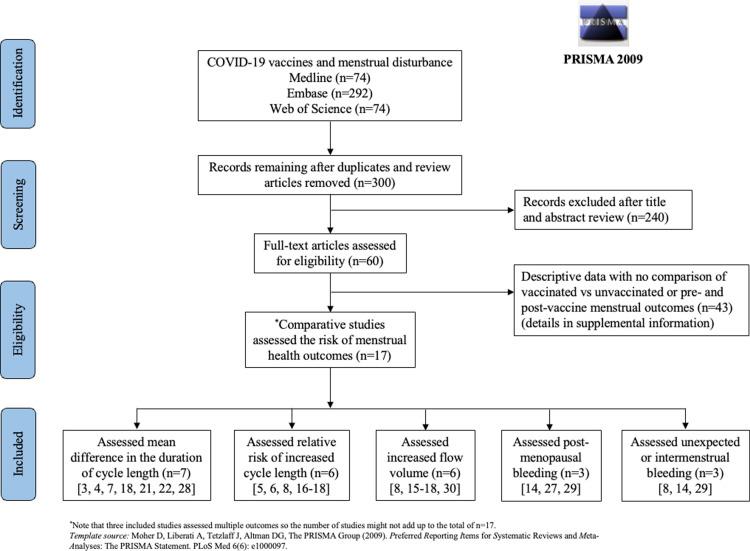
Seventeen studies with >1·9 million participants were analyzed. We found a 19% greater risk of increase in menstrual cycle length as compared to unvaccinated people or pre-vaccination time-periods (summary relative risk (sRR): 1·19; 95% CI: 1·11-1·26; n = 23,718 participants). The increase in risk was the same for Pfizer-BioNTech (sRR: 1·15; 1·05-1·27; n = 16,595) and Moderna vaccines (sRR: 1·15; 1·05-1·25; n = 7,523), similar for AstraZeneca (sRR: 1·27; 1·02-1·59; n = 532), and higher for the Janssen (sRR: 1·69; 1·14-2·52; n = 751) vaccine. In the first cycle after vaccination, length increased by <half-day (summary mean difference (sMD): 0·34 days; 0·21-0·46 days; n = 30,320) after the first dose and by 0·62 days (sMD: 0·62: 0·41-0·82; n = 17,608) after the second dose. In the second cycle after vaccination, the risk was not elevated (sMD: -0·02; -0·16-0·12; n = 18,602). The increase in risk was between 7-9% but statistically insignificant for heavier flow; 7% for post-menopausal bleeding (first dose: 1·07; 1·01-1·12; n = 1,321,268 and second dose: 1·07; 1·03-1·11; n = 1,482,884); and 16-41% for unexpected or intermenstrual bleeding (first dose: 1·16; 0·83-1·61; n = 1,303,687 and second dose: 1·41; 0·99-2·01; n = 1,390,317).
INTERPRETATION
We observed a mild increase in the risk of menstrual disturbance associated with COVID-19 vaccines. Such risks are likely clinically unmeaningful. Vaccine recipients should be appropriately counseled.
背景
2019冠状病毒病(COVID-19)疫苗与月经紊乱之间的关系尚不清楚,部分原因是研究人员采用了各种研究设计来测量不同的结果(例如,月经推迟与月经周期长度变化)。月经紊乱可能是影响人们接受COVID-19疫苗意愿的一个决定性因素。
方法
我们在医学文献数据库(Medline)、荷兰医学文摘数据库(Embase)和科学网(Web of Science)中检索了关于月经周期长度、经量、绝经后出血以及意外出血或经间期出血的研究。采用固定效应荟萃分析,并使用肖尔校正的异质性置信区间对数据进行分析。
结果
对17项研究进行了分析,这些研究的参与者超过190万。我们发现,与未接种疫苗者或接种疫苗前的时间段相比,接种疫苗后月经周期长度增加的风险高19%(汇总相对风险[sRR]:1.19;95%置信区间[CI]:1.11 - 1.26;n = 23718名参与者)。辉瑞 - 生物科技公司(Pfizer - BioNTech)疫苗(sRR:1.15;1.05 - 1.27;n = 16595)和莫德纳(Moderna)疫苗(sRR:1.15;1.05 - 1.25;n = 7523)的风险增加幅度相同,阿斯利康(AstraZeneca)疫苗的风险增加幅度相似(sRR:1.27;1.02 - 1.59;n = 532),而杨森(Janssen)疫苗的风险增加幅度更高(sRR:1.69;1.14 - 2.52;n = 751)。在接种疫苗后的第一个周期,第一剂疫苗接种后月经周期长度增加不到半天(汇总平均差[sMD]:0.34天;0.21 - 0.46天;n = 30320),第二剂疫苗接种后增加0.62天(sMD:0.62;0.41 - 0.82;n = 17608)。在接种疫苗后的第二个周期,风险未升高(sMD: - 0.02; - 0.16 - 0.12;n = 18602)。经量增加的风险为7% - 9%,但在统计学上无显著意义;绝经后出血的风险为7%(第一剂:1.07;1.01 - 1.12;n = 1321268,第二剂:1.07;1.03 - 1.11;n = 1482884);意外出血或经间期出血的风险为16% - 41%(第一剂:1.16;0.83 - 1.61;n = 1303687,第二剂:1.41;0.99 - 2.01;n = 1390317)。
解读
我们观察到与COVID-19疫苗相关的月经紊乱风险有轻微增加。这种风险在临床上可能没有意义。应对疫苗接种者进行适当的咨询。

 Zotero 插件