
MCL-1在犬肝细胞癌中的过表达及其作为预后标志物的效能
Overexpression of MCL-1 in canine hepatocellular carcinoma and its efficacy as a prognostic marker.
作者信息
Baek Jehun, Cho Jaeho, Shin Hun-Kyeong, Kim Wan Hee
机构信息
Department of Veterinary Clinical Sciences, College of Veterinary Medicine, Research Institute for Veterinary Science, Seoul National University, 1 Gwanak-Ro, Gwanak-Gu, Seoul, 08826, Republic of Korea.
出版信息
BMC Vet Res. 2025 May 16;21(1):349. doi: 10.1186/s12917-025-04798-6.
BACKGROUND
Myeloid cell leukemia-1 (MCL-1)-an anti-apoptotic protein of the B-cell lymphoma 2 family-is commonly overexpressed in human cancers, promoting tumorigenesis and chemoresistance. Upregulated MCL-1 in human hepatocellular carcinoma (HCC) has been demonstrated in numerous studies, and therapeutic agents targeting this protein have been assessed. However, its prognostic significance in canine HCC remains unclear. The objective of this study was to detect MCL-1 protein in canine normal liver tissue and compare its expression level with that in HCC tissue using western blotting. Immunohistochemistry (IHC) was used to quantify MCL-1 intensity levels in normal, non-neoplastic hepatic diseases, and HCC tissues, and the differences were assessed. Additionally, the relevance of MCL-1 immunostaining to various clinical and pathological parameters was evaluated.
RESULTS
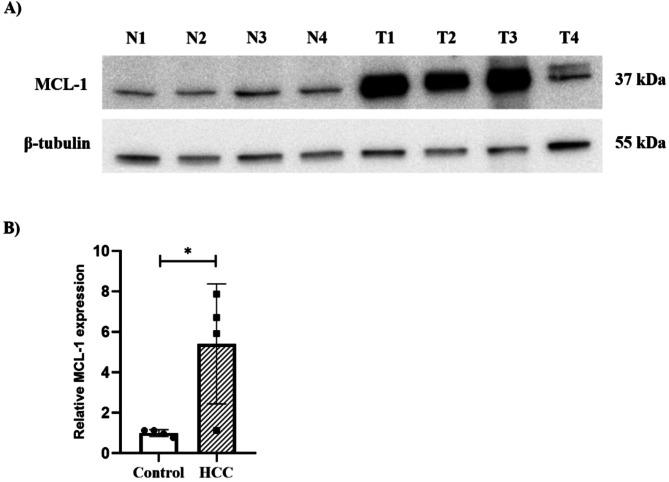
MCL-1 expression was markedly elevated in HCC tissues relative to normal liver tissues (P = 0.029). Additionally, all 10 normal liver tissues exhibited low IHC expression, which significantly increased as the malignancy progressed (P < 0.001). In the HCC samples, high MCL-1 immunostaining was substantially correlated with metastatic status (P = 0.034) and tumor size (P = 0.046). Moreover, survival curve analysis revealed a significant relationship between upregulated MCL-1 and lower disease-free survival and overall survival rate (P = 0.006 and P = 0.031, respectively).
CONCLUSION
MCL-1 expression is increased in canine HCC, and its overexpression significantly correlates to worse clinical outcomes. Therefore, MCL-1 is considered to be a promising prognostic marker.
背景
髓样细胞白血病-1(MCL-1)——一种B细胞淋巴瘤2家族的抗凋亡蛋白——在人类癌症中通常过度表达,促进肿瘤发生和化疗耐药性。众多研究已证实人类肝细胞癌(HCC)中MCL-1上调,并且针对该蛋白的治疗药物已得到评估。然而,其在犬类HCC中的预后意义仍不清楚。本研究的目的是使用蛋白质免疫印迹法检测犬正常肝组织中的MCL-1蛋白,并将其表达水平与HCC组织中的进行比较。免疫组织化学(IHC)用于量化正常、非肿瘤性肝病和HCC组织中的MCL-1强度水平,并评估差异。此外,还评估了MCL-1免疫染色与各种临床和病理参数的相关性。
结果
与正常肝组织相比,HCC组织中MCL-1表达明显升高(P = 0.029)。此外,所有10个正常肝组织均表现出低IHC表达,随着恶性程度进展显著增加(P < 0.001)。在HCC样本中,高MCL-1免疫染色与转移状态(P = 0.034)和肿瘤大小(P = 0.046)显著相关。此外,生存曲线分析显示MCL-1上调与无病生存率和总生存率降低之间存在显著关系(分别为P = 0.006和P = 0.031)。
结论
犬类HCC中MCL-1表达增加,其过表达与更差的临床结果显著相关。因此,MCL-1被认为是一个有前景的预后标志物。


 Zotero 插件