
序列和分类学特征评估促进了醇氧化酶的发现。
Sequence and taxonomic feature evaluation facilitated the discovery of alcohol oxidases.
作者信息
Han Yilei, Ding Xuwei, Tan Junjian, Sun Yajuan, Duan Yunjiang, Liu Zheng, Zheng Gaowei, Lu Diannan
机构信息
Department of Chemical Engineering, Tsinghua University, Beijing, 100084, China.
State Key Laboratory of Bioreactor Engineering, Shanghai Collaborative Innovation Center for Biomanufacturing, East China University of Science and Technology, Shanghai, 200237, China.
出版信息
Synth Syst Biotechnol. 2025 Apr 22;10(3):907-915. doi: 10.1016/j.synbio.2025.04.014. eCollection 2025 Sep.
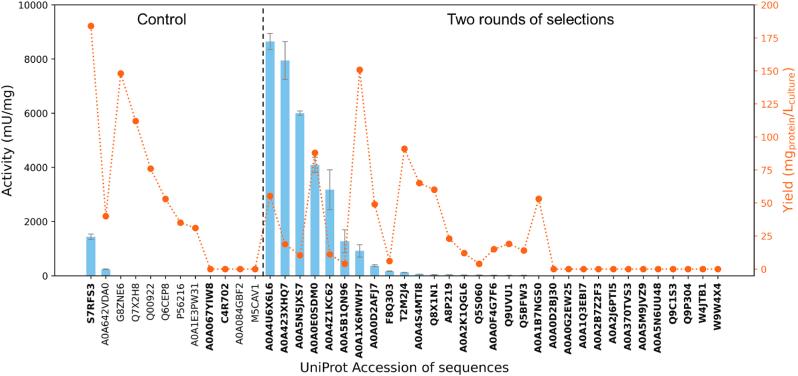
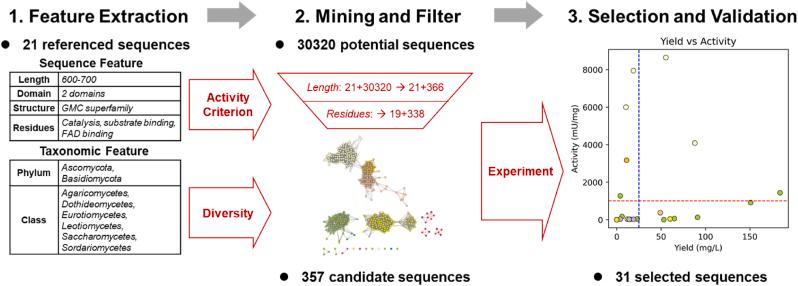
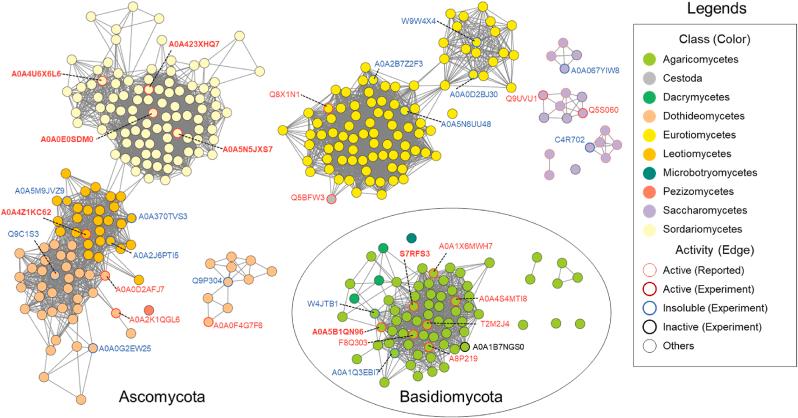
Recent advancements in data technology offer immense opportunities for the discovery and development of new enzymes for the green synthesis of chemicals. Current protein databases predominantly prioritize overall sequence matches. The multi-scale features underpinning catalytic mechanisms and processes, which are scattered across various data sources, have not been sufficiently integrated to be effectively utilized in enzyme mining. In this study, we developed a sequence- and taxonomic-feature evaluation driven workflow to discover enzymes that can be expressed in and catalyze chemical reactions , using alcohol oxidase (AOX) for demonstration, which catalyzes the conversion of methanol to formaldehyde. A dataset of 21 reported AOXs was used to construct sequence scoring rules based on features, including sequence length, structural motifs, catalytic-related residues, binding residues, and overall structure. These scoring rules were applied to filter the results from HMM-based searches, yielding 357 candidate sequences of eukaryotic origin, which were categorized into six classes at 85 % sequence similarity. Experimental validation was conducted in two rounds on 31 selected sequences representing all classes. Among these selected sequences, 19 were expressed as soluble proteins in , and 18 of these soluble proteins exhibited AOX activity, as predicted. Notably, the most active recombinant AOX exhibited an activity of 8.65 ± 0.29 U/mg, approaching the highest activity of native eukaryotic enzymes. Compared to the established UniProt-annotation-based workflow, this feature-evaluation-based approach yielded a higher probability of highly active recombinant AOX (from 8.3 % to 19.4 %), demonstrating the efficiency and potential of this multi-dimensional feature evaluation method in accelerating the discovery of active enzymes.
数据技术的最新进展为发现和开发用于化学品绿色合成的新酶提供了巨大机遇。当前的蛋白质数据库主要优先考虑整体序列匹配。支撑催化机制和过程的多尺度特征分散在各种数据源中,尚未得到充分整合以在酶挖掘中有效利用。在本研究中,我们开发了一种由序列和分类特征评估驱动的工作流程,以发现可在[具体表达宿主]中表达并催化化学反应的酶,以醇氧化酶(AOX)为例进行说明,其催化甲醇转化为甲醛。使用21个已报道的AOX数据集基于包括序列长度、结构基序、催化相关残基、结合残基和整体结构等特征构建序列评分规则。这些评分规则用于筛选基于隐马尔可夫模型(HMM)搜索的结果,产生了357个真核生物来源的候选序列,这些序列在85%序列相似性水平上被分为六类。对代表所有类别的31个选定序列进行了两轮实验验证。在这些选定序列中,19个在[具体表达宿主]中表达为可溶性蛋白,其中18个可溶性蛋白表现出预测的AOX活性。值得注意的是,活性最高的重组AOX表现出8.65±0.29 U/mg的活性,接近天然真核酶的最高活性。与基于已建立的UniProt注释的工作流程相比,这种基于特征评估的方法产生高活性重组AOX的概率更高(从8.3%提高到19.4%),证明了这种多维特征评估方法在加速活性酶发现方面的效率和潜力。


 Zotero 插件