
一名神经母细胞瘤患者肿瘤与游离DNA全基因组测序的比较分析:病例报告
Comparative analysis of whole-genome sequencing of tumor and cfDNA in a neuroblastoma patient: a case report.
作者信息
Fransson Susanne, Georgantzi Kleopatra, Djos Anna, Gaarder Jennie, Svensson Johanna, Anthonydhason Vimala, Kogner Per, Martinsson Tommy, Umapathy Ganesh
机构信息
Department of Laboratory Medicine, Institute of Biomedicine, Sahlgrenska Academy, University of Gothenburg, Gothenburg, Sweden.
Childhood Cancer Research Unit, Department of Women's and Children's Health, Karolinska Institutet, and Pediatric Oncology, Astrid Lindgren Children's Hospital, Karolinska University Hospital, Stockholm, Sweden.
出版信息
Front Oncol. 2025 May 2;15:1569520. doi: 10.3389/fonc.2025.1569520. eCollection 2025.
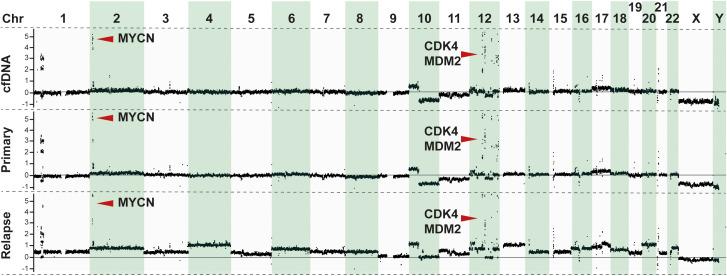
High-risk neuroblastoma (NB) poses significant challenges in pediatric oncology due to its resistance to conventional therapies, leading to relapse and poor prognosis. Copy number variations (CNVs) are strong prognostic factors in NB, prompting exploration into alternative methods for CNV profiling. We conducted whole-genome sequencing (WGS) of the circulating cell-free DNA (cfDNA) from a patient with NB and compared the WGS of the primary and relapsed tumor tissue. Our analysis revealed concordance between the somatic single nucleotide variants (SNVs), insertions and deletions (indels), and CNVs identified in the cfDNA and tumor WGS. Notably, WGS detected numerical chromosome imbalances, large and focal structural aberrations including amplifications in , , and , using low-input cfDNA. Furthermore, additional variants unique to the cfDNA, such as the rare (p.R970C) variant, were identified, possibly representing sub-clonal populations or variants present at metastatic sites. In conclusion, WGS analysis of cfDNA offers a noninvasive, cost-effective, rapid, and sensitive alternative for CNV profiling in patients with NB. This approach holds promise for improving prognostication and for guiding personalized treatment strategies in NB.
高危神经母细胞瘤(NB)因其对传统疗法具有抗性,导致复发和预后不良,给儿科肿瘤学带来了重大挑战。拷贝数变异(CNV)是NB的重要预后因素,促使人们探索CNV分析的替代方法。我们对一名NB患者的循环游离DNA(cfDNA)进行了全基因组测序(WGS),并比较了原发肿瘤组织和复发肿瘤组织的WGS。我们的分析揭示了cfDNA和肿瘤WGS中鉴定出的体细胞单核苷酸变异(SNV)、插入和缺失(indel)以及CNV之间的一致性。值得注意的是,WGS使用低输入量的cfDNA检测到了染色体数目失衡、大型和局灶性结构畸变,包括、和的扩增。此外,还鉴定出了cfDNA特有的其他变异,如罕见的(p.R970C)变异,可能代表亚克隆群体或转移部位存在的变异。总之,cfDNA的WGS分析为NB患者的CNV分析提供了一种非侵入性、经济高效、快速且灵敏的替代方法。这种方法有望改善NB的预后评估并指导个性化治疗策略。



 Zotero 插件