
使用脑电图和深度卷积神经网络预测安慰剂反应:与三个独立数据集的临床数据的相关性
Predicting Placebo Responses Using EEG and Deep Convolutional Neural Networks: Correlations with Clinical Data Across Three Independent Datasets.
作者信息
Khayretdinova Mariam, Pshonkovskaya Polina, Zakharov Ilya, Adamovich Timothy, Kiryasov Andrey, Zhdanov Andrey, Shovkun Alexey
机构信息
Brainify.AI, 101 Americas Avenue, 3 Floor, NY City, NY, 10013, USA.
Centre for Mathematical Sciences, University of Cambridge, Wilberforce Rd, Cambridge, CB3 0 WA, UK.
出版信息
Neuroinformatics. 2025 May 19;23(2):32. doi: 10.1007/s12021-025-09725-6.
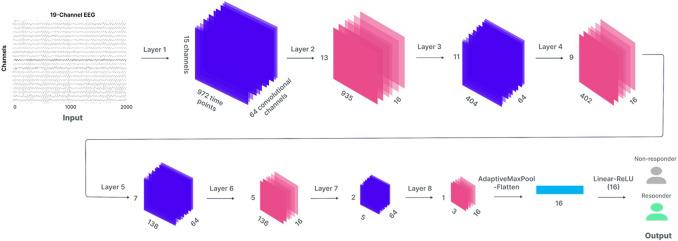
Identifying likely placebo responders can help design more efficient clinical trials by stratifying participants, reducing sample size requirements, and enhancing the detection of true drug effects. In response to this need, we developed a deep convolutional neural network (DCNN) model using resting-state EEG data from the EMBARC study, achieving a balanced accuracy of 69% in predicting placebo responses in patients with major depressive disorder (MDD). We then applied this model to two additional datasets, LEMON and CAN-BIND-which did not include placebo groups-to investigate potential relationships between the model's predictions and various clinical features in independent samples. Notably, the model's predictions correlated with factors previously linked to placebo response in MDD, including age, extraversion, and cognitive processing speed. These findings highlight several factors associated with placebo susceptibility, offering insights that could guide more efficient clinical trial designs. Future research should explore the broader applicability of such predictive models across different medical conditions, and replicate the current EEG-based model of placebo response in independent samples.
识别可能的安慰剂反应者有助于通过对参与者进行分层、减少样本量要求以及增强对真实药物效果的检测来设计更高效的临床试验。为满足这一需求,我们利用来自EMBARC研究的静息态脑电图数据开发了一种深度卷积神经网络(DCNN)模型,在预测重度抑郁症(MDD)患者的安慰剂反应方面达到了69%的平衡准确率。然后,我们将该模型应用于另外两个数据集,即LEMON和CAN - BIND(这两个数据集不包括安慰剂组),以研究该模型的预测与独立样本中各种临床特征之间的潜在关系。值得注意的是,该模型的预测与先前与MDD中安慰剂反应相关的因素有关,包括年龄、外向性和认知处理速度。这些发现突出了几个与安慰剂易感性相关的因素,提供了可指导更高效临床试验设计的见解。未来的研究应探索此类预测模型在不同医疗条件下的更广泛适用性,并在独立样本中复制当前基于脑电图的安慰剂反应模型。
 Zotero 插件