
改进的体积相关联光电子显微镜(CLEM)显示,在自噬缺陷细胞中,异常吞噬泡和含RB1CC1/FIP200的聚集体似乎围绕着SQSTM1/p62聚集体。
Improved volume CLEM revealed that aberrant phagophores and RB1CC1/FIP200-containing clusters appear surround SQSTM1/p62 aggregates in -deficient cells.
作者信息
Kakuta Soichiro, Yamaguchi Junji, Suzuki Chigure, Tanida Isei, Uchiyama Yasuo
机构信息
Laboratory of Morphology and Image Analysis, Biomedical Research Core Facilities, Juntendo University Graduate School of Medicine, Tokyo, Japan.
Department of Cellular and Molecular Neuropathology, Juntendo University Graduate School of Medicine, Tokyo, Japan.
出版信息
Autophagy Rep. 2023 Sep 15;2(1):2256599. doi: 10.1080/27694127.2023.2256599. eCollection 2023.
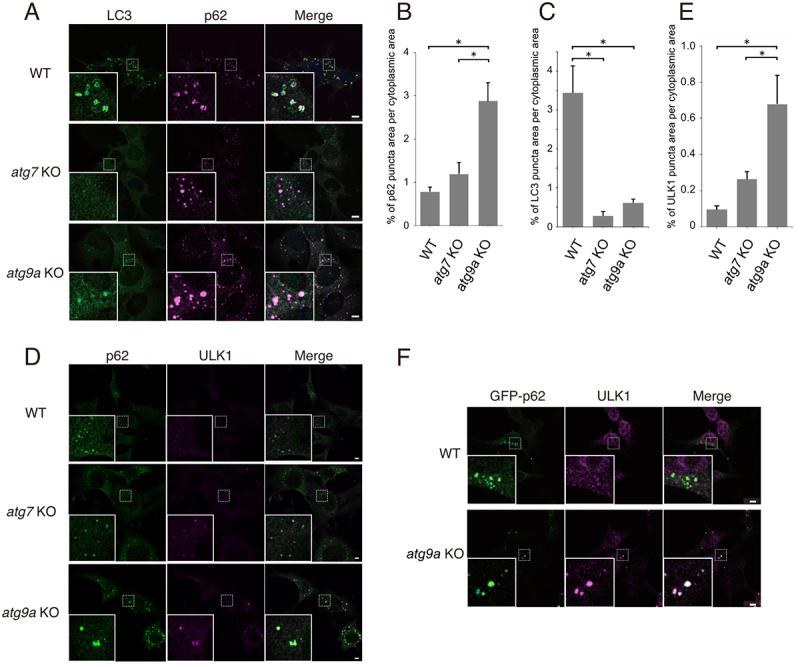
ATG9A is an important membrane protein in mammalian macroautophagy. The formation of autophagosomes and phagophores is blocked in KO cells. However, it remains possible that residual membrane formation activity exists in these cells. These precursor structures that precede phagophores are, if they exist, rare and may be difficult to find. Here, we introduce the modified volume correlative light and electron microscopy (CLEM) method to analyze these structures three-dimensionally. In addition to target proteins, mitochondria were labeled as a landmark for precise correlation of slice images by a confocal fluorescence microscope and a focused ion beam scanning electron microscope. We found phagophores and small membrane vesicles near SQSTM1/p62 aggregates in KO cells, indicating that phagophores could be formed in -deficient cells, although they were immature and inefficient. Furthermore, we found that RB1CC1/FIP200-positive structures formed clusters around SQSTM1/p62 with ferritin and TAX1BP1. Taken together, our method contributes to the understanding of undiscovered fine structures. CLEM: correlative light and electron microscopy; EM: electron microscopy; ER: endoplasmic reticulum; FIB-SEM: focused ion beam scanning electron microscopy; FM: fluorescence microscopy; GFP: green fluorescent protein; KO: knock out; MEF: mouse embryonic fibroblast; PBS: phosphate-buffered saline; ROI: region of interest; SEM: scanning electron microscopy.
ATG9A是哺乳动物巨自噬中的一种重要膜蛋白。自噬体和吞噬泡的形成在基因敲除(KO)细胞中受阻。然而,这些细胞中仍有可能存在残余的膜形成活性。如果存在的话,这些先于吞噬泡的前体结构很罕见,可能难以找到。在这里,我们引入改良的体积相关光电子显微镜(CLEM)方法对这些结构进行三维分析。除了目标蛋白外,线粒体被标记为通过共聚焦荧光显微镜和聚焦离子束扫描电子显微镜精确关联切片图像的标志物。我们在基因敲除细胞中发现吞噬泡和SQSTM1/p62聚集体附近的小膜泡,这表明吞噬泡可以在缺乏(某种物质)的细胞中形成,尽管它们不成熟且效率低下。此外,我们发现RB1CC1/FIP200阳性结构与铁蛋白和TAX1BP1一起在SQSTM1/p62周围形成簇。综上所述,我们的方法有助于理解未被发现的精细结构。 CLEM:相关光电子显微镜;EM:电子显微镜;ER:内质网;FIB - SEM:聚焦离子束扫描电子显微镜;FM:荧光显微镜;GFP:绿色荧光蛋白;KO:基因敲除;MEF:小鼠胚胎成纤维细胞;PBS:磷酸盐缓冲盐水;ROI:感兴趣区域;SEM:扫描电子显微镜。



 Zotero 插件