
海洋微塑料对神经和功能障碍的影响:一项基于人群水平的研究。
Impact of Marine Microplastics on Neurologic and Functional Disabilities: A Population-Level Study.
作者信息
Makwana Bhargav, Desai Brinda, Srinivasan Jayashri, Apetauerova Diana, Dani Sourbha S, Sehgal Siddharth, Yerstein Oleg, Khadke Sumanth, Kumar Ashish, Nasir Khurram, Wadhera Rishi, Kong Yixin, Navas-Acien Ana, Adamkiewicz Gary, Rajagopalan Sanjay, Al-Kindi Sadeer, Moffatt-Bruce Susan, Ganatra Sarju
机构信息
Division of Cardiovascular Medicine, Department of Medicine, Lahey Hospital & Medical Center, Burlington, Massachusetts, USA.
Department of Neurology, Lahey Hospital & Medical Center, Burlington, Massachusetts, USA.
出版信息
Eur J Neurol. 2025 May;32(5):e70144. doi: 10.1111/ene.70144.
BACKGROUND
Microplastics are emerging as environmental pollutants with potential neurotoxic effects, yet their association with neurological disabilities remains largely unexplored.
METHODS
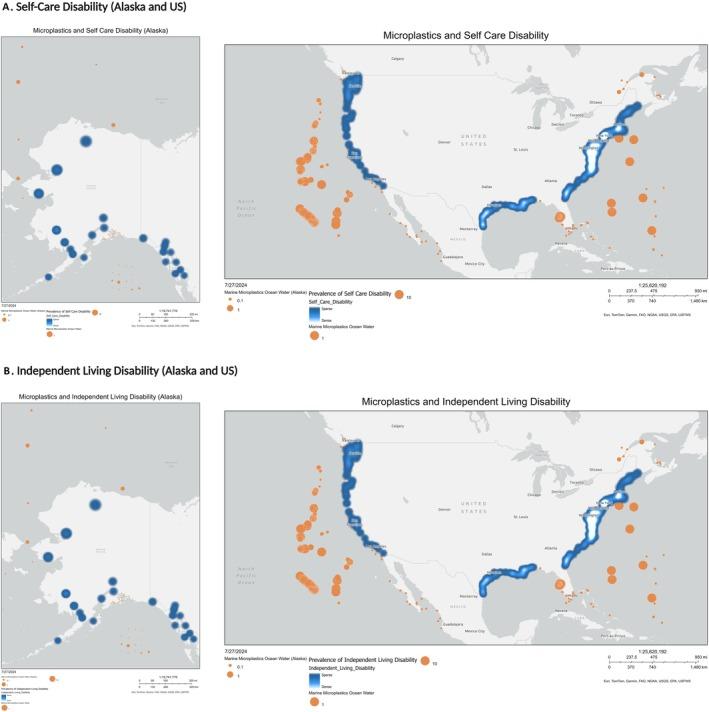
In this cross-sectional study comprising 218 coastal counties in the United States, we compared the self-reported prevalence of cognitive disability, mobility disability, self-care disability, and independent living disability in counties with very high and low marine microplastic levels (MMLs). Unadjusted and adjusted prevalence ratios (PRs) were computed using population-weighted quasi-Poisson regression across three different models to examine the relationship between disability prevalence and MMLs.
RESULTS
Counties exposed to very high marine microplastic levels had a higher mean prevalence of self-reported cognitive disability (15.2% vs. 13.9%), mobility disability (14.1% vs. 12.3%), self-care disability (4.2% vs. 3.6%), and independent living disability (8.5% vs. 7.7%) compared to those exposed to low levels (p < 0.001). Regression analyses revealed significantly elevated adjusted prevalence ratios (PRs) for cognitive (PR: 1.09 [95% CI: 1.06-1.12], p < 0.001), mobility (PR: 1.06 [1.03-1.10], p < 0.001), self-care (PR: 1.16 [1.11-1.20], p < 0.001), and independent living disability (PR: 1.08 [1.05-1.12], p < 0.001) in counties with very high microplastic exposure compared to those with low exposure.
CONCLUSIONS
This study highlights a significant association between marine microplastic pollution and the self-reported prevalence of cognitive, mobility, self-care, and independent living disabilities at the county level. While merely associative, these findings emphasize the urgent need for further investigation into the individual-level health impacts of microplastic exposure and underscore the importance of environmental interventions to mitigate potential risks.
背景
微塑料正成为具有潜在神经毒性作用的环境污染物,但其与神经功能障碍的关联在很大程度上仍未得到探索。
方法
在这项涵盖美国218个沿海县的横断面研究中,我们比较了海洋微塑料水平(MMLs)非常高和非常低的县中自我报告的认知障碍、行动障碍、自我护理障碍和独立生活障碍的患病率。使用人口加权准泊松回归在三种不同模型中计算未调整和调整后的患病率比(PRs),以检验残疾患病率与MMLs之间的关系。
结果
与暴露于低水平微塑料的县相比,暴露于非常高海洋微塑料水平的县自我报告的认知障碍(15.2%对13.9%)、行动障碍(14.1%对12.3%)、自我护理障碍(4.2%对3.6%)和独立生活障碍(8.5%对7.7%)的平均患病率更高(p < 0.001)。回归分析显示,与低暴露县相比,微塑料暴露非常高的县中认知(PR:1.09 [95% CI:1.06 - 1.12],p < 0.001)、行动(PR:1.06 [1.03 - 1.10],p < 0.001)、自我护理(PR:1.16 [1.11 - 1.20],p < 0.001)和独立生活障碍(PR:1.08 [1.05 - 1.12],p < 0.001)的调整患病率比显著升高。
结论
本研究突出了海洋微塑料污染与县级自我报告的认知、行动、自我护理和独立生活障碍患病率之间的显著关联。虽然只是关联性的,但这些发现强调了迫切需要进一步调查微塑料暴露对个体健康的影响,并强调了环境干预以减轻潜在风险的重要性。

 Zotero 插件