
肿瘤坏死因子抑制剂与传统合成改善病情抗风湿药对类风湿关节炎免疫衰老和炎症衰老的不同影响:一项横断面分析
Diverging effects of tumor necrosis factor inhibitors and conventional synthetic disease-modifying antirheumatic drugs on immunosenescence and inflammageing in rheumatoid arthritis: a cross-sectional analysis.
作者信息
Schwarz Tobias, Almanzar Giovanni, Völkl Sebastian, Feuchtenberger Martin, Leierer Johannes, Schmidt Christian, Deininger Frank, Tony Hans-Peter, Schmalzing Marc, Prelog Martina
机构信息
Department of Pediatrics, Pediatric Rheumatology and Special Immunology, University Hospital Würzburg, University of Würzburg, Würzburg, Germany.
Department of Internal Medicine II, Rheumatology/Clinical Immunology, University Hospital Würzburg, University of Würzburg, Würzburg, Germany.
出版信息
Immun Ageing. 2025 May 22;22(1):21. doi: 10.1186/s12979-025-00508-w.
BACKGROUND
Immunosenescence is characterized by a decline in naive T cells, a reduced T cell receptor repertoire, and the accumulation of terminally-differentiated and unspecifically-activated proinflammatory cells, a process called inflammageing. Premature immunosenescence is thought to be pathogenetically relevant in rheumatoid arthritis (RA), either by posing a risk factor for its development, or by advancing the rheumatic disease as a result of excess antigenic and inflammatory stimulation. We investigated parameters of immunosenescence in RA patients treated with conventional synthetic disease-modifying antirheumatic drugs (csDMARDs) only compared to patients treated additionally or exclusively with a tumor necrosis factor inhibitor (TNFi) and age-matched healthy controls to investigate the effect of RA treatment on age-associated T cell phenotypes and functions.
RESULTS
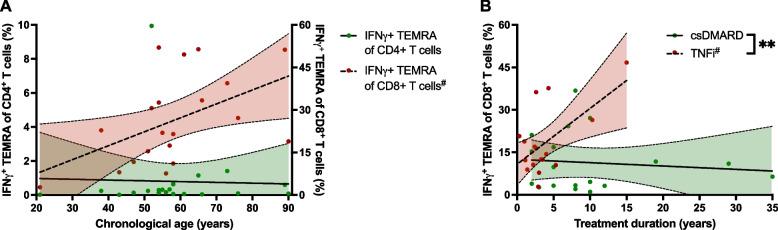
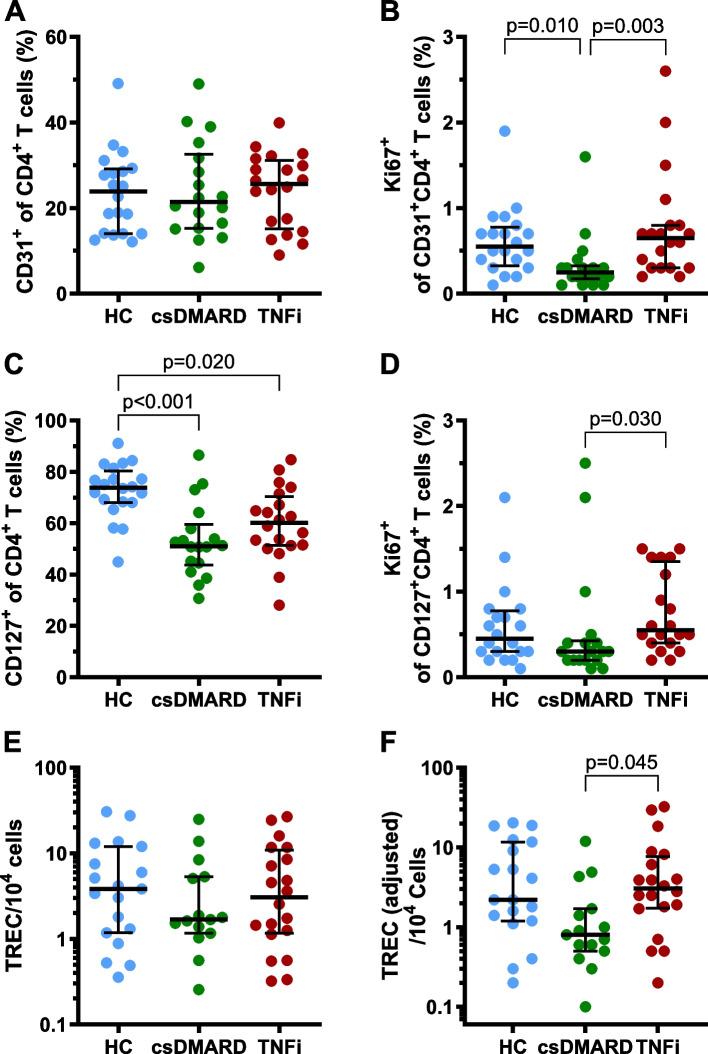
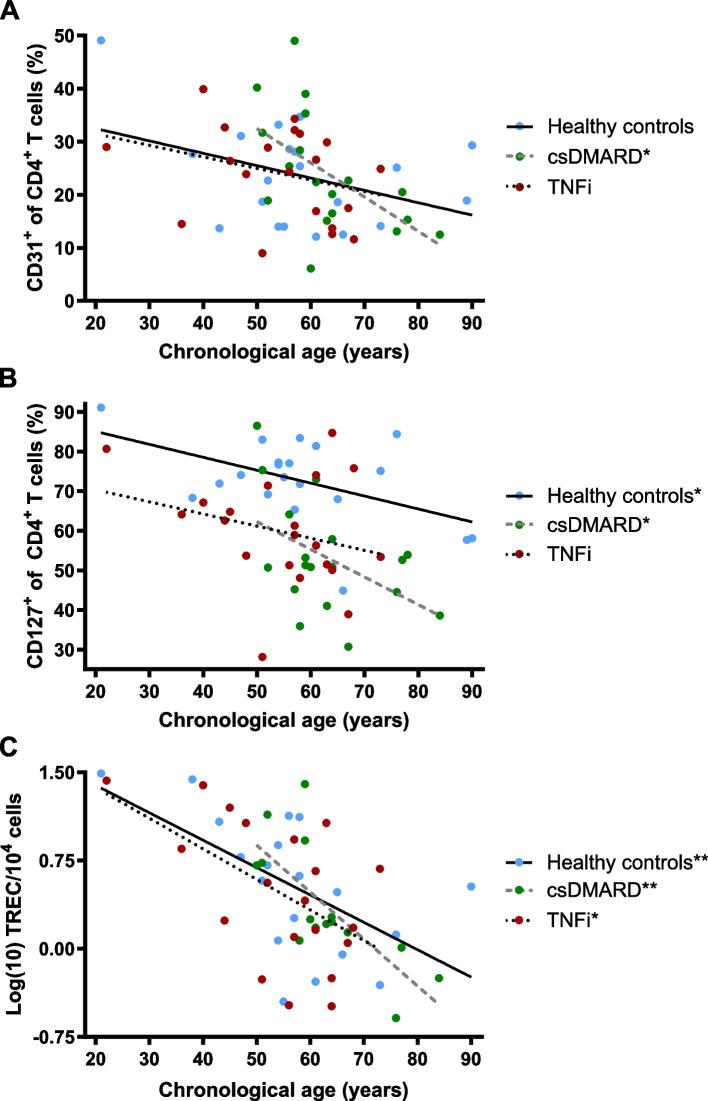
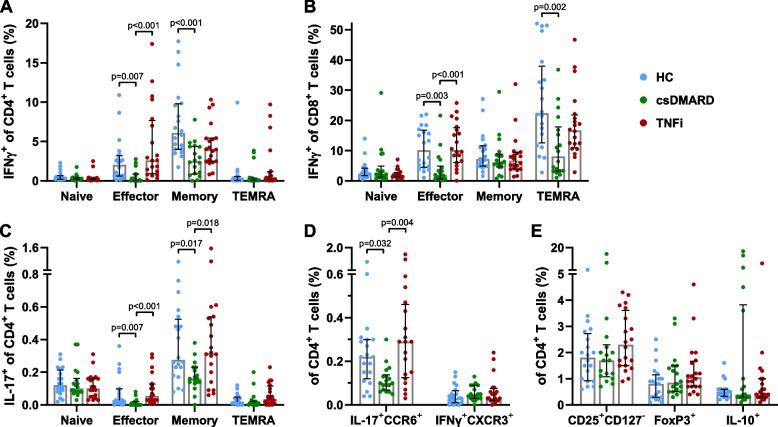
The csDMARD-only treated patients, compared to the TNFi-treated patients and healthy controls, displayed an enhanced age-dependent decline in CD31 recent thymic emigrants (RTE) and Interleukin-7 (IL-7)-receptor α-chain (CD127)-expressing CD4 T cells participating in IL-7-associated homeostatic proliferation, a diminished proliferation of RTE and CD127 T cells, as well as reduced T cell receptor excision circle (TREC) counts. However, whereas the RA patients exhibited reduced proportions of unspecifically activated IFNγ- and IL-17-producing T cells, TNFi initiation induced an increase in these proinflammatory cells.
CONCLUSIONS
Whereas a TNFi treatment seems to counteract the non-inflammatory aspects of immunosenescence, it induces increasing proportions of terminally-differentiated, cytokine-producing effector memory T cells, requiring awareness as possibly contributing to secondary autoimmune phenomena in RA.
背景
免疫衰老的特征是初始T细胞减少、T细胞受体库缩小以及终末分化和非特异性激活的促炎细胞积累,这一过程称为炎症衰老。过早的免疫衰老被认为在类风湿关节炎(RA)的发病机制中具有相关性,要么是其发病的危险因素,要么是由于过量的抗原和炎症刺激而促使风湿性疾病进展。我们研究了仅接受传统合成抗风湿药物(csDMARDs)治疗的RA患者与额外接受或仅接受肿瘤坏死因子抑制剂(TNFi)治疗的患者以及年龄匹配的健康对照者的免疫衰老参数,以研究RA治疗对与年龄相关的T细胞表型和功能的影响。
结果
与接受TNFi治疗的患者和健康对照者相比,仅接受csDMARDs治疗的患者在参与IL-7相关稳态增殖的CD31近期胸腺迁出细胞(RTE)和表达白细胞介素-7(IL-7)受体α链(CD127)的CD4 T细胞中,年龄依赖性下降更为明显,RTE和CD127 T细胞的增殖减少,以及T细胞受体切除环(TREC)计数降低。然而,虽然RA患者中未特异性激活的产生IFNγ和IL-17的T细胞比例降低,但开始使用TNFi会导致这些促炎细胞增加。
结论
虽然TNFi治疗似乎可以抵消免疫衰老的非炎症方面,但它会诱导终末分化的、产生细胞因子的效应记忆T细胞比例增加,需要注意这可能会导致RA中的继发性自身免疫现象。

 Zotero 插件