
美国成年人血清钠在正常范围内及其与生物衰老的U型关系。
Serum sodium within the normal range and its U-shaped relationship with biological aging in U.S. adults.
作者信息
Tong Xianxiang, Wang Fei, Liu Mengxue
机构信息
Department of Anesthesiology, Sichuan Provincial People's Hospital, School of Medicine, University of Electronic Science and Technology of China, Chengdu, China.
出版信息
Front Nutr. 2025 May 8;12:1589962. doi: 10.3389/fnut.2025.1589962. eCollection 2025.
BACKGROUND
This cross-sectional study evaluated the correlation between serum sodium levels (135-145 mmol/L) and biological aging in U.S. adults. Biological age, derived from multi-system biomarkers, provides a more accurate assessment of aging than chronological age. Hydration balance, reflected by serum sodium, may modulate age-related diseases and mortality, but its link to biological aging remains underexplored.
METHODS
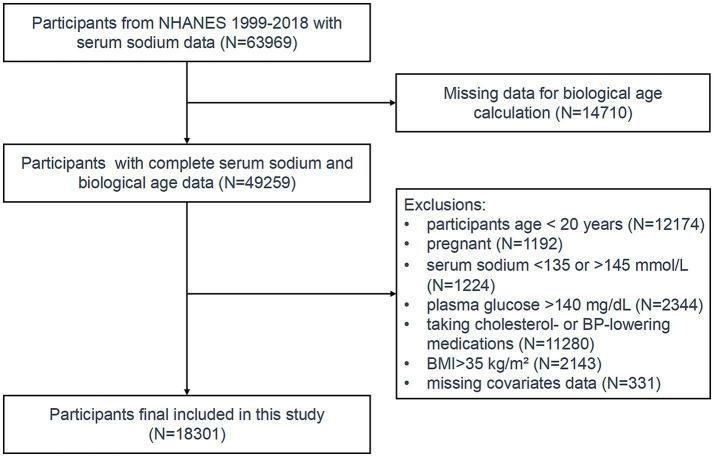
Using NHANES data (1999-2018), we focused on normonatremic adults (≥20 years). The final cohort included 18,301 participants. Biological age was estimated using the Klemera and Doubal method, and ∆age (biological age-chronological age) was calculated. Associations were assessed using multivariate regression, generalized additive models, and threshold analysis. Subgroup analyses were conducted for variations across different populations.
RESULTS
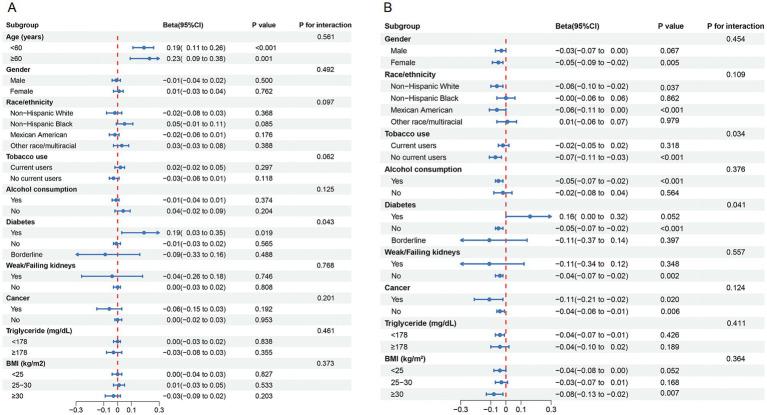
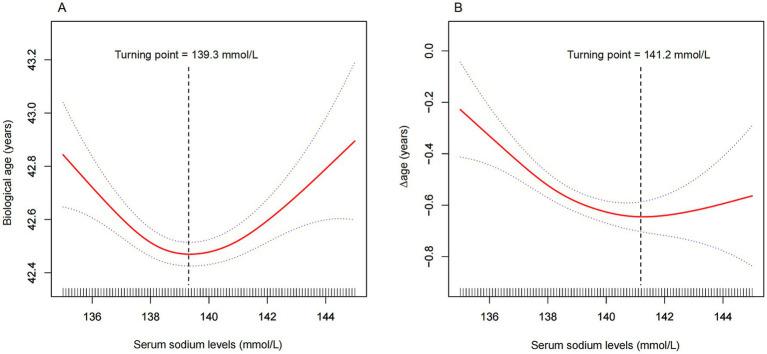
Nonlinear analysis revealed a U-shaped relationship between serum sodium and biological age. The lowest biological age occurred at 139.3 mmol/L: each 1 mmol/L increase below this threshold was associated with a reduction of 0.10 years in biological age (95% CI: -0.15, -0.05), whereas values above it showed a 0.08-year increase (95% CI: 0.04, 0.13). For ∆age, a negative association was observed below 141.2 mmol/L, with each increase linked to a 0.07-year decrease (95% CI: -0.10, -0.04). Subgroup analyses revealed significant interactions in diabetic and smoking populations.
CONCLUSION
Maintaining serum sodium levels within an optimal range (138-142 mmol/L) may help delay biological aging. Hydration management may serve as a modifiable factor for healthy aging, particularly in high-risk groups such as individuals with diabetes or tobacco use.
背景
这项横断面研究评估了美国成年人血清钠水平(135 - 145毫摩尔/升)与生物衰老之间的相关性。源自多系统生物标志物的生物年龄比实际年龄能更准确地评估衰老情况。血清钠所反映的水合平衡可能会调节与年龄相关的疾病和死亡率,但其与生物衰老的联系仍未得到充分研究。
方法
利用美国国家健康与营养检查调查(NHANES)数据(1999 - 2018年),我们聚焦于血钠正常的成年人(≥20岁)。最终队列包括18301名参与者。使用克莱梅拉和杜巴尔方法估算生物年龄,并计算Δ年龄(生物年龄 - 实际年龄)。使用多变量回归、广义相加模型和阈值分析评估相关性。针对不同人群的差异进行亚组分析。
结果
非线性分析显示血清钠与生物年龄之间呈U形关系。生物年龄最低值出现在139.3毫摩尔/升:低于此阈值每增加1毫摩尔/升,生物年龄减少0.10岁(95%置信区间:-0.15,-0.05),而高于此值则增加0.08岁(95%置信区间:0.04,0.13)。对于Δ年龄,在141.2毫摩尔/升以下观察到负相关,每增加1毫摩尔/升与减少0.07岁相关(95%置信区间:-0.10,-0.04)。亚组分析显示在糖尿病和吸烟人群中有显著交互作用。
结论
将血清钠水平维持在最佳范围(138 - 142毫摩尔/升)内可能有助于延缓生物衰老。水合管理可能是健康衰老的一个可调节因素,特别是在糖尿病患者或吸烟者等高风险人群中。
 Zotero 插件