
前庭康复和双任务训练对中风幸存者平衡和步态的影响:系统评价与荟萃分析
Impact of Vestibular Rehabilitation and Dual-Task Training on Balance and Gait in Survivors of Stroke: A Systematic Review and Meta-Analysis.
作者信息
Nairn Brooke, Koohi Nehzat, Kaski Diego, Bamiou Doris-Eva, Pavlou Marousa
机构信息
UCL Ear Institute University College London London UK.
Department of Neuro-Otology University College London Hospitals London UK.
出版信息
J Am Heart Assoc. 2025 Jun 3;14(11):e040663. doi: 10.1161/JAHA.124.040663. Epub 2025 May 23.
BACKGROUND
Evidence supports that vestibular rehabilitation therapy (VRT) improves the static and dynamic balance of survivors of stroke, yet VRT is rarely included in stroke rehabilitation guidelines. We aim to answer the question: What are the effects of VRT or dual-task training (DTT) on balance and gait for reducing the risk of falls among survivors of late subacute and chronic stroke?
METHODS
Following the Preferred Reporting Items for Systematic Reviews and Meta-Analysis Statement guidelines, electronic databases PubMed, EMBASE, MEDLINE, Web of Science, and Scopus for English were searched to identify randomized controlled trials published within the past 10 years in the English language, investigating VRT for patients with late subacute and chronic stroke.
RESULTS
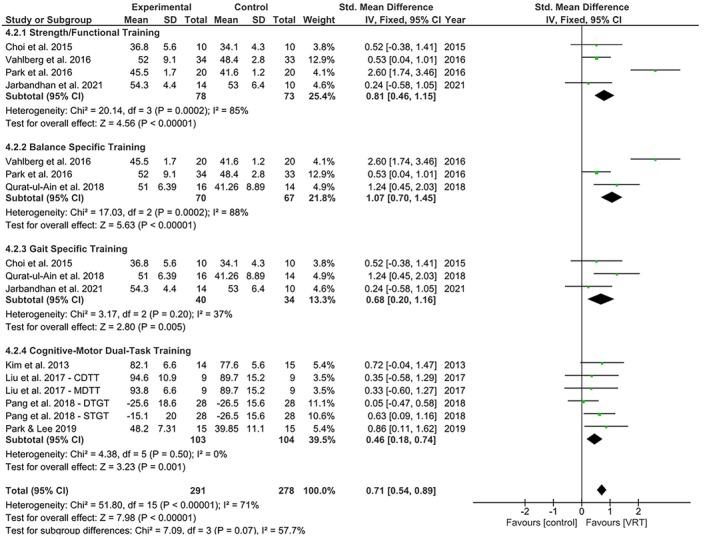
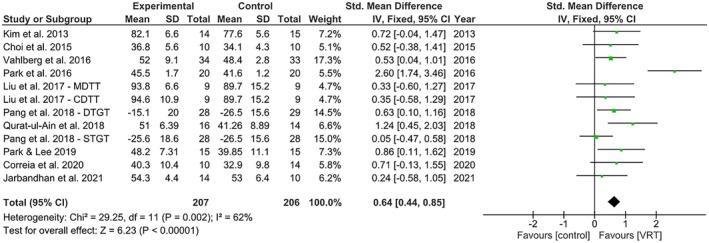
Eleven studies (n=509 participants) were included in the systematic review, and 10 studies (n=413 participants) were included in a meta-analysis. The average participant age was 60.9 years, with 62.11% male. On average, 36 months had passed since stroke onset. The pooled effect standardized mean difference suggests that VRT has a significantly large effect for improving balance (standardized mean difference, 0.64 [95% CI, 0.44-0.85], <0.00001), particularly from balance-specific training (standardized mean difference, 1.07 [95% CI, 0.70-1.45], =0.002). Dual-task training (DTT) moderately improved gait (standardized mean difference, 0.46 [95% CI, 0.18-0.74], =0.001), with greater benefits from DTT compared with single-task training.
CONCLUSIONS
Despite substantial heterogeneity across studies, the evidence supports that VRT, can probably improve balance, and DTT may improve gait outcomes among survivors of late subacute and chronic stroke. An optimal program for this population should focus on balance and DTT with subcomponents of gait and strength training. Further research is required to determine the optimal number of weeks, sessions/week, and duration (minutes) of VRT sessions.
REGISTRATION
URL: https://www.crd.york.ac.uk/PROSPERO/; Unique identifier: CRD42023450254.
背景
有证据表明,前庭康复治疗(VRT)可改善中风幸存者的静态和动态平衡,但VRT很少被纳入中风康复指南。我们旨在回答以下问题:VRT或双任务训练(DTT)对平衡和步态有何影响,以降低亚急性后期和慢性中风幸存者的跌倒风险?
方法
按照系统评价和Meta分析报告规范指南,检索了英文电子数据库PubMed、EMBASE、MEDLINE、Web of Science和Scopus,以识别过去10年内发表的关于亚急性后期和慢性中风患者VRT的随机对照试验。
结果
系统评价纳入了11项研究(n = 509名参与者),Meta分析纳入了10项研究(n = 413名参与者)。参与者的平均年龄为60.9岁,男性占62.11%。中风发作后平均过去了36个月。合并效应标准化均差表明,VRT对改善平衡有显著的大效应(标准化均差,0.64 [95% CI,0.44 - 0.85],<0.00001),特别是来自特定平衡训练(标准化均差,1.07 [95% CI,0.70 - 1.45],=0.002)。双任务训练(DTT)适度改善了步态(标准化均差,

 Zotero 插件