
RND超家族多药外排泵AdeABC、AdeFGH和AdeIJK对多重耐药AYE菌株抗菌耐药性及毒力因子的作用
Contribution of RND superfamily multidrug efflux pumps AdeABC, AdeFGH, and AdeIJK to antimicrobial resistance and virulence factors in multidrug-resistant AYE.
作者信息
Xie Lulin, Li Junwei, Peng Qin, Liu Xianqing, Lin Fei, Dai Xiaozhen, Ling Baodong
机构信息
Key Laboratory of Structure-Specific Small Molecule Drugs at Chengdu Medical College of Sichuan Province, School of Pharmacy, Chengdu Medical College, Chengdu, China.
Department of Pharmacy, Clinical Medical College and The First Affiliated Hospital of Chengdu Medical College, Chengdu, China.
出版信息
Antimicrob Agents Chemother. 2025 Jul 2;69(7):e0185824. doi: 10.1128/aac.01858-24. Epub 2025 May 23.
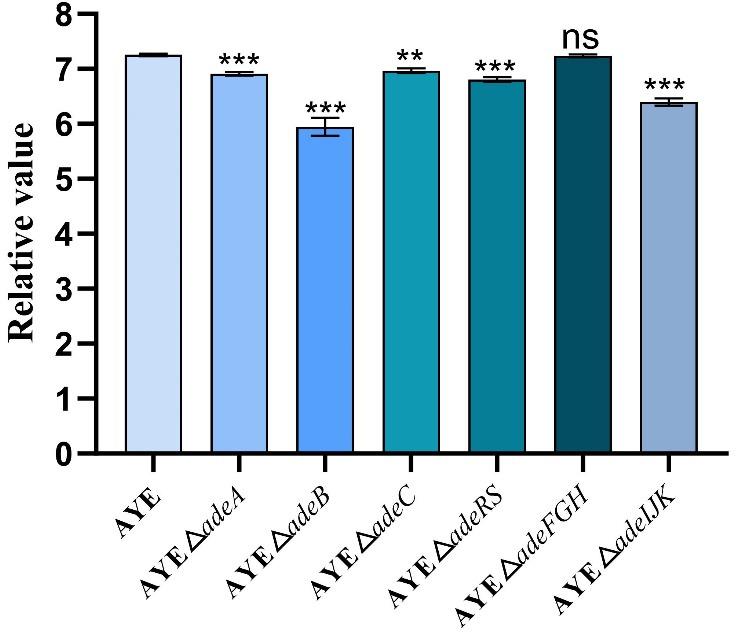
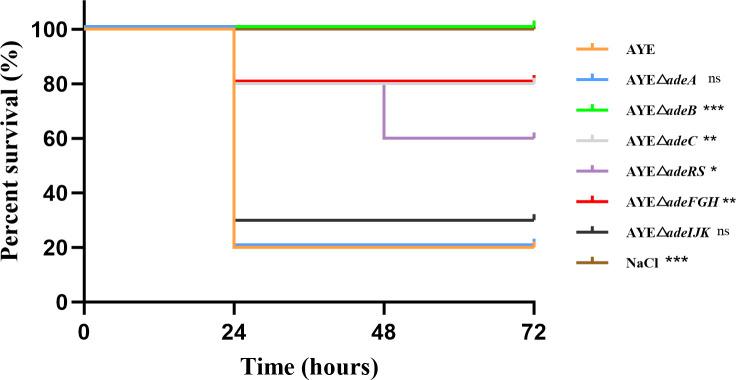
is a critical priority gram-negative bacterial species characterized by multidrug resistance. The latter is significantly attributable to the resistance-nodulation-cell division (RND) superfamily of tripartite multidrug efflux systems represented by AdeABC, AdeFGH, and AdeIJK. By constructing isogenic deletion mutants, this investigation assessed the impact of RND efflux pumps on planktonic and biofilm cell antimicrobial susceptibility as well as on biofilm formation and virulence factors in a multidrug-resistant reference strain, AYE. Inactivation of individual genes encoding the aforementioned three RND pumps or regulators (i.e., AYE△, △, △, △, △, and △ mutants) demonstrated that the three efflux pumps, particularly AdeB, contribute to resistance in both planktonic and biofilm cells to structurally unrelated anti-. drugs, including carbapenems, fluoroquinolones, macrolides, polymyxins, and/or tetracyclines/tigecycline. The pump inactivation also altered other functions, changes in bacterial motility and adhesion, reduction of biofilm formation, and decreased expression of the genes related to biofilm formation and virulence factors (, , , and , except for whose expression was increased). The virulence assay measured through the survival rates of -infected revealed the relation between RND pumps (particularly AdeB) and pathogenicity. The findings together expand the understanding of specific RND pumps or components for their roles in resistance and virulence/pathogenicity in the presence of high-level multidrug resistance, highlighting the RND pumps as potential therapeutic intervention targets against infection.
是一种以多重耐药为特征的关键优先革兰氏阴性菌。后者很大程度上归因于以AdeABC、AdeFGH和AdeIJK为代表的三方多药外排系统的耐药-结瘤-细胞分裂(RND)超家族。通过构建同基因缺失突变体,本研究评估了RND外排泵对多药耐药参考菌株AYE的浮游和生物膜细胞抗菌敏感性以及生物膜形成和毒力因子的影响。编码上述三种RND泵或调节因子的单个基因(即AYE△、△、△、△、△和△突变体)的失活表明,这三种外排泵,特别是AdeB,有助于浮游和生物膜细胞对结构不相关的抗菌药物产生耐药性,包括碳青霉烯类、氟喹诺酮类、大环内酯类、多粘菌素类和/或四环素类/替加环素。泵失活还改变了其他功能,如细菌运动性和粘附性的变化、生物膜形成的减少以及与生物膜形成和毒力因子相关基因的表达降低(、、、和,除了其表达增加)。通过感染的存活率进行的毒力测定揭示了RND泵(特别是AdeB)与致病性之间的关系。这些发现共同扩展了对特定RND泵或组件在高水平多药耐药情况下其在耐药性和毒力/致病性中作用的理解,突出了RND泵作为针对感染的潜在治疗干预靶点。



 Zotero 插件