
激光与双极前列腺汽化术治疗出血倾向患者的随机试验及前沿分析
Laser vs. bipolar prostate vaporization in bleeding-prone patients: a randomized trial and cutting-edge analysis.
作者信息
Shorbagy Ahmed A, Ismail Mohammed, Kotb Youssef M, Desouki Mohamed, Shabayek Mohamed, Hanna Peter
机构信息
Department of Urology, Ain Shams University, Cairo, Egypt.
Department of Urology, Aswan University, Aswan, Egypt.
出版信息
World J Urol. 2025 May 23;43(1):322. doi: 10.1007/s00345-025-05692-4.
PURPOSE
To compare effectiveness and safety of transurethral diode laser vaporization of prostate (diode LVP) versus bipolar transurethral vaporization of prostate (B-TUVP) in symptomatic benign prostatic hyperplasia (BPH) patients receiving oral anticoagulants/anti-platelet drugs.
PATIENTS AND METHODS
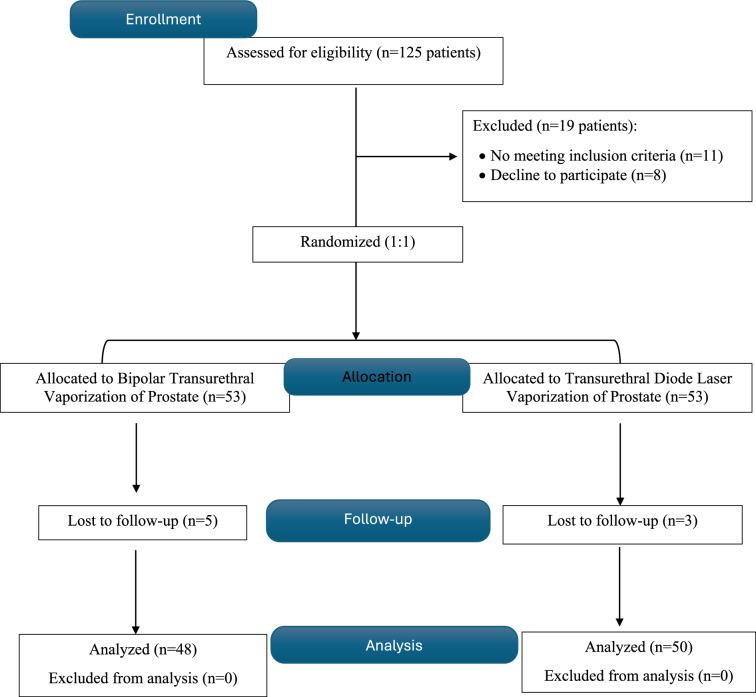
All symptomatic prostate patients receiving oral anticoagulants/anti-platelet drugs are prospectively enrolled in the study between January 2023 to May 2024 in our institution. Of total 98 patients were randomized to B-TUVP (48 patients) or diode LVP (50 patients). The primary outcome is to compare B-TUVP with diode LVP regarding operative bleeding and postoperative hemoglobin drop. Secondary outcomes assess time of urinary irrigation, time of urethral catheter removal, length of hospital stays, and 6-month postoperative functional outcomes; IPSS, postoperative flow rate, and postvoid residual urine.
RESULTS
Baseline characteristics were similar in both groups. Diode LVP group had a significantly higher postoperative hemoglobin with a lower drop compared to B-TUVP group (p = 0.032, p = 0.007; respectively). The diode LVP group had a significantly reduced urinary irrigation duration compared to the B-TUVP group (p = 0.031). Also, diode LVP patients had early catheter removal compared to those in the B-TUVP group (p = 0.014). Additionally, the diode group had a notably reduced hospital stay duration compared to the B-TUVP group (p = 0.024). There were no significant differences between both groups regarding 6-month postoperative IPSS, Q max and PVRU.
CONCLUSION
Diode LVP of the prostate is a safer alternative for treating BPH with fewer risks compared to B-TUVP especially in patients receiving anticoagulants. Nonetheless, both treatments yield similar 6-months functional outcomes.
目的
比较经尿道二极管激光前列腺汽化术(二极管LVP)与双极经尿道前列腺汽化术(B-TUVP)在接受口服抗凝药/抗血小板药物治疗的有症状良性前列腺增生(BPH)患者中的有效性和安全性。
患者与方法
2023年1月至2024年5月期间,所有接受口服抗凝药/抗血小板药物治疗的有症状前列腺患者均前瞻性纳入本机构的研究。总共98例患者被随机分为B-TUVP组(48例患者)或二极管LVP组(50例患者)。主要结局是比较B-TUVP与二极管LVP在手术出血和术后血红蛋白下降方面的情况。次要结局评估膀胱冲洗时间、拔除尿道导管时间、住院时间以及术后6个月的功能结局;国际前列腺症状评分(IPSS)、术后尿流率和残余尿量。
结果
两组的基线特征相似。与B-TUVP组相比,二极管LVP组术后血红蛋白显著更高,下降幅度更低(分别为p = 0.032,p = 0.007)。与B-TUVP组相比,二极管LVP组的膀胱冲洗持续时间显著缩短(p = 0.031)。此外,与B-TUVP组患者相比,二极管LVP患者拔除导管更早(p = 0.014)。另外,与B-TUVP组相比,二极管组的住院时间显著缩短(p = 0.024)。两组术后6个月的IPSS、最大尿流率(Q max)和残余尿量(PVRU)无显著差异。
结论
对于治疗BPH,尤其是接受抗凝治疗的患者,前列腺二极管LVP是一种更安全的选择,与B-TUVP相比风险更低。尽管如此,两种治疗方法产生的6个月功能结局相似。
 Zotero 插件