
-烯丙基氘代二十二碳六烯酸酯化磷脂抵抗大鼠脑内的体内过氧化反应。
-Allylic Deuterated Docosahexaenoic Acid-Esterified Phospholipids Resist In Vivo Peroxidation in Rat Brain.
作者信息
Garza Secilia, James Genevieve, Park Hui Gyu, Baker Paul R S, Agbaga Martin-Paul, Ea Vicki, Shchepinov Mikhail S, Brenna J Thomas
机构信息
Department of Chemistry, University of Texas at Austin, Austin, Texas 78705, United States.
Dell Pediatric Research Institute, Department of Pediatrics, University of Texas at Austin, Austin, Texas 78723, United States.
出版信息
J Am Chem Soc. 2025 Jun 4;147(22):18504-18511. doi: 10.1021/jacs.4c17871. Epub 2025 May 23.
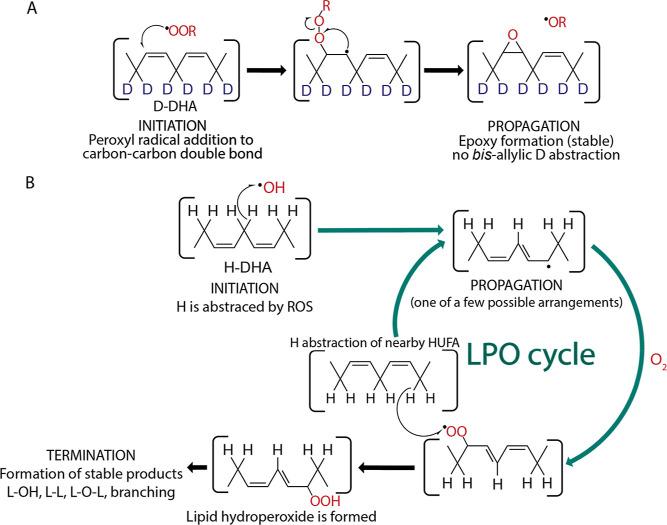
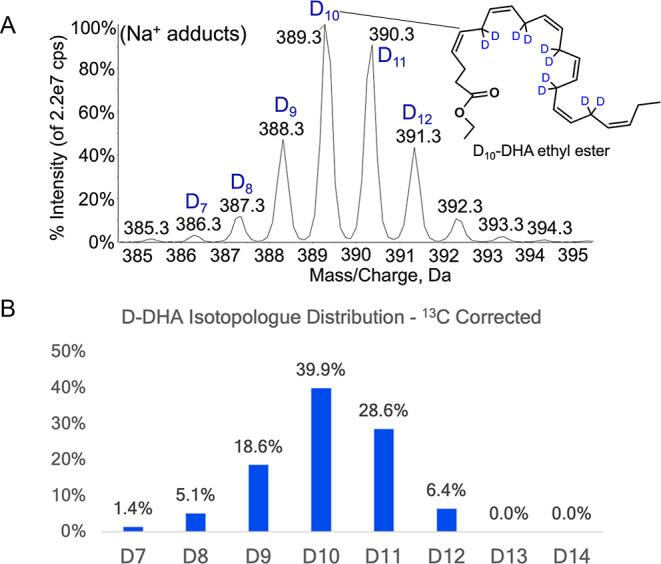
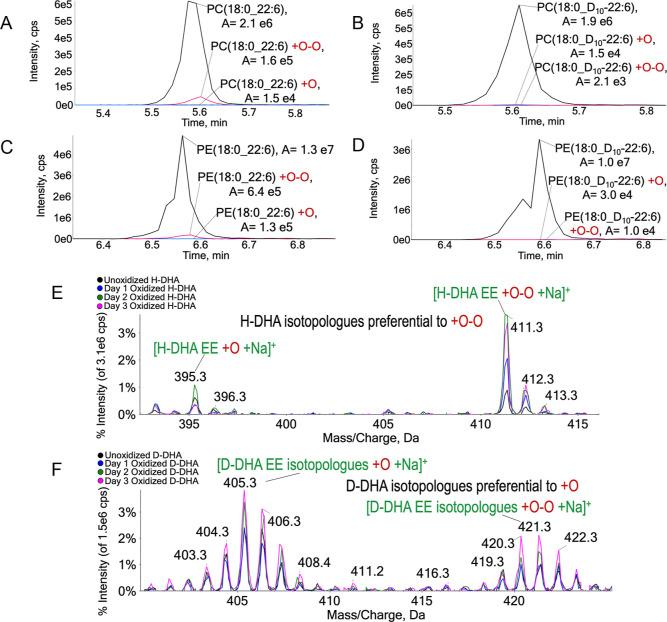
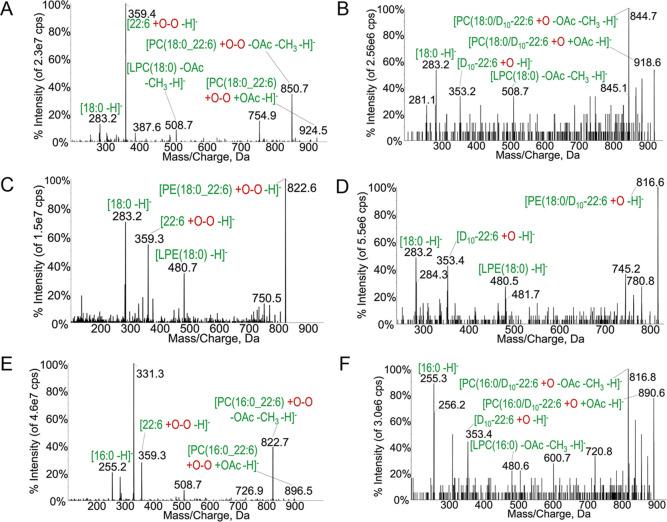
The human central nervous system simultaneously has the most highly unsaturated fatty acids (HUFAs) and the highest metabolic rate among body tissue. Up to 1% of consumed O is converted to reactive oxygen species (ROS) that cause unregulated damage to HUFA-rich membrane phospholipids (PLs). Docosahexaenoic acid (DHA) is the brain's most unsaturated and abundant HUFA. Reinforcing the ROS-labile -allylic positions with deuterium (D-DHA) protects against oxidative damage in vitro and in vivo. We developed an LC-MS/MS method to detect ambient levels of nascent oxidation products of DHA and D-DHA containing PLs in rat brain lipid extracts. Multiple reaction monitoring (MRM)-triggered mass spectra confirmed D-DHA incorporation in D-DHA-fed rat brain PLs. DHA-PL nascent oxidation products add 2 O, consistent with known peroxidation reactions. In contrast, D-DHA oxidation is primarily detected as a single O addition, consistent with epoxidation. D-DHA-PL showed 20%-30% lower overall oxidation compared to DHA-PL. Our data are consistent with a mechanism of action whereby D-DHA blocks excess lipid peroxidation, leading to lower overall membrane damage. D-DHA is a unique therapeutic approach against neurodegenerative diseases where ROS-driven oxidation is implicated.
人类中枢神经系统在身体组织中同时具有最高度不饱和脂肪酸(HUFAs)和最高代谢率。高达1%的消耗氧会转化为活性氧(ROS),对富含HUFA的膜磷脂(PLs)造成不受控制的损伤。二十二碳六烯酸(DHA)是大脑中最不饱和且含量丰富的HUFA。用氘强化对ROS不稳定的烯丙基位置(D-DHA)可在体外和体内防止氧化损伤。我们开发了一种液相色谱-串联质谱(LC-MS/MS)方法,用于检测大鼠脑脂质提取物中含DHA和D-DHA的PLs的新生氧化产物的环境水平。多反应监测(MRM)触发的质谱证实了D-DHA掺入喂食D-DHA的大鼠脑PLs中。DHA-PL新生氧化产物添加2个氧,这与已知的过氧化反应一致。相比之下,D-DHA氧化主要检测为单次氧添加,这与环氧化一致。与DHA-PL相比,D-DHA-PL的总体氧化降低了20%-30%。我们的数据与一种作用机制一致,即D-DHA可阻止过量的脂质过氧化,从而减少总体膜损伤。D-DHA是一种针对涉及ROS驱动氧化的神经退行性疾病的独特治疗方法。

 Zotero 插件