
常染色体显性遗传阿尔茨海默病不同阶段的泛素-蛋白酶体系统
Ubiquitin-proteasome system in the different stages of dominantly inherited Alzheimer's disease.
作者信息
Liu Haiyan, Bui Quoc, Hassenstab Jason, Gordon Brian A, Benzinger Tammie L S, Timsina Jigyasha, Sung Yun Ju, Karch Celeste, Renton Alan E, Daniels Alisha, Morris John C, Xiong Chengjie, Ibanez Laura, Perrin Richard J, Llibre-Guerra Jorge J, Day Gregory S, Supnet-Bell Charlene, Xu Xiong, Berman Sarah B, Chhatwal Jasmeer P, Ikeuchi Takeshi, Kasuga Kensaku, Niimi Yoshiki, Huey Edward D, Schofield Peter R, Brooks William S, Ryan Natalie S, Jucker Mathias, Laske Christoph, Levin Johannes, Vöglein Jonathan, Roh Jee Hoon, Lopera Francisco, Bateman Randall J, Cruchaga Carlos, McDade Eric M
机构信息
Department of Neurology, Washington University in St. Louis, St. Louis, Missouri, USA.
Department of Biostatistics, Washington University in St. Louis, St. Louis, Missouri, USA.
出版信息
Alzheimers Dement. 2025 May;21(5):e70243. doi: 10.1002/alz.70243.
INTRODUCTION
This study investigated the role of the ubiquitin-proteasome system (UPS) in dominantly inherited Alzheimer's disease (DIAD) by examining cerebrospinal fluid (CSF) levels of UPS proteins.
METHOD
The SOMAscan assay was used to detect changes in UPS proteins in mutation carriers (MCs) relative to disease progression; imaging and CSF biomarkers of amyloid, tau, and neurodegeneration measures; and Clinical Dementia Rating scale.
RESULTS
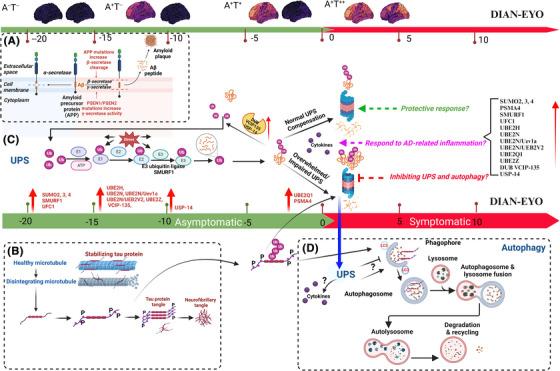
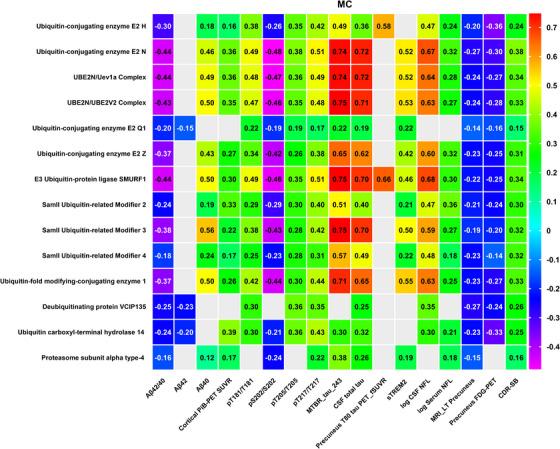
Subtle increases in specific ubiquitin enzymes were detected in MCs up to two decades before symptom onset, with more pronounced elevations in UPS-activating enzymes near symptom onset. Significant correlations were found between UPS proteins and Alzheimer's disease (AD) biomarkers, especially between autophagy markers and late-stage tau biomarkers, microglia, and axonal degeneration.
DISCUSSION
The rise in UPS proteins alongside tau-related markers suggests UPS involvement in tau neurofibrillary tangles. Elevated CSF UPS proteins in DIAD MCs may serve as indicators of disease progression, and may support the UPS as a therapeutic target in AD.
HIGHLIGHTS
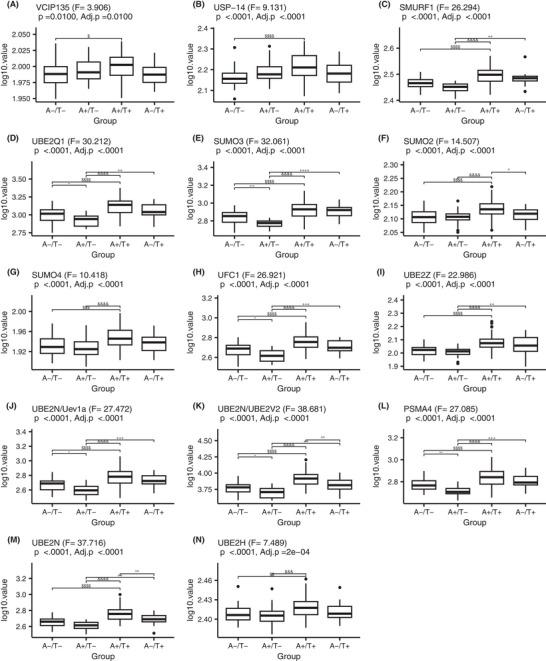
This study investigates the ubiquitin-proteasome system (UPS) in Dominantly Inherited Alzheimer's Disease (DIAD), highlighting early molecular changes linked to disease progression. Using SOMAscan proteomics, we identified significant UPS protein alterations in cerebrospinal fluid of mutation carriers, notably up to 20 years before clinical symptom onset. Correlations between UPS protein levels and Alzheimer's biomarkers, particularly tau and neurodegeneration markers, suggest a strong association between UPS dysregulation and tau pathology in DIAD. Dynamic UPS changes align with A/T biological staging: UPS proteins were shown to increase across Aβ/tau (A/T) groups, with largest increases in the A+/T+ group, reinforcing their role in late-stage tau pathology and disease progression. These findings underscore the potential of UPS proteins as early biomarkers for Alzheimer's disease progression and as novel therapeutic targets, especially in tau-pathology-driven neurodegeneration. This work contributes to understanding AD pathogenesis, by emphasizing the importance of protein quality control systems and by offering avenues for future biomarker discovery and therapeutic development in Alzheimer's disease.
引言
本研究通过检测脑脊液中泛素 - 蛋白酶体系统(UPS)蛋白水平,探讨了泛素 - 蛋白酶体系统在显性遗传阿尔茨海默病(DIAD)中的作用。
方法
采用SOMAscan检测法,以检测突变携带者(MCs)中UPS蛋白相对于疾病进展的变化;淀粉样蛋白、tau蛋白和神经退行性变指标的影像学及脑脊液生物标志物;以及临床痴呆评定量表。
结果
在症状出现前长达二十年的突变携带者中,检测到特定泛素酶有细微增加,在症状出现时,UPS激活酶升高更为明显。发现UPS蛋白与阿尔茨海默病(AD)生物标志物之间存在显著相关性,尤其是自噬标志物与晚期tau生物标志物、小胶质细胞和轴突退行性变之间。
讨论
UPS蛋白与tau相关标志物一同升高,提示UPS参与tau神经原纤维缠结。DIAD突变携带者脑脊液中UPS蛋白升高可能作为疾病进展的指标,并可能支持将UPS作为AD的治疗靶点。
要点
本研究调查了显性遗传阿尔茨海默病(DIAD)中的泛素 - 蛋白酶体系统(UPS),突出了与疾病进展相关的早期分子变化。使用SOMAscan蛋白质组学,我们在突变携带者的脑脊液中鉴定出显著的UPS蛋白改变,特别是在临床症状出现前20年。UPS蛋白水平与阿尔茨海默病生物标志物之间的相关性,尤其是tau蛋白和神经退行性变标志物,表明DIAD中UPS失调与tau病理之间存在密切关联。UPS的动态变化与A/T生物学分期一致:UPS蛋白在Aβ/tau(A/T)组中均有增加,在A + /T +组中增加最大,强化了它们在晚期tau病理和疾病进展中的作用。这些发现强调了UPS蛋白作为阿尔茨海默病进展早期生物标志物和新型治疗靶点的潜力,特别是在tau病理驱动的神经退行性变中。这项工作通过强调蛋白质质量控制系统的重要性,并为阿尔茨海默病未来的生物标志物发现和治疗开发提供途径,有助于理解AD的发病机制。

 Zotero 插件