
约旦医疗保健专业人员对猴痘的准备情况、知识水平和态度:一项横断面调查。
Readiness, knowledge, and attitudes of healthcare professionals in Jordan toward Monkeypox: a cross-sectional survey.
作者信息
Al Meslamani Ahmad Z, Abu-Naser Dania, Al-Rifai Rami H
机构信息
College of Pharmacy, Al Ain University, P.O. Box 112612, Abu Dhabi, United Arab Emirates.
AAU Health and Biomedical Research Center, Al Ain University, P.O. Box 112612, Abu Dhabi, United Arab Emirates.
出版信息
Sci Rep. 2025 May 25;15(1):18178. doi: 10.1038/s41598-025-03051-2.
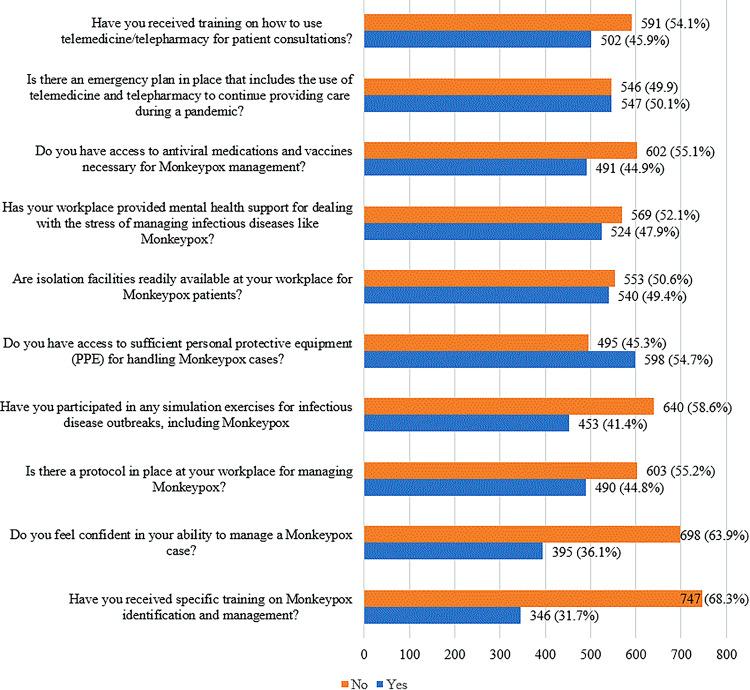
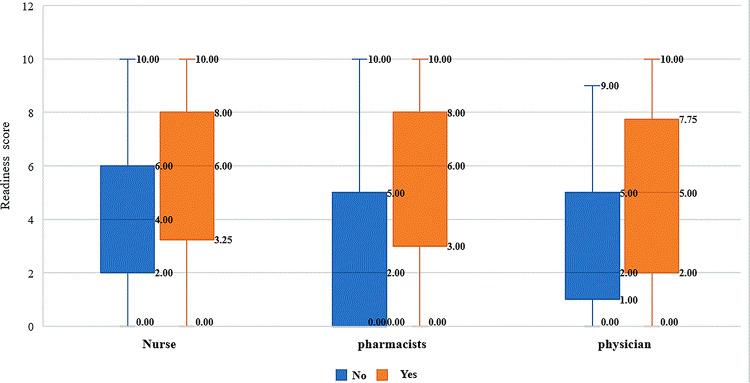
Healthcare professionals play a vital role in managing and containing disease outbreaks. This study evaluated the level of readiness, knowledge, and attitudes of healthcare professionals in Jordan towards Monkeypox (Mpox) disease and explored factors associated with poor level of readiness, poor level of knowledge, and negative attitude toward Mpox. A pre-validated cross-sectional survey was carried out on healthcare professionals (physicians, pharmacists and nurses) actively involved in patient care in Jordan from 15 July to 30 September 2024. After being pilot-tested on 30 healthcare professionals, the 48-item questionnaire, collected information on participant's demographics, and readiness, knowledge, and attitudes towards Mpox. Multivariable logistic regression identified factors associated with poor readiness, poor knowledge, and negative attitude. A total of 1093 healthcare professionals participated in the survey, including 329 physicians (30.1%), 346 pharmacists (31.7%), and 418 nurses (38.2%). Among participants, 58.0% demonstrated high levels of readiness, and 53.9% showed high levels of knowledge regarding Mpox. However, one-third (33.6%) were unaware of the availability of an effective vaccine, and only 30.7% recognized the lack of an effective treatment for Mpox. Nurses had higher readiness scores (median: 5, IQR: 5) compared to physicians (median: 4, IQR: 6) and pharmacists (median: 4, IQR: 6), while physicians scored highest in knowledge (median: 8, IQR: 4), followed by nurses (median: 7, IQR: 4) and pharmacists (median: 5, IQR: 4). No prior pandemic response experience was positively associated with increased likelihood of poor Mpox readiness (AOR: 2.11, 95% CI: 1.60-2.78) and poor knowledge (AOR: 1.40, 95% CI: 1.08-1.81). Poor knowledge was also linked to relying on workshops as the main information source (AOR: 2.55, 95% CI: 1.50-4.32). Negative attitudes were associated with lack of prior response experience (AOR: 1.36, 95% CI: 1.04-1.77), not using digital health records (AOR: 1.56, 95% CI: 1.18-2.05), and depending on colleagues for information (AOR: 1.73, 95% CI: 1.00-3.00) while attending workshop was protective against having negative attitude (AOR: 0.32, 95% CI: 0.17-0.60). While over half of healthcare professionals in Jordan demonstrated high readiness and knowledge regarding Mpox, significant gaps remain, particularly in vaccine and treatment awareness. Nurses showed higher readiness, whereas physicians had better knowledge levels. Targeted training and improved information dissemination strategies are needed to enhance Mpox response capacity among healthcare professionals.
医疗保健专业人员在管理和控制疾病爆发方面发挥着至关重要的作用。本研究评估了约旦医疗保健专业人员对猴痘(Mpox)疾病的准备程度、知识水平和态度,并探讨了与准备程度低、知识水平差以及对猴痘持消极态度相关的因素。于2024年7月15日至9月30日对约旦积极参与患者护理的医疗保健专业人员(医生、药剂师和护士)进行了一项预先验证的横断面调查。在对30名医疗保健专业人员进行预测试后,这份包含48个条目的问卷收集了参与者的人口统计学信息以及对猴痘的准备程度、知识水平和态度。多变量逻辑回归确定了与准备不足、知识匮乏和消极态度相关的因素。共有1093名医疗保健专业人员参与了调查,其中包括329名医生(30.1%)、346名药剂师(31.7%)和418名护士(38.2%)。在参与者中,58.0%表现出较高的准备程度,53.9%对猴痘表现出较高的知识水平。然而,三分之一(33.6%)的人不知道有有效的疫苗,只有30.7%的人认识到猴痘缺乏有效的治疗方法。与医生(中位数:4,四分位间距:6)和药剂师(中位数:4,四分位间距:6)相比,护士的准备程度得分更高(中位数:5,四分位间距:5),而医生的知识得分最高(中位数:8,四分位间距:4),其次是护士(中位数:7,四分位间距:4)和药剂师(中位数:5,四分位间距:4)。没有先前的大流行应对经验与猴痘准备不足(调整后比值比:2.11,95%置信区间:1.60 - 2.78)和知识匮乏(调整后比值比:1.40,95%置信区间:1.08 - 1.81)的可能性增加呈正相关。知识匮乏还与依赖研讨会作为主要信息来源有关(调整后比值比:2.55,95%置信区间:1.50 - 4.32)。消极态度与缺乏先前的应对经验(调整后比值比:1.36,95%置信区间:1.04 - 1.77)、不使用数字健康记录(调整后比值比:1.56,95%置信区间:1.18 - 2.05)以及在参加研讨会时依赖同事获取信息(调整后比值比:1.73,95%置信区间:1.00 - 3.00)相关,而参加研讨会对消极态度有保护作用(调整后比值比:0.32,95%置信区间:0.17 - 0.60)。虽然约旦超过一半的医疗保健专业人员对猴痘表现出较高的准备程度和知识水平,但仍存在显著差距,特别是在疫苗和治疗认知方面。护士表现出较高的准备程度,而医生的知识水平更好。需要有针对性的培训和改进信息传播策略,以提高医疗保健专业人员应对猴痘的能力。

 Zotero 插件