
瑞典人群的进食时间模式及其与社会人口学变量和营养摄入的关联:一项横断面研究。
Temporal meal patterns in the Swedish population and associations with socio-demographic variables and nutrient intakes: a cross-sectional study.
作者信息
Schultz Jenny, Moraeus Lotta, Lindroos Anna Karin, Warensjö Lemming Eva
机构信息
Department of Food studies, Nutrition and Dietetics, Uppsala University, Uppsala, Sweden.
Division for Risk and Benefit Assessment, Swedish Food Agency, Uppsala, Sweden.
出版信息
Br J Nutr. 2025 May 28;133(10):1363-1373. doi: 10.1017/S0007114525103462. Epub 2025 May 26.
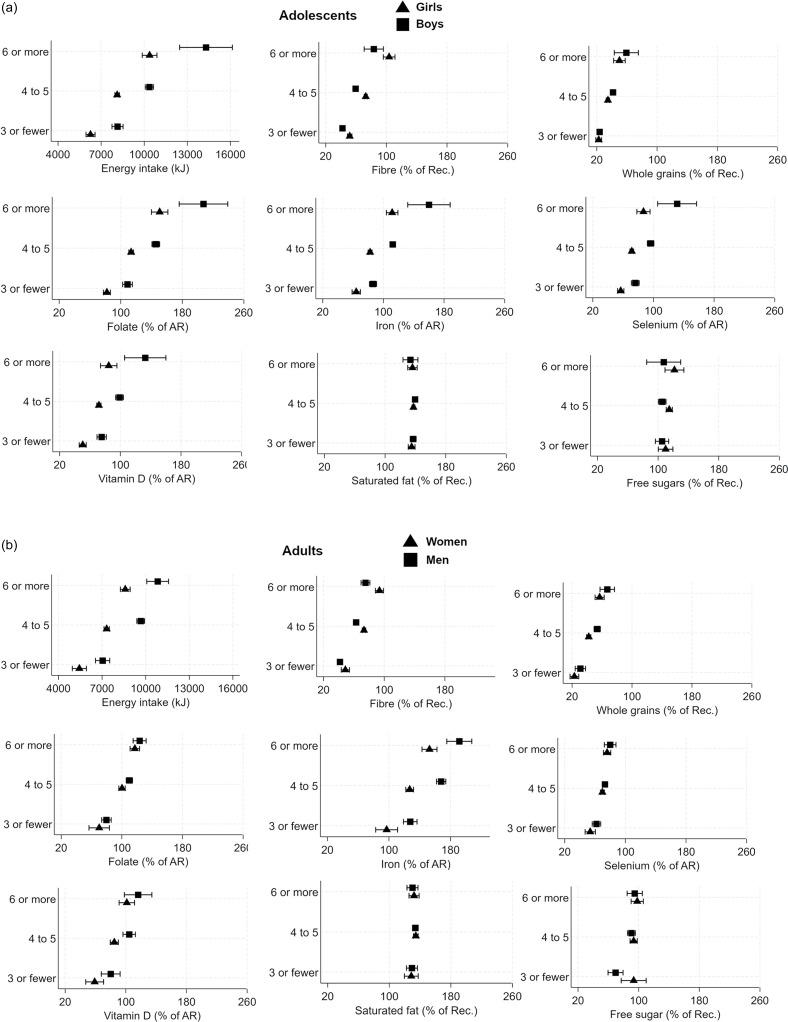
Timing of food intake seems to impact metabolism and circadian rhythms, and eating in synchronisation with the rhythms has been suggested to be favourable for health. This study aims to evaluate temporal meal patterns in the Swedish population and explore differences between population groups. Further, to investigate whether temporal meal patterns are associated with energy and nutrient intake, data were sourced from two national dietary surveys Riksmaten Adolescents 2016-2017 and Riksmaten Adults 2010-2011, with a total of 4763 participants. Food intake and temporal meal patterns were measured with 3- to 4-day food diaries and/or 24-hour recalls. The average meal frequency was 4·2 eating occasions (sd 0·9) per day for adolescents with an eating window of 11·9 h (sd 1·7). For adults, it was 4·6 (sd 1·1) eating occasions and an eating window of 12·0 h (sd 1·9) Meal frequency was positively associated with energy intake in both adolescents ( = 0·47) and adults ( = 0·51). Meal frequency was higher with age, and adolescents skipped breakfast more often, and had a later energy distribution than adults. A higher eating frequency and eating breakfast are associated with a higher absolute intake of whole grains, as well as Vitamin D and folate. A higher eating frequency makes it more likely to reach nutrient requirements. However, a higher eating frequency was also associated with a higher intake of free sugars. The findings can serve as reference data for temporal meal patterns in the Swedish context and also show differences within a population, which can be valuable insights for public health nutrition.
食物摄入的时间似乎会影响新陈代谢和昼夜节律,有人认为与这些节律同步进食对健康有益。本研究旨在评估瑞典人群的进餐时间模式,并探讨不同人群组之间的差异。此外,为了调查进餐时间模式是否与能量和营养摄入有关,数据来源于两项全国性饮食调查——2016 - 2017年瑞典青少年饮食调查和2010 - 2011年瑞典成年人饮食调查,共有4763名参与者。通过3至4天的食物日记和/或24小时回顾法来测量食物摄入量和进餐时间模式。青少年平均每天进餐频率为4.2次(标准差0.9),进食窗口为11.9小时(标准差1.7)。成年人的进餐频率为4.6次(标准差1.1),进食窗口为12.0小时(标准差1.9)。进餐频率在青少年(r = 0.47)和成年人(r = 0.51)中均与能量摄入呈正相关。进餐频率随年龄增长而增加,青少年比成年人更常不吃早餐,且能量分配时间更晚。较高的进餐频率和吃早餐与全谷物、维生素D和叶酸的绝对摄入量较高有关。较高的进餐频率更有可能满足营养需求。然而,较高的进餐频率也与游离糖摄入量较高有关。这些研究结果可为瑞典背景下的进餐时间模式提供参考数据,同时也显示了人群内部的差异,这对公共卫生营养具有重要的参考价值。

 Zotero 插件