
川芎嗪纳米药物递送系统通过压电型机械敏感离子通道蛋白1-抑制素2介导的线粒体质量监测减轻阿霉素介导的心肌损伤。
Ligustrazine nano-drug delivery system ameliorates doxorubicin-mediated myocardial injury via piezo-type mechanosensitive ion channel component 1-prohibitin 2-mediated mitochondrial quality surveillance.
作者信息
Wang Junyan, Zhuang Haowen, Li Chun, Cai Ruiqi, Shi Hongshuo, Pang Boxian, Guo Zhijiang, Ong Sang-Bing, Nie Yifeng, Du Yingzhen, Zhou Hao, Chang Xing
机构信息
State Key Laboratory of Traditional Chinese Medicine Syndrome, School of Pharmaceutical Sciences, Guangzhou University of Chinese Medicine, Guangzhou, 510006, Guangdong, China.
Liaoning University of Traditional Chinese Medicine, Shenyang, 110032, Liaoning, China.
出版信息
J Nanobiotechnology. 2025 May 27;23(1):383. doi: 10.1186/s12951-025-03420-z.
BACKGROUND
Doxorubicin (DOX) demonstrates significant therapeutic and anticancer efficacy. Nevertheless, it demonstrates significant cardiotoxicity, resulting in permanent cardiac damage. Ligustrazine (LIG) is a bioactive alkaloid derived from the rhizome of the medicinal plant Ligusticum chuanxiong Hort. The alkaloid has exhibited cardioprotective properties. The therapeutic application of LIG is constrained by inadequate water solubility, fast breakdown, and low bioavailability. Nanoparticle drug delivery technologies effectively address these constraints by encapsulating LIG into nanocarriers, significantly enhancing its solubility and bioavailability, hence maximizing its therapeutic efficacy. Consequently, this study employed tetrahedral backbone nucleic acid molecules as LIG carriers. Furthermore, animal models and single-cell sequencing analyses were employed to forecast the mechanisms and targets of pertinent studies. A mouse model genetically modified for the piezo type mechanosensitive ion channel component 1 (PIEZO1), transmembrane BAX inhibitor motif containing 6 (TMBIM6), and prohibitin 2 (PHB2), along with an in vivo and in vitro model of DOX-induced cardiomyopathy (DIC), was established, and a gene-modified cellular system comprising upstream genes and downstream effector targets was constructed. The mechanism of LIG was validated by molecular biology and integrated pharmacology with the implementation of the LIG nano-drug loading method.
RESULTS
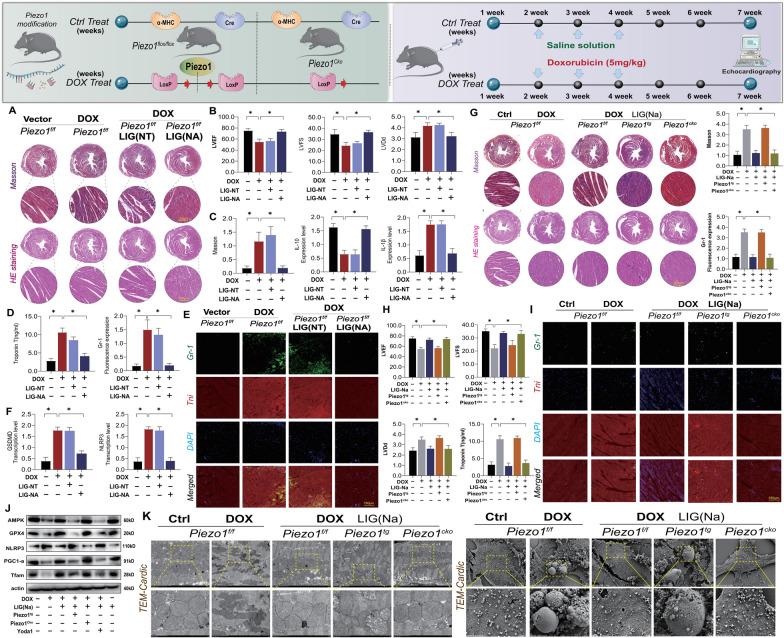
LIG nano-delivery enhanced DOX-induced cardiac dysfunction and mitochondrial impairment by modulating the PHB2Ser91/Ser176 phosphorylation axis through PIEZO1-TMBIM6, and significantly suppressed cardiomyocyte pyroptosis resulting from mitochondrial homeostasis dysregulation. The findings indicate that LIG nano-delivery is a promising therapeutic approach for addressing DIC.
CONCLUSION
The PHB2Ser91/Ser176 phosphorylation axis regulated by PIEZO1-TMBIM6 is an important target for LIG nano-drug delivery systems to improve mitochondrial damage in DIC.
背景
阿霉素(DOX)具有显著的治疗和抗癌功效。然而,它也表现出显著的心脏毒性,会导致永久性心脏损伤。川芎嗪(LIG)是一种从药用植物川芎的根茎中提取的生物活性生物碱。该生物碱已显示出心脏保护特性。LIG的治疗应用受到水溶性不足、快速分解和低生物利用度的限制。纳米颗粒药物递送技术通过将LIG封装到纳米载体中有效解决了这些限制,显著提高了其溶解度和生物利用度,从而最大化其治疗效果。因此,本研究采用四面体骨架核酸分子作为LIG载体。此外,还利用动物模型和单细胞测序分析来预测相关研究的机制和靶点。建立了一种针对压电型机械敏感离子通道成分1(PIEZO1)、含跨膜BAX抑制基序6(TMBIM6)和抑制素2(PHB2)进行基因改造的小鼠模型,以及DOX诱导的心肌病(DIC)的体内和体外模型,并构建了一个包含上游基因和下游效应靶点的基因改造细胞系统。通过分子生物学和整合药理学,采用LIG纳米载药方法验证了LIG的作用机制。
结果
LIG纳米递送通过PIEZO1 - TMBIM6调节PHB2Ser91/Ser176磷酸化轴,增强了DOX诱导的心脏功能障碍和线粒体损伤,并显著抑制了线粒体稳态失调导致的心肌细胞焦亡。研究结果表明,LIG纳米递送是一种有前景的治疗DIC的方法。
结论
PIEZO1 - TMBIM6调节的PHB2Ser91/Ser176磷酸化轴是LIG纳米药物递送系统改善DIC中线粒体损伤的重要靶点。


 Zotero 插件