
用于生物膜控制的精油:抗菌耐药时代的作用机制、协同作用及转化挑战
Essential Oils for Biofilm Control: Mechanisms, Synergies, and Translational Challenges in the Era of Antimicrobial Resistance.
作者信息
Touati Abdelaziz, Mairi Assia, Ibrahim Nasir Adam, Idres Takfarinas
机构信息
Laboratoire d'Ecologie Microbienne, Université de Bejaia, FSNV, Bejaia 06000, Algeria.
Department of Biology, College of Science, Imam Mohammad Ibn Saud Islamic University (IMSIU), Riyadh 13318, Saudi Arabia.
出版信息
Antibiotics (Basel). 2025 May 13;14(5):503. doi: 10.3390/antibiotics14050503.
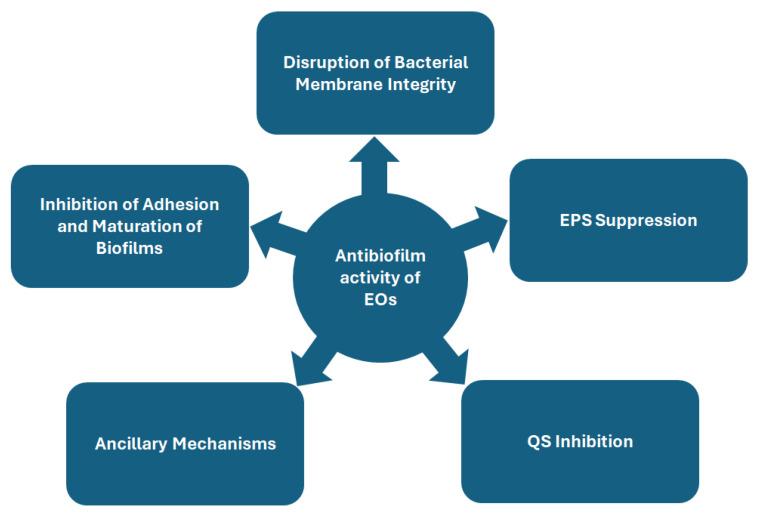
Biofilms, structured microbial consortia embedded in self-produced extracellular matrices, pose significant challenges across the medical, industrial, and environmental sectors due to their resistance to antimicrobial therapies and ability to evade the immune system. Their resilience is driven by multifaceted mechanisms, including matrix-mediated drug sequestration, metabolic dormancy, and quorum sensing (QS)-regulated virulence, which collectively sustain persistent infections and contribute to the amplification of antimicrobial resistance (AMR). This review critically examines the potential of plant-derived essential oils (EOs) as innovative agents for biofilm control. EOs exhibit broad-spectrum antibiofilm activity through multi-target mechanisms, including disrupting initial microbial adhesion, degrading extracellular polymeric substances (EPSs), suppressing QS pathways, and compromising membrane integrity. Their ability to act synergistically with conventional antimicrobials at sub-inhibitory concentrations enhances therapeutic efficacy while reducing the selection pressure for resistance. Despite their potential, EO applications face technical challenges, such as compositional variability due to botanical sources, formulation stability issues, and difficulties in standardization for large-scale production. Clinical translation is further complicated by biofilm stage- and strain-dependent efficacy, insufficient in vivo validation of therapeutic outcomes, and potential cytotoxicity at higher doses. These limitations underscore the need for optimized delivery systems, such as nanoencapsulation, to enhance bioavailability and mitigate adverse effects. Future strategies should include combinatorial approaches with antibiotics or EPS-degrading enzymes, advanced formulation technologies, and standardized protocols to bridge laboratory findings to clinical practice. By addressing these challenges, EOs hold transformative potential to mitigate biofilm-associated AMR, offering sustainable, multi-target alternatives for infection management and biofilm prevention in diverse contexts.
生物膜是嵌入自身产生的细胞外基质中的结构化微生物群落,由于其对抗菌疗法的抗性以及逃避免疫系统的能力,在医学、工业和环境领域都构成了重大挑战。它们的恢复力由多方面机制驱动,包括基质介导的药物隔离、代谢休眠以及群体感应(QS)调节的毒力,这些机制共同维持持续性感染并促进抗菌药物耐药性(AMR)的扩散。本综述批判性地研究了植物源精油(EOs)作为生物膜控制创新剂的潜力。精油通过多靶点机制表现出广谱抗生物膜活性,包括破坏初始微生物粘附、降解细胞外聚合物(EPSs)、抑制QS途径以及破坏膜完整性。它们在亚抑制浓度下与传统抗菌药物协同作用的能力提高了治疗效果,同时降低了耐药性的选择压力。尽管具有潜力,但精油的应用面临技术挑战,例如由于植物来源导致的成分变异性、制剂稳定性问题以及大规模生产标准化困难。生物膜阶段和菌株依赖性疗效、治疗结果体内验证不足以及高剂量下潜在的细胞毒性使临床转化更加复杂。这些限制强调了需要优化的递送系统,如纳米封装,以提高生物利用度并减轻不良反应。未来的策略应包括与抗生素或EPS降解酶的联合方法、先进的制剂技术以及将实验室研究结果与临床实践联系起来的标准化方案。通过应对这些挑战,精油具有减轻生物膜相关AMR的变革潜力,为不同环境下的感染管理和生物膜预防提供可持续的、多靶点替代方案。
 Zotero 插件