
癌症中的ADAM蛋白酶:生物学作用、治疗挑战及新出现的机遇
ADAM Proteases in Cancer: Biological Roles, Therapeutic Challenges, and Emerging Opportunities.
作者信息
Arora Sakshi, Scott Andrew M, Janes Peter W
机构信息
Tumour Targeting Laboratory, Olivia Newton-John Cancer Research Institute, Melbourne, VIC 3084, Australia.
School of Cancer Medicine, Latrobe University, Melbourne, VIC 3083, Australia.
出版信息
Cancers (Basel). 2025 May 19;17(10):1703. doi: 10.3390/cancers17101703.
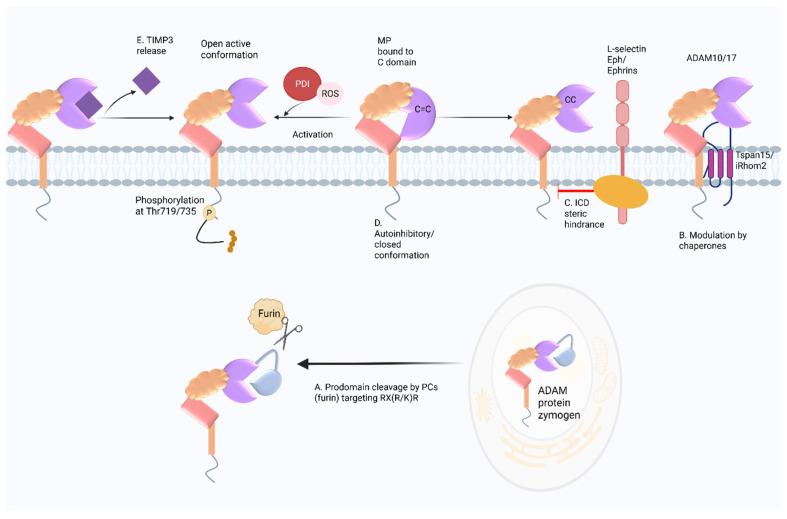
ADAM (A Disintegrin and Metalloproteinase) family members are multifunctional transmembrane proteases that govern tumorigenesis and metastasis by cleaving membrane-bound substrates such as growth factors, cytokines, and cell adhesion molecules. Several ADAMs, including ADAM8, ADAM9, ADAM10, ADAM12, and ADAM17, are overexpressed in malignancies and are linked with a poor prognosis. These proteases contribute to tumour growth by regulating cell proliferation, cell fate, invasion, angiogenesis, and immune evasion. ADAM10 and ADAM17, especially, facilitate the shedding of critical developmental and growth factors and their receptors, as well as immuno-regulatory molecules, hence promoting tumour progression, immune escape, and resistance to therapy. Recent work has unveiled multiple regulatory pathways that modulate ADAM functions, which include trafficking, dimerization, and conformational modifications that affect substrate accessibility. These observations have rekindled efforts to produce selective ADAM inhibitors, avoiding the off-target consequences reported with early small molecule inhibitors targeting the enzyme active site, which is conserved also in matrix metalloproteinases (MMPs). Promising approaches tested in preclinical models and, in some cases, clinical settings include more selective small-molecule inhibitors, monoclonal antibodies, and antibody-drug conjugates designed to specifically target ADAMs. In this review, we will discuss the emerging roles of ADAMs in cancer biology, as well as the molecular processes that control their function. We further discuss the therapeutic potential of targeting ADAMs, with a focus on recent advances and future directions in the development of ADAM-specific cancer therapies.
ADAM(一种解聚素和金属蛋白酶)家族成员是多功能跨膜蛋白酶,通过切割膜结合底物(如生长因子、细胞因子和细胞粘附分子)来调控肿瘤发生和转移。包括ADAM8、ADAM9、ADAM10、ADAM12和ADAM17在内的几种ADAM在恶性肿瘤中过表达,并与不良预后相关。这些蛋白酶通过调节细胞增殖、细胞命运、侵袭、血管生成和免疫逃逸来促进肿瘤生长。特别是ADAM10和ADAM17,它们促进关键发育和生长因子及其受体以及免疫调节分子的脱落,从而促进肿瘤进展、免疫逃逸和对治疗的抵抗。最近的研究揭示了多种调节ADAM功能的途径,包括影响底物可及性的运输、二聚化和构象修饰。这些发现重新激发了人们开发选择性ADAM抑制剂的努力,避免了早期针对酶活性位点的小分子抑制剂所报道的脱靶效应,这种活性位点在基质金属蛋白酶(MMP)中也保守。在临床前模型以及某些情况下在临床环境中测试的有前景的方法包括更具选择性的小分子抑制剂、单克隆抗体和设计用于特异性靶向ADAM的抗体药物偶联物。在这篇综述中,我们将讨论ADAM在癌症生物学中的新作用,以及控制其功能的分子过程。我们还将讨论靶向ADAM的治疗潜力,重点关注ADAM特异性癌症治疗开发的最新进展和未来方向。

 Zotero 插件