
亚洲水牛蛭抗菌肽Macins的遗传变异与基因表达() 。 (你提供的原文括号部分不完整,请检查补充完整后以便更准确理解和翻译)
Genetic Variation and Gene Expression of the Antimicrobial Peptide Macins in Asian Buffalo Leech ().
作者信息
Yu Yunfei, Tang Lizhou, Xiao Mingkang, Yin Jingjing, Ye Tianyu, Sun Rujiao, Ai Rui, Zhao Fang, Huang Zuhao, Lin Gonghua
机构信息
School of Life Sciences, Jinggangshan University, Ji'an 343009, China.
School of Life Sciences, Jiangxi Normal University, Nanchang 330022, China.
出版信息
Biology (Basel). 2025 May 8;14(5):517. doi: 10.3390/biology14050517.
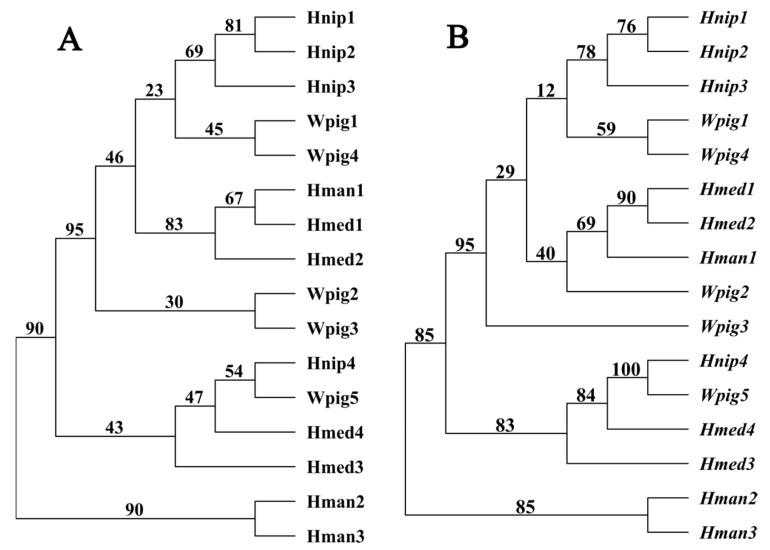
With the growing severity of antibiotic resistance, antimicrobial peptides demonstrate significant potential for medical applications. Here, we performed genome and transcriptome sequencing of 30 Asian buffalo leech () individuals and integrated data from three other leech species (, , and ) to investigate genetic variation and gene expression of macins. Three macins (Hman1, Hman2, and Hman3), along with their encoding genes (, , and ), were identified in . Hman1 exhibited the highest similarity (63.5 ± 12.0%) to macins from other leeches, followed by Hman2 (57.8 ± 7.4%) and Hman3 (30.0 ± 3.5%). Both amino acid and codon sequences of Hman1 were conserved within the species, whereas Hman2 and Hman3 exhibited markedly higher variability. All sequences were translatable, while four and 28 sequences had degenerated into pseudogenes. Transcripts per million (TPM) values for , , and were 2196.63, 242.35, and 1.22, respectively. Total macin expression in was less than 1/20 of that in . Based on sequence variation and expression patterns, we propose that Hman1 retains functionality while Hman2 and Hman3 have lost or are losing their antibacterial functions.
随着抗生素耐药性日益严重,抗菌肽在医学应用中显示出巨大潜力。在此,我们对30只亚洲水牛蛭()个体进行了基因组和转录组测序,并整合了来自其他三种水蛭物种(、和)的数据,以研究水蛭抗菌肽(macins)的遗传变异和基因表达。在中鉴定出了三种水蛭抗菌肽(Hman1、Hman2和Hman3)及其编码基因(、和)。Hman1与其他水蛭的水蛭抗菌肽相似度最高(63.5 ± 12.0%),其次是Hman2(57.8 ± 7.4%)和Hman3(30.0 ± 3.5%)。Hman1的氨基酸和密码子序列在物种内保守,而Hman2和Hman3的变异性明显更高。所有序列均可翻译,而四个和28个序列已退化为假基因。、和的每百万转录本(TPM)值分别为2196.63、242.35和1.22。中的水蛭抗菌肽总表达量不到中的1/20。基于序列变异和表达模式,我们提出Hman1保留了功能,而Hman2和Hman3已经或正在失去其抗菌功能。



 Zotero 插件