
胸腺炎症:组成性激活的炎症网络和胸腺中“异位”细胞类型在诱导T细胞耐受性及其他方面的作用。
Thymflammation: The Role of a Constitutively Active Inflammatory Network and "Ectopic" Cell Types in the Thymus in the Induction of T Cell Tolerance and Beyond.
作者信息
Kreslavsky Taras
机构信息
Division of Immunology and Respiratory Medicine, Department of Medicine Solna, Karolinska Institutet, Karolinska University Hospital, Stockholm, Sweden.
Center for Molecular Medicine, Karolinska University Hospital, Stockholm, Sweden.
出版信息
Immunol Rev. 2025 Jul;332(1):e70037. doi: 10.1111/imr.70037.
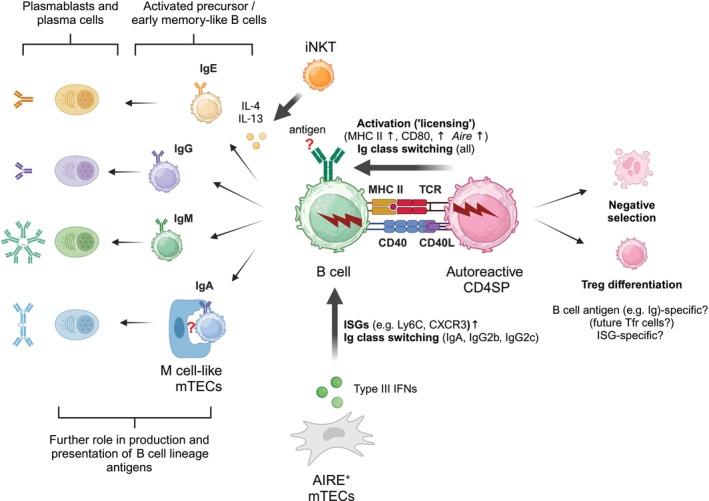
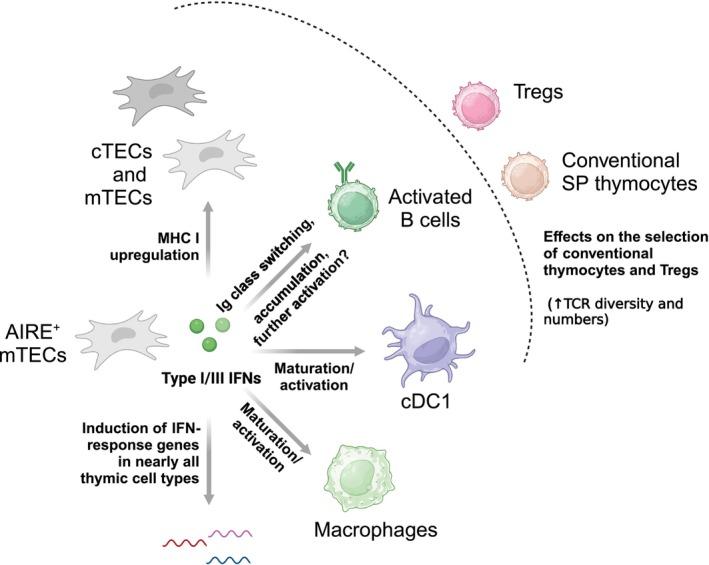
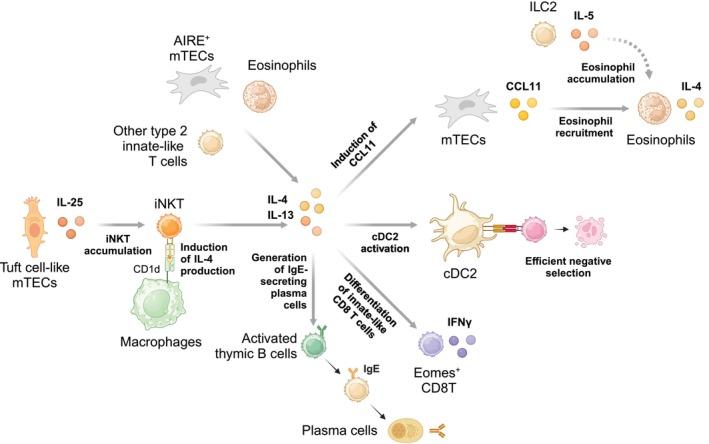
The thymus exhibits constitutive activation of nearly all major inflammatory pathways, including sterile MyD88-dependent signaling and interferon production by mTECs, the presence of cellular and molecular components of type 1, type 2, and type 3 responses, as well as sustained B cell activation. The reasons for the existence of such a complex constitutively active inflammatory network at the site of T cell development-where the initial pathogen encounter is unlikely-have remained enigmatic. We propose that this inflammatory thymic 'ecosystem' has evolved to promote immunological tolerance to 'inflammatory self'-endogenous molecules absent from most peripheral tissues at steady state but upregulated during pathogen invasion. The spatial and temporal overlap with pathogen presence makes the discrimination of the inflammatory self from pathogen-derived molecules a unique challenge for the adaptive immune system. The frequent occurrence of diseases associated with autoantibodies against proinflammatory cytokines underscores the persistent risk of these molecules being misidentified as foreign. Their abundant representation in the thymus, therefore, is likely to be critical for maintaining tolerance. This review explores current insights into the thymic inflammatory network, its cellular and molecular constituents, and their role in the induction of T cell tolerance.
胸腺几乎对所有主要炎症通路都呈现组成性激活,包括无菌性MyD88依赖性信号传导以及mTECs产生干扰素,存在1型、2型和3型反应的细胞和分子成分,以及持续的B细胞激活。在不太可能首次接触病原体的T细胞发育部位存在如此复杂的组成性激活炎症网络的原因一直成谜。我们提出,这种炎症性胸腺“生态系统”已经进化,以促进对“炎症性自身”——即在稳态下大多数外周组织中不存在但在病原体入侵期间上调的内源性分子——的免疫耐受。与病原体存在的时空重叠使得适应性免疫系统难以区分炎症性自身和病原体衍生分子。与抗促炎细胞因子自身抗体相关疾病的频繁发生凸显了这些分子被误识别为外来分子的持续风险。因此,它们在胸腺中的大量存在可能对维持耐受性至关重要。本综述探讨了目前对胸腺炎症网络、其细胞和分子成分及其在诱导T细胞耐受性中的作用的见解。
 Zotero 插件