
蛋白质冠层和光调制对光活化银纳米颗粒抗菌活性的影响
Impact of protein corona and light modulation on the antibacterial activity of light-activated silver nanoparticles.
作者信息
Godakhindi Varsha, Nur Anjumana Jannati, Munir Mariya, Vivero-Escoto Juan L
机构信息
Department of Chemistry, University of North Carolina at Charlotte, Charlotte, NC 28223, USA.
Nanoscale Science Program, University of North Carolina at Charlotte, Charlotte, NC 28223, USA.
出版信息
J Mater Chem B. 2025 May 29. doi: 10.1039/d5tb00081e.
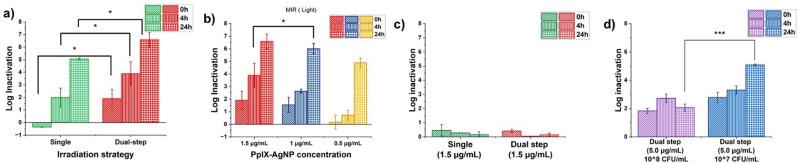
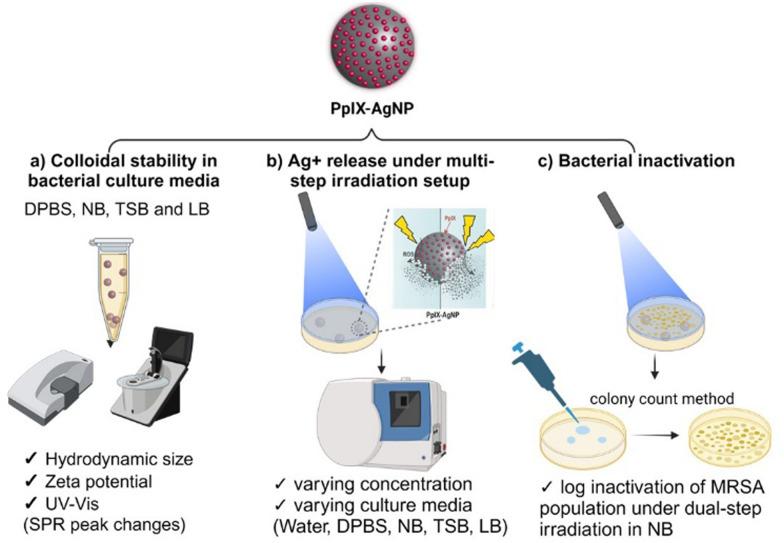
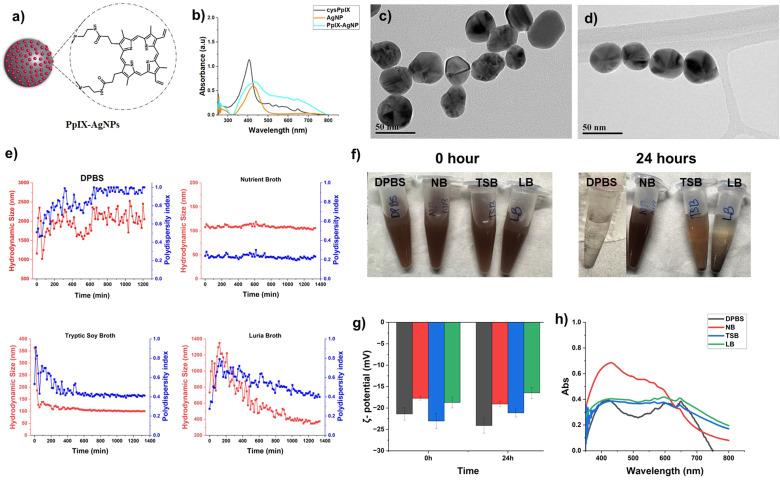
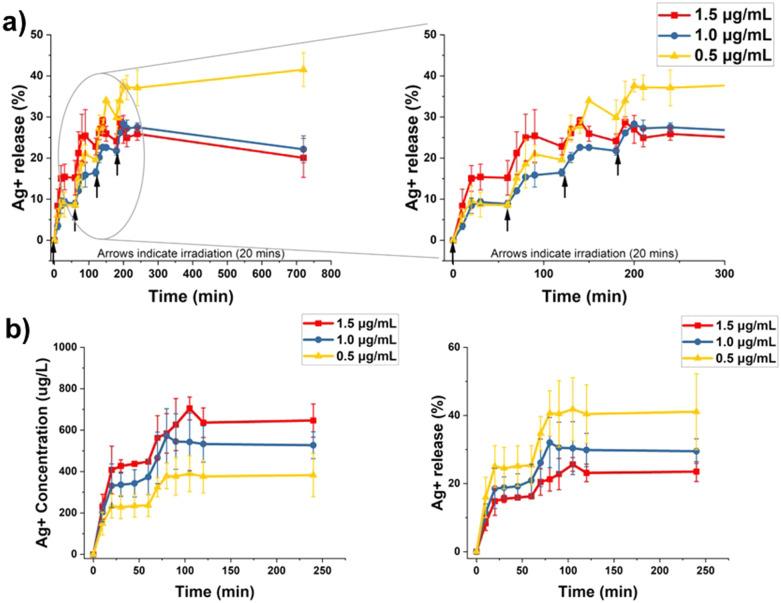
Silver nanoparticles (AgNPs) as antimicrobial agents have gained extensive popularity due to their broad-spectrum action. Recently, AgNPs have been combined with photosensitizers (PS) to develop a synergistic antimicrobial effect. This synergy is associated with the light-activated increase in the release of Ag, which drives the antibacterial mechanism against antibiotic-resistant bacteria (ARB). A factor typically not considered in the performance of AgNPs is the environmental conditions, such as salt and protein content, that significantly impact their bactericidal effect. In this work, we used protoporphyrin IX (PpIX) as a PS to synthesize PpIX-AgNPs. We elucidated the critical role of environmental conditions on the colloidal stability of PpIX-AgNPs in different bacterial culture media. We also determined the impact of the culture media on the light-activated release kinetics of Ag. We found that cell media with lower protein and higher salt content drive the colloidal stability and release kinetics of Ag from AgNPs. Furthermore, we have shown that the multiple-irradiation approach of this light-controlled platform maximizes the release of Ag and promotes effective antibacterial action. We successfully tested this multiple-irradiation strategy in methicillin-resistant (MRSA) demonstrating ∼7-log-unit reduction at 1.5 μg mL of PpIX-AgNP. A 6-log-unit MRSA inhibition was achieved in the nutrient broth (NB) media under the same irradiation strategy. We envision that this light-activated PpIX-AgNPs system can overcome major issues with the elimination of ARB and reduce side effects.
银纳米颗粒(AgNPs)作为抗菌剂因其广谱作用而广受欢迎。最近,AgNPs已与光敏剂(PS)结合以产生协同抗菌效果。这种协同作用与光激活导致的银释放增加有关,这推动了针对耐抗生素细菌(ARB)的抗菌机制。在评估AgNPs性能时通常未考虑的一个因素是环境条件,例如盐和蛋白质含量,它们会显著影响其杀菌效果。在这项工作中,我们使用原卟啉IX(PpIX)作为PS来合成PpIX-AgNPs。我们阐明了环境条件对PpIX-AgNPs在不同细菌培养基中胶体稳定性的关键作用。我们还确定了培养基对银的光激活释放动力学的影响。我们发现蛋白质含量较低且盐含量较高的细胞培养基会影响AgNPs中银的胶体稳定性和释放动力学。此外,我们已经表明,这个光控平台的多次照射方法可使银的释放最大化并促进有效的抗菌作用。我们在耐甲氧西林金黄色葡萄球菌(MRSA)中成功测试了这种多次照射策略,在1.5μg/mL的PpIX-AgNP浓度下显示出约7个对数单位的减少。在相同的照射策略下,在营养肉汤(NB)培养基中实现了6个对数单位的MRSA抑制。我们设想这种光激活的PpIX-AgNPs系统可以克服消除ARB的主要问题并减少副作用。

 Zotero 插件