
阿来替尼治疗转移性ALK阳性非小细胞肺癌中的寡残留疾病
Oligo-residual disease in metastatic ALK-positive NSCLC treated with alectinib.
作者信息
Yang Xi, Chu Xiao, Ye Ruiting, Ni Jianjiao, Zeng Ya, Zhou Yue, Xia Qing, Wang Shengping, Li Qiao, Liu Shuai, Zhu Zhengfei, Chu Li
机构信息
Department of Radiation Oncology, Fudan University Shanghai Cancer Center, 270 Dong An Road, Shanghai, 200032, China.
Department of Oncology, Shanghai Medical College, Fudan University, Shanghai, 200032, China.
出版信息
Clin Exp Metastasis. 2025 May 29;42(4):31. doi: 10.1007/s10585-025-10351-4.
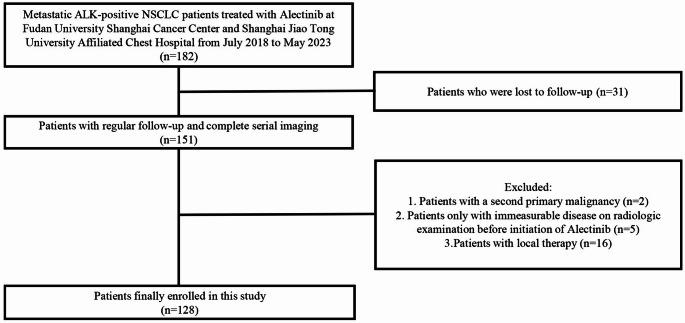
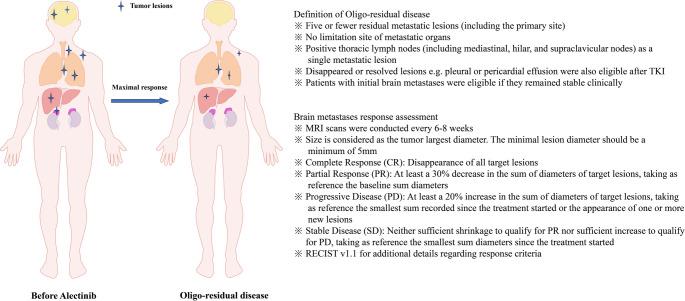
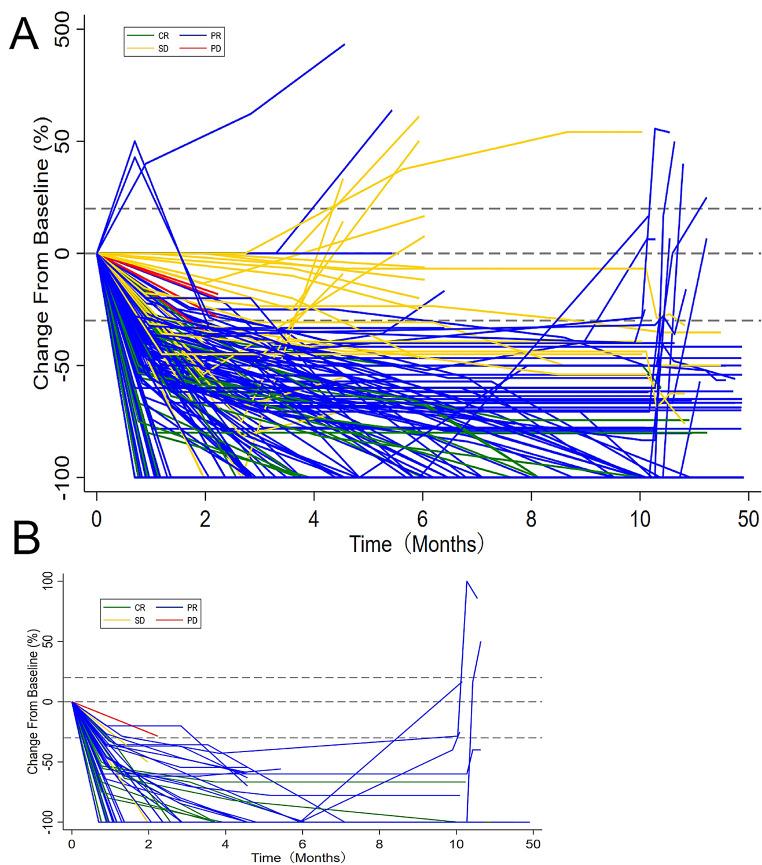
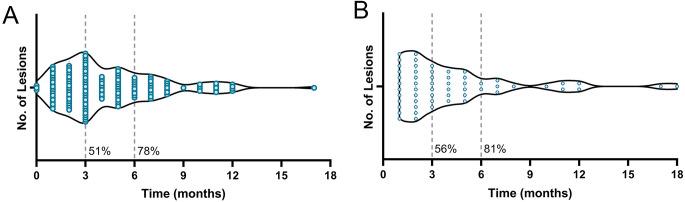
Accumulating evidence suggests local consolidative therapy may delay resistance and benefit metastatic NSCLC patients with oligo-residual disease (ORD) after effective systemic therapy. However, the incidence and clinical features of ORD in Alectinib-treated metastatic ALK-positive NSCLC remain unclear. We retrospectively reviewed serial scans of metastatic ALK-positive NSCLC patients treated with Alectinib. ORD was defined as the presence of five or fewer residual metastatic lesions (including the primary site) among those developed partial response as the best response after Alectinib treatment. Initial patterns of recurrence were classified as involving only residual-site recurrence (RR), only new-site recurrence (NR), or a combination of both (RNR). Among 128 patients, 62 patients had PR as the best response, among whom 18 (29.0%) had ORD. The median time to tumor volume nadir was 4.9 (range, 1.1-19.2) months and no independent predictor of ORD was found. To date, 50.0% (9/18) patients with ORD developed their initial progressive disease (PD), mostly (5, 55.6%) with only residual sites. Among the 9 PD patients, 6 patients (6/9, 66.7%) with brain lesions at baseline. Half (3/6, 50.0%) were involved in only brain residual sites. Our study found ORD is not rare in Alectinib treated ALK-positive NSCLC, with 55.6% having initial PD at originally involved sites. Similar recurrence pattern is also observed in PD patients with baseline BMs. These findings indicate that residual disease may enable the emergence of acquired resistance in both CNS and other organs, thus supporting potential clinical benefits for LCT in these ORD patients. Clinical trial number Not applicable.
越来越多的证据表明,局部巩固治疗可能会延迟耐药,并使有效的全身治疗后患有寡残留疾病(ORD)的转移性非小细胞肺癌(NSCLC)患者受益。然而,阿来替尼治疗的转移性ALK阳性NSCLC中ORD的发生率和临床特征仍不清楚。我们回顾性分析了接受阿来替尼治疗的转移性ALK阳性NSCLC患者的系列扫描结果。ORD被定义为在阿来替尼治疗后出现部分缓解作为最佳反应的患者中,残留转移病灶(包括原发部位)为五个或更少。初始复发模式分为仅残留部位复发(RR)、仅新部位复发(NR)或两者兼有(RNR)。在128例患者中,62例患者的最佳反应为部分缓解,其中18例(29.0%)患有ORD。肿瘤体积最低点的中位时间为4.9(范围1.1 - 19.2)个月,未发现ORD的独立预测因素。迄今为止,50.0%(9/18)的ORD患者出现了初始进展性疾病(PD),大多数(5例,55.6%)仅在残留部位。在9例PD患者中,6例(6/9,66.7%)基线时有脑转移灶。其中一半(3/6,50.0%)仅涉及脑残留部位。我们的研究发现,ORD在阿来替尼治疗的ALK阳性NSCLC中并不少见,55.6%的患者在最初受累部位出现初始PD。在基线有脑转移的PD患者中也观察到类似的复发模式。这些发现表明,残留疾病可能使中枢神经系统和其他器官出现获得性耐药,从而支持对这些ORD患者进行局部巩固治疗可能带来的临床益处。临床试验编号:不适用。

 Zotero 插件