
急性肾损伤幸存者与晚期慢性肾脏病患者自我报告的负担及健康相关生活质量比较
Self-Reported Burden and Health-Related Quality of Life in Acute Kidney Injury Survivors Compared with Patients with Advanced CKD.
作者信息
Huang Félix, Ethier Isabelle, Vaillant Isabelle, Silver Samuel A, Côté Jean-Maxime
机构信息
Faculty of Medicine, Université de Montréal, Montréal, Québec, Canada.
Division of Nephrology, Centre hospitalier de l'Université de Montréal, Montréal, Québec, Canada.
出版信息
Kidney360. 2025 May 1;6(5):720-727. doi: 10.34067/KID.0000000707. Epub 2025 Jan 17.
KEY POINTS
Patients recently discharged after a severe AKI episode have a low health-related quality of life. This self-reported quality of life is comparable with that of people living with advanced CKD.
BACKGROUND
Survivors of severe AKI are at risk of increased morbidity. There are limited data of the quality of life (QOL) of patients who recently have had an AKI episode. The purpose of this study was to explore the health-related QOL of severe AKI survivors when compared with patients living with advanced CKD.
METHODS
A prospective observational cohort study of severe AKI survivors who attended follow-up in a specialized post-AKI clinic was compared with a cohort of patients with advanced stage 4 or 5 CKD followed in a dedicated nephrology clinic. Self-reported health-related QOL was determined with the Treatment Burden Questionnaire (TBQ) and compared between both groups.
RESULTS
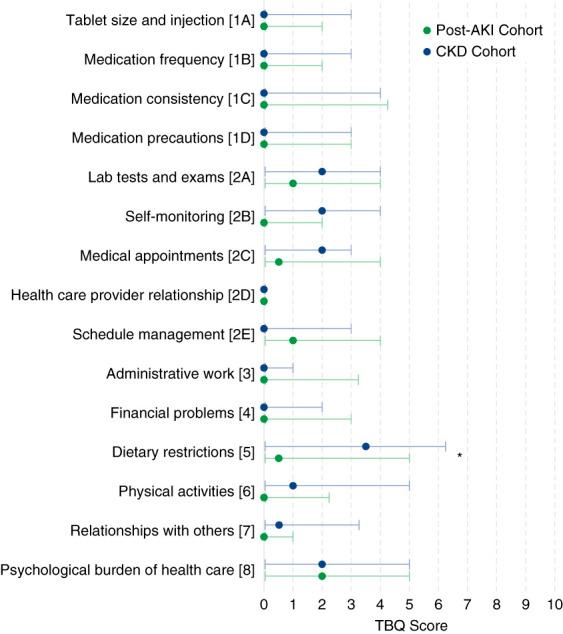
A total of 100 participants were included in this analysis. As opposed to participants with CKD, AKI survivors were younger (median age: 63 [52–72] versus 72 [62–79] years) and had lower comorbidities (median Charlson index: 5 [2–7] versus 8 [6–9]) and higher eGFR at follow-up (median: 60 [40–82] versus 15 [12–20]). The overall QOL reported by AKI survivors was not statistically different from participants with advanced CKD (median TBQ score: 19.0 [6.5–43.8] versus 25 [12.8–43.0]), = 0.45). The only domain where a significant difference was observed between the two cohorts was dietary restrictions ( = 0.037). A negative correlation between age and TBQ score was observed (Spearman's rank: −0.23 [ = 0.02]), especially in participants with CKD (−0.51 [ = 0.001]), meaning older participants reported a lower effect on health-related QOL, and between eGFR and TBQ (−0.20 [ = 0.049]), meaning participants with lower eGFR reported lower health-related QOL. No correlation was observed for hospital length of stay, burden of medication, or follow-up duration since hospital discharge.
CONCLUSIONS
This study showed that health-related QOL of patients recently discharged after a severe AKI episode is comparable with the low QOL reported by patients living with advanced CKD. How to integrate that information into clinical practice when offering post-AKI care requires further research.
关键点
严重急性肾损伤(AKI)发作后近期出院的患者健康相关生活质量较低。这种自我报告的生活质量与晚期慢性肾脏病(CKD)患者相当。
背景
严重AKI幸存者有发病风险增加的情况。关于近期发生AKI发作的患者生活质量(QOL)的数据有限。本研究的目的是探讨严重AKI幸存者与晚期CKD患者相比的健康相关QOL。
方法
对在专门的AKI后诊所接受随访的严重AKI幸存者进行前瞻性观察队列研究,并与在专门的肾脏病诊所随访的4期或5期晚期CKD患者队列进行比较。使用治疗负担问卷(TBQ)确定自我报告的健康相关QOL,并在两组之间进行比较。
结果
本分析共纳入100名参与者。与CKD参与者不同,AKI幸存者更年轻(中位年龄:63[52 - 72]岁对72[62 - 79]岁),合并症更少(中位Charlson指数:5[2 - 7]对8[6 - 9]),随访时估算肾小球滤过率(eGFR)更高(中位值:60[40 - 82]对15[12 - 20])。AKI幸存者报告的总体QOL与晚期CKD参与者无统计学差异(中位TBQ评分:19.0[6.5 - 43.8]对25[12.8 - 43.0]),P = 0.45)。在两个队列之间观察到显著差异的唯一领域是饮食限制(P = 0.037)。观察到年龄与TBQ评分之间存在负相关(Spearman等级:−0.23[P = 0.02]),尤其是在CKD参与者中(−0.51[P = 0.001]),这意味着年龄较大的参与者报告对健康相关QOL的影响较低,以及eGFR与TBQ之间存在负相关(−0.20[P = 0.049]),这意味着eGFR较低的参与者报告的健康相关QOL较低。未观察到住院时间、药物负担或出院后随访时间的相关性。
结论
本研究表明,严重AKI发作后近期出院的患者健康相关QOL与晚期CKD患者报告的低QOL相当。在提供AKI后护理时如何将该信息整合到临床实践中需要进一步研究。


 Zotero 插件