
一项关于肠道微生物群和免疫细胞对胰腺神经内分泌肿瘤影响的系统性孟德尔随机研究。
A systematic Mendelian randomized study of the effects of the gut microbiome and immune cells on pancreatic neuroendocrine tumors.
作者信息
Chen Fangsheng, Zhou Yuan, Mao Xinwen, Lin Ronggui, Huang Heguang
机构信息
Department of General Surgery, Fujian Medical University Union Hospital, Fuzhou, Fujian, People's Republic of China.
Department of Hepatobiliary and Pancreatic Surgery, Affiliated Hospital of Guilin Medical University, Guilin, People's Republic of China.
出版信息
Discov Oncol. 2025 May 30;16(1):961. doi: 10.1007/s12672-025-02761-3.
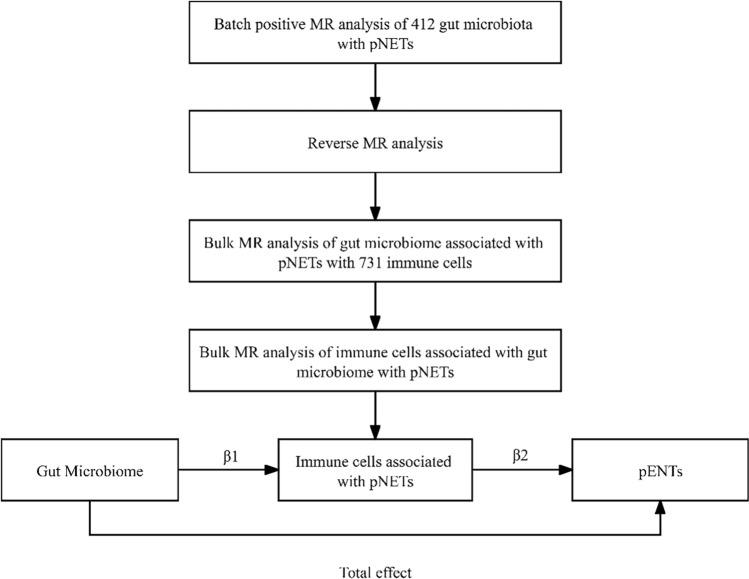
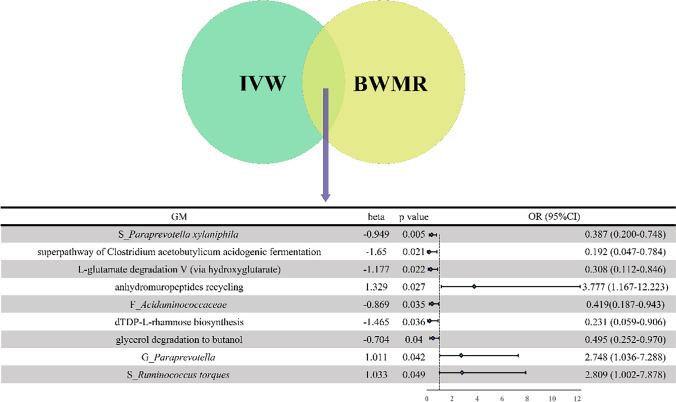
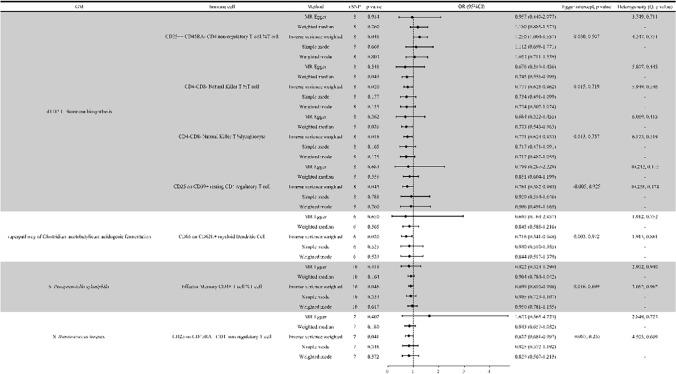
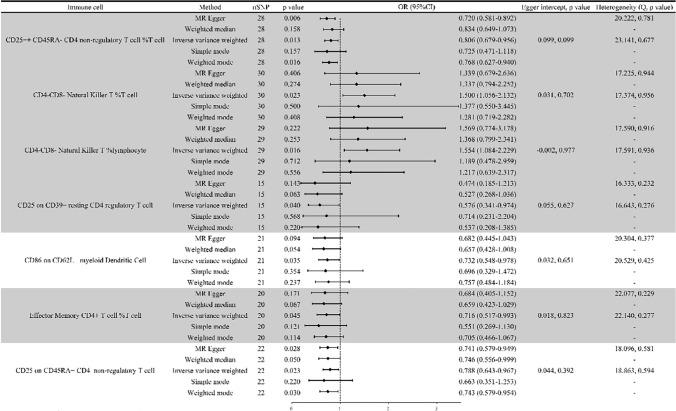
Pancreatic neuroendocrine tumors (pNETs) are a rare subset of pancreatic cancers often diagnosed late and characterized by complex behaviors. Recent evidence suggests the gut microbiome (GM) significantly influences various diseases by modulating the immune system. This study utilized a Mendelian randomization (MR) approach to investigate the causal relationship between GM and pNETs, using single nucleotide polymorphism data as instrumental variables. Two-sample MR analysis identified significant correlations between GM and immune cell types. The study found eight specific GMs affecting pNETs risk: the family Sutterellaceae (OR: 1.52, 95% CI 1.10-2.10, p = 0.01), the genus Paraprevotella (OR: 1.34, 95% CI 1.05-1.72, p = 0.02), the species Paraprevotella unclassified (OR: 1.40, 95% CI 1.08-1.81, p = 0.01), and the species Ruminococcus torques (OR: 1.45, 95% CI 1.12-1.89, p = 0.01) increased risk, while the class Gammaproteobacteria (OR: 0.75, 95% CI 0.57-0.98, p = 0.04), the family Acidaminococcaceae (OR: 0.70, 95% CI 0.52-0.94, p = 0.02), the species Paraprevotella xylaniphila (OR: 0.72, 95% CI 0.54-0.96, p = 0.03), and the species Bacteroides finegoldii (OR: 0.68, 95% CI 0.51-0.91, p = 0.01) decreased it. Mediation analysis indicated the species Ruminococcus torques mediated the effect of CD25 on CD45RA+ CD4 non-regulatory T cells on pNETs, accounting for 3.6% of the total effect. This study provides evidence suggestive of a potential causal role of specific GM compositions in pNETs progression and their mediation through immune cell signatures. However, mechanistic studies are required to further validate this relationship.
胰腺神经内分泌肿瘤(pNETs)是胰腺癌中较为罕见的一类,通常在晚期才被诊断出来,且具有复杂的行为特征。最近有证据表明,肠道微生物群(GM)通过调节免疫系统对多种疾病产生显著影响。本研究采用孟德尔随机化(MR)方法,以单核苷酸多态性数据作为工具变量,来探究GM与pNETs之间的因果关系。两样本MR分析确定了GM与免疫细胞类型之间存在显著相关性。该研究发现有8种特定的GM会影响pNETs风险:萨特氏菌科(比值比:1.52,95%置信区间1.10 - 2.10,p = 0.01)、副普雷沃氏菌属(比值比:1.34,95%置信区间1.05 - 1.72,p = 0.02)、未分类的副普雷沃氏菌(比值比:1.40,95%置信区间1.08 - 1.81,p = 0.01)以及扭链瘤胃球菌(比值比:1.45,95%置信区间1.12 - 1.89,p = 0.01)会增加风险,而γ-变形菌纲(比值比:0.75,95%置信区间0.57 - 0.98,p = 0.04)、氨基酸球菌科(比值比:0.70,95%置信区间0.52 - 0.94,p = 0.02)、嗜木聚糖副普雷沃氏菌(比值比:0.72,95%置信区间0.54 - 0.96,p = 0.03)以及脆弱拟杆菌(比值比:0.68,95%置信区间0.51 - 0.91,p = 0.01)会降低风险。中介分析表明,扭链瘤胃球菌介导了CD25对pNETs上CD45RA + CD4非调节性T细胞的影响,占总效应的3.6%。本研究提供的证据表明,特定的GM组成在pNETs进展中可能具有因果作用,并通过免疫细胞特征发挥中介作用。然而,还需要进行机制研究来进一步验证这种关系。


 Zotero 插件