
在英国国家医疗服务体系(NHS)中,使用维奈克拉和阿扎胞苷或小剂量阿糖胞苷治疗新诊断急性髓系白血病(AML)的真实世界疗效。
Real-world outcomes of newly diagnosed AML treated with venetoclax and azacitidine or low-dose cytarabine in the UK NHS.
作者信息
Othman Jad, Lam Ho Pui Jeff, Leong Sarah, Basheer Faisal, Abdallah Islam, Fleming Kathryn, Mehta Priyanka, Yassin Heba, Laurie John, Austin Michael, Gallipoli Paolo, Taylor Tom, Dennis Mike, Elliot Johnathon, Clarke Georgina, Dang Raymond, Vidler Jennifer, Krishnamurthy Pramila, Latif Anne-Louise, Kalkur Pallavi, Shahidianakbar Maryam, Campbell Victoria, Mannari Deepak, Sutherland Emily, Wickramaratne Thishakya, Collins Angela, Zhao Rui, Mak Herng, Belsham Edward, Banerjee Shabnam, Bashir Jamila, Pillai Srinivas, Whitmill Richard, Galli Sofia, Amer Mariam, Murthy Vidhya, Murray Duncan, Wandroo Farooq, Hogan Francesca, Crolla Francesca, Fowler Nicole, Khan Anjum, O'Nions Jenny, Dillon Richard
机构信息
Department of Medical and Molecular Genetics, King's College London, London, United Kingdom.
Department of Haematology, Guy's and St Thomas' NHS Foundation Trust, London, United Kingdom.
出版信息
Blood Neoplasia. 2024 May 23;1(3):100017. doi: 10.1016/j.bneo.2024.100017. eCollection 2024 Sep.
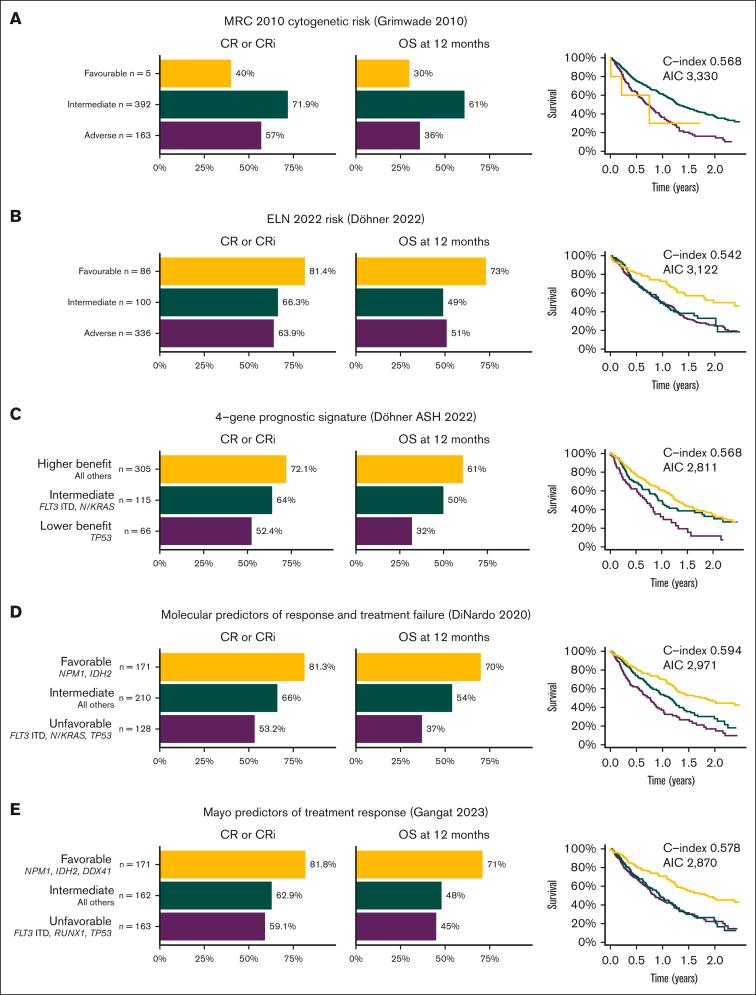
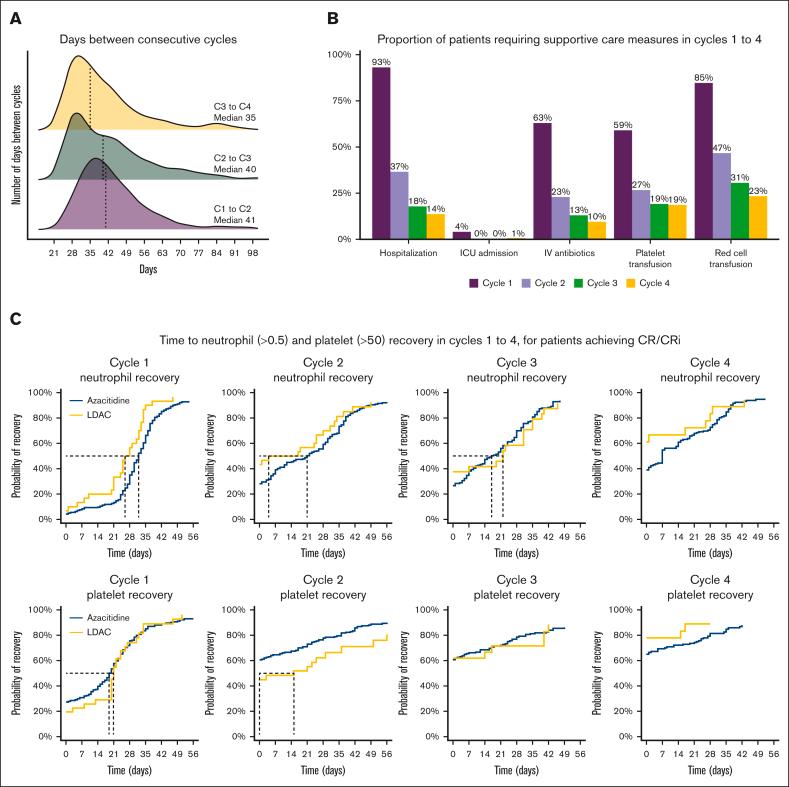
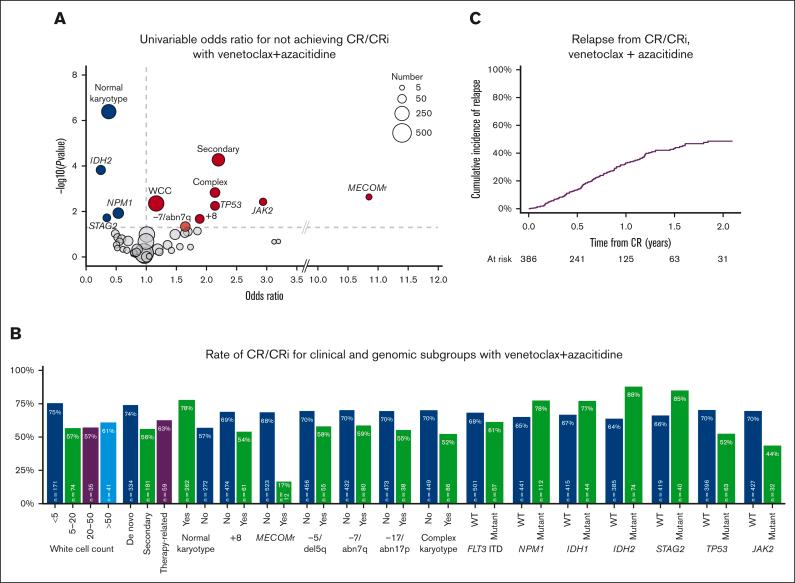
Venetoclax with azacitidine is the standard of care for patients with acute myeloid leukemia (AML) who are unfit for intensive chemotherapy; however, uncertainties remain regarding the treatment schedule, accurate prognostication, and outcomes for patients treated outside clinical trials. The option of venetoclax with low-dose cytarabine (LDAC) is also available; however, it is not clear for which patients it may be a useful alternative. Here, we report a large real-world cohort of 654 patients treated in 53 UK hospitals with either venetoclax and azacitidine (n = 587) or LDAC (n = 67). The median age was 73 years, and 59% had de novo AML. Most patients received 100 mg of venetoclax with an azole antifungal. In cycle 1, patients spent a median of 14 days in the hospital, and 85% required red cell transfusion, 59% platelet transfusion, and 63% required IV antibiotics. Supportive care requirements significantly reduced after the first cycle. Patients receiving venetoclax-azacitidine had a complete remission (CR)/CR with incomplete hematological recovery rate of 67%, day 30 and day 60 mortality of 5% and 8%, respectively, and median overall survival of 13.6 months. Mutations in , , , and were associated with improved survival, whereas age, secondary and therapy-related AML, +8, rearrangements, complex karyotype, , and mutations were associated with poorer survival. Prognostic systems derived specifically for patients treated with venetoclax-azacitidine performed better than the European LeukemiaNet and Medical Research Council classifications; however, improved risk classifications are still required. In the 149 patients with mutated AML, outcomes were similar for those treated with venetoclax-azacitidine and venetoclax-LDAC.
维奈克拉联合阿扎胞苷是不适合接受强化化疗的急性髓系白血病(AML)患者的标准治疗方案;然而,关于治疗方案、准确的预后评估以及在临床试验之外接受治疗的患者的治疗结果仍存在不确定性。维奈克拉联合小剂量阿糖胞苷(LDAC)也是一种选择;然而,尚不清楚它对哪些患者可能是一种有用的替代方案。在此,我们报告了一个来自英国53家医院的654例患者的大型真实世界队列,这些患者接受了维奈克拉联合阿扎胞苷(n = 587)或LDAC(n = 67)治疗。中位年龄为73岁,59%的患者为初发AML。大多数患者接受100mg维奈克拉联合一种唑类抗真菌药治疗。在第1周期,患者住院时间的中位数为14天,85%的患者需要红细胞输注,59%的患者需要血小板输注,63%的患者需要静脉使用抗生素。第1周期后支持治疗需求显著减少。接受维奈克拉 - 阿扎胞苷治疗的患者完全缓解(CR)/血细胞未完全恢复的CR率为67%,第30天和第60天的死亡率分别为5%和8%,中位总生存期为13.6个月。 、 、 和 的突变与生存改善相关,而年龄、继发性和治疗相关的AML、 +8、 重排、复杂核型、 以及 的突变与较差的生存相关。专门为接受维奈克拉 - 阿扎胞苷治疗的患者推导的预后系统比欧洲白血病网络和医学研究委员会的分类表现更好;然而,仍需要改进风险分类。在149例 突变的AML患者中,接受维奈克拉 - 阿扎胞苷和维奈克拉 - LDAC治疗的患者的结局相似。


 Zotero 插件