
股骨骨转移瘤人工关节置换术后假体周围感染:发生率及危险因素,单中心研究
Periprosthetic Infection after Endoprosthetic Reconstruction for Femoral Bone Metastases: Incidence and Risk Factors, a Single Center Study.
作者信息
Kim Shinn, Kim Han-Soo, Kim Yongsung, Park Jay Hoon, Han Ilkyu
机构信息
Department of Orthopedic Surgery, Seoul National University Hospital, Seoul, Korea.
Department of Orthopedic Surgery, Seoul National University College of Medicine, Seoul, Korea.
出版信息
Clin Orthop Surg. 2025 Jun;17(3):546-554. doi: 10.4055/cios24336. Epub 2025 May 2.
BACKGROUND
This study aims to identify the incidence and risk factors of periprosthetic infections following endoprosthetic reconstruction of femoral metastatic bone disease (MBD). In this population with MBD, the marked impact of infection on the patient's systemic treatment highlights the importance of understanding both the incidence and associated risk factors.
METHODS
This retrospective cohort study included a total of 140 patients who underwent endoprosthetic reconstruction for femoral MBD at a tertiary referral hospital in South Korea between 2009 and 2019. Infection-free survival was estimated using the Kaplan-Meier method, and Cox proportional hazards model analyses were performed to evaluate the risk factors associated with periprosthetic infection.
RESULTS
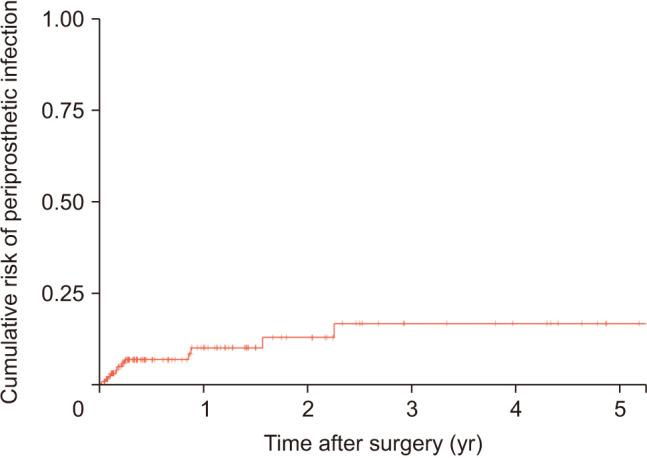
The incidence of periprosthetic infection in patients who underwent endoprosthetic reconstruction for femoral MBD was 9% (12 out of 140 patients). Risk factors for periprosthetic infection were hepatocellular carcinoma (HCC) as the primary tumor (hazard ratio [HR], 6.08; 95% CI, 1.63-22.6; = 0.007) and low preoperative absolute neutrophil count (HR, 6.99; 95% CI, 1.79-27.4; = 0.005).
CONCLUSIONS
Patients with femoral MBD had a 9% risk of developing a periprosthetic infection. Given their limited life expectancy, this translated to a substantial rate of 58.9 infections per 1,000 person-joint-years. Possible risk factors for periprosthetic infection were low preoperative absolute neutrophil count and HCC as the primary tumor. The high incidence of periprosthetic infection and its associated risk factors should be considered in patients undergoing endoprosthetic reconstruction for femoral MBD.
背景
本研究旨在确定股骨转移性骨病(MBD)假体周围感染的发生率及危险因素。在这个患有MBD的人群中,感染对患者全身治疗的显著影响凸显了了解发生率及相关危险因素的重要性。
方法
这项回顾性队列研究纳入了2009年至2019年期间在韩国一家三级转诊医院接受股骨MBD假体置换重建的140例患者。采用Kaplan-Meier法估计无感染生存期,并进行Cox比例风险模型分析以评估与假体周围感染相关的危险因素。
结果
接受股骨MBD假体置换重建的患者中,假体周围感染的发生率为9%(140例患者中有12例)。假体周围感染的危险因素包括原发性肿瘤为肝细胞癌(HCC)(风险比[HR],6.08;95%置信区间[CI],1.63 - 22.6;P = 0.007)和术前绝对中性粒细胞计数低(HR,6.99;95% CI,1.79 - 27.4;P = 0.005)。
结论
股骨MBD患者发生假体周围感染的风险为9%。鉴于他们有限的预期寿命,这相当于每1000人关节年中有58.9例感染的相当高的发生率。假体周围感染的可能危险因素是术前绝对中性粒细胞计数低和原发性肿瘤为HCC。对于接受股骨MBD假体置换重建的患者,应考虑假体周围感染的高发生率及其相关危险因素。


 Zotero 插件