
海地青年糖尿病的病因决定因素及特征(EDDHY研究)
Etiologic Determinants and Characteristics of Diabetes in Haitian Youth (EDDHY Study).
作者信息
Jean-Baptiste Eddy, Larco Philippe, Oettingen Julia E Von, Noble Janelle A, Mack Steven J, Song Ningyi, Martin Harper R N, Rozemuller Erik, Atkinson Mark A, Govender Denira, Larco Nancy Charles, Ogle Graham D
机构信息
Fondation Haïtienne de Diabète et de Maladies Cardiovasculaires (FHADIMAC), Port-au-Prince, Haiti.
Research Institute of the McGill University Health Centre, Montreal, Canada.
出版信息
Pediatr Diabetes. 2025 May 25;2025:9974561. doi: 10.1155/pedi/9974561. eCollection 2025.
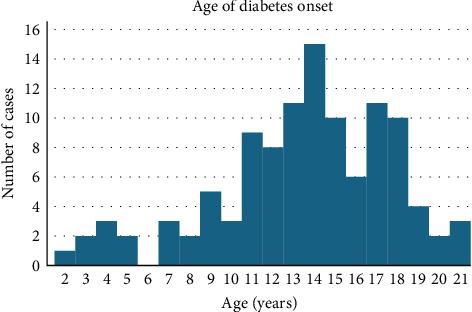
Published information on youth-onset diabetes in Haiti is scarce, with limited data available on diabetes autoimmunity and genetic susceptibility to the disease. We determined the anthropometric, metabolic, and immunological characteristics and human leukocyte antigen (HLA)-associated risks in patients with youth-onset diabetes. One hundred and ten subjects with type 1 diabetes (T1D) aged <22 years and diagnosed for < 2 years were evaluated. Demographic and clinical information, as well as biochemical parameters, including blood glucose, hemoglobin A1c, fasting C-peptide (FCP), and T1D-associated autoantibodies, were assessed. DNA from 54 subjects and 66 controls was genotyped for classical HLA loci. Of the 110 patients, 54% were male. Onset age was 13.5 ± 4.2 years (range 2-21), and disease duration was 11.7 ± 8.1 months (range 0-24). Idiopathic T1D was found in 62 (56.4%) patients and was diagnosed at an older age than immune-mediated T1D (14.4 ± 3.5 years vs., 12.3 ± 4.8 years, =0.01), with a higher BMI z-score in patients aged <14 years than in those aged ≥14 years (-0.29 ± 1.52 vs., -1.15 ± 1.18, =0.01). No correlation was found between immune-mediated T1D and BMI z-score. Diabetic ketoacidosis was present at diagnosis in 18 (16.4%) patients. Zinc transporter 8 autoantibodies (ZnT8A) were marginally more common in younger patients. Low FCP levels were found in 71 (64.5%) patients. Thyroid peroxidase antibodies (TPO-Ab) and thyroglobulin antibodies (TG-Ab) were positive in 1.1% and 2.2% of the patients, respectively. The alleles , , , and showed a significant T1D risk, whereas , , and were protective. Three haplotypes were strongly associated with T1D: , , both predisposing, and , . Idiopathic T1D is common among youth in Haiti. A significant proportion of all patients had preserved C-peptide secretion. Overall, predisposing and protective HLA patterns were identified. Study results highlight the importance of distinguishing T1D endotypes within and between populations.
海地青少年糖尿病的公开信息匮乏,关于糖尿病自身免疫和疾病遗传易感性的数据有限。我们确定了青少年糖尿病患者的人体测量、代谢和免疫学特征以及人类白细胞抗原(HLA)相关风险。对110名年龄<22岁且确诊<2年的1型糖尿病(T1D)患者进行了评估。评估了人口统计学和临床信息以及生化参数,包括血糖、糖化血红蛋白A1c、空腹C肽(FCP)和T1D相关自身抗体。对54名受试者和66名对照的DNA进行了经典HLA位点基因分型。110名患者中,54%为男性。发病年龄为13.5±4.2岁(范围2 - 21岁),病程为11.7±8.1个月(范围0 - 24个月)。62名(56.4%)患者为特发性T1D,其诊断年龄高于免疫介导性T1D(14.4±3.5岁对12.3±4.8岁,P = 0.01),<14岁患者的BMI z评分高于≥14岁患者(-0.29±1.52对-1.15±1.18,P = 0.01)。免疫介导性T1D与BMI z评分之间未发现相关性。18名(16.4%)患者诊断时存在糖尿病酮症酸中毒。锌转运体8自身抗体(ZnT8A)在年轻患者中略为常见。71名(64.5%)患者FCP水平较低。甲状腺过氧化物酶抗体(TPO - Ab)和甲状腺球蛋白抗体(TG - Ab)分别在1.1%和2.2%的患者中呈阳性。等位基因 、 、 和 显示出显著的T1D风险,而 、 和 具有保护作用。三种单倍型与T1D密切相关: 、 均为易感型,以及 、 。特发性T1D在海地青少年中很常见。所有患者中有很大一部分C肽分泌保留。总体而言,确定了易感和保护性HLA模式。研究结果强调了在人群内部和人群之间区分T1D内型的重要性。

 Zotero 插件