
组装后构象变化使新冠病毒聚合酶具备延伸能力。
A post-assembly conformational change makes the SARS-CoV-2 polymerase elongation-competent.
作者信息
Klein Misha, Das Arnab, Bera Subhas C, Anderson Thomas K, Kocincova Dana, Lee Hery W, Wang Bing, Papini Flavia S, Marecki John C, Arnold Jamie J, Cameron Craig E, Raney Kevin D, Artsimovitch Irina, Götte Mathias, Kirchdoerfer Robert N, Depken Martin, Dulin David
机构信息
Department of Physics and Astronomy, and LaserLaB Amsterdam, Vrije Universiteit Amsterdam, De Boelelaan 1100, 1081 HZ Amsterdam, The Netherlands.
Junior Research Group 2, Interdisciplinary Center for Clinical Research, Friedrich-Alexander-University Erlangen-Nürnberg (FAU), Cauerstr. 3, 91058 Erlangen, Germany.
出版信息
Nucleic Acids Res. 2025 May 22;53(10). doi: 10.1093/nar/gkaf450.
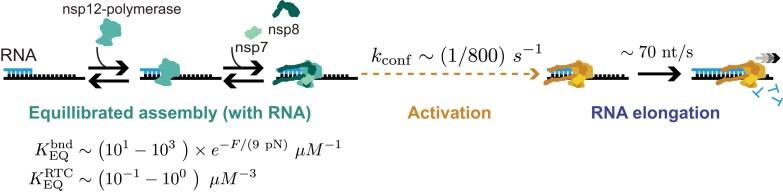
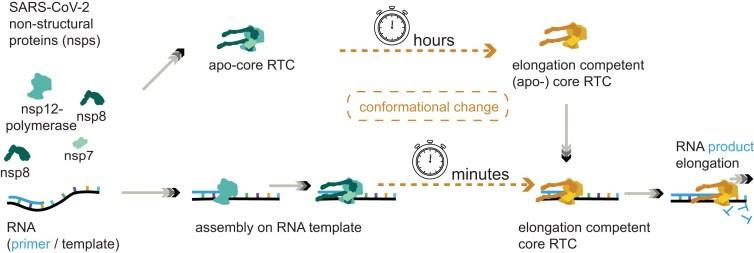
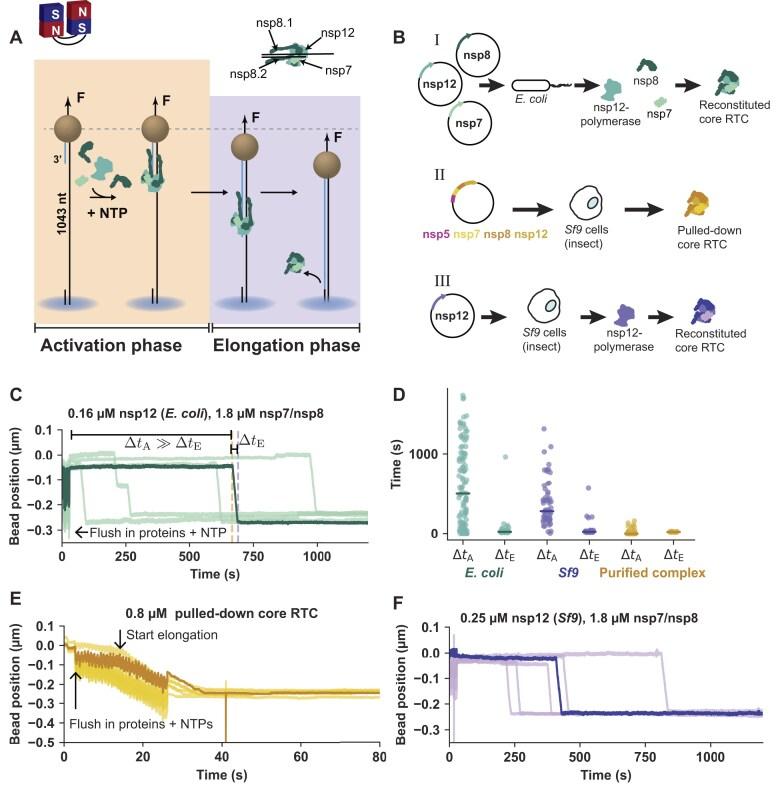
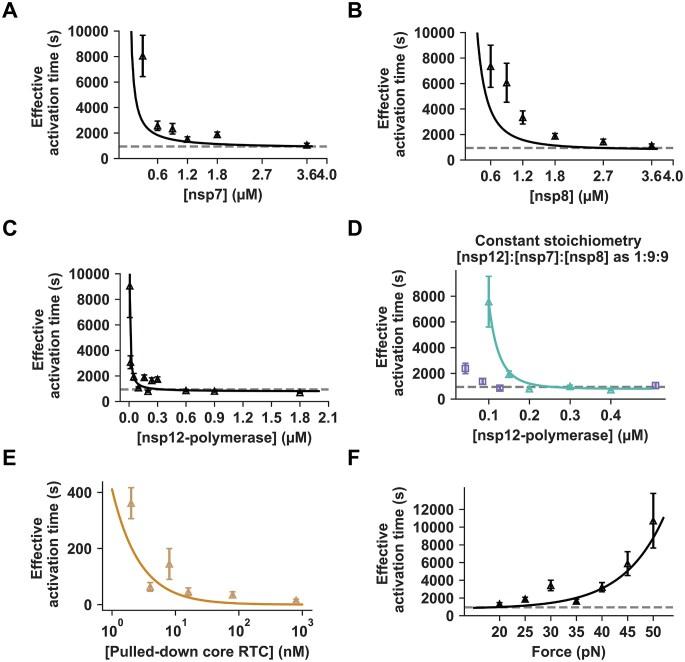
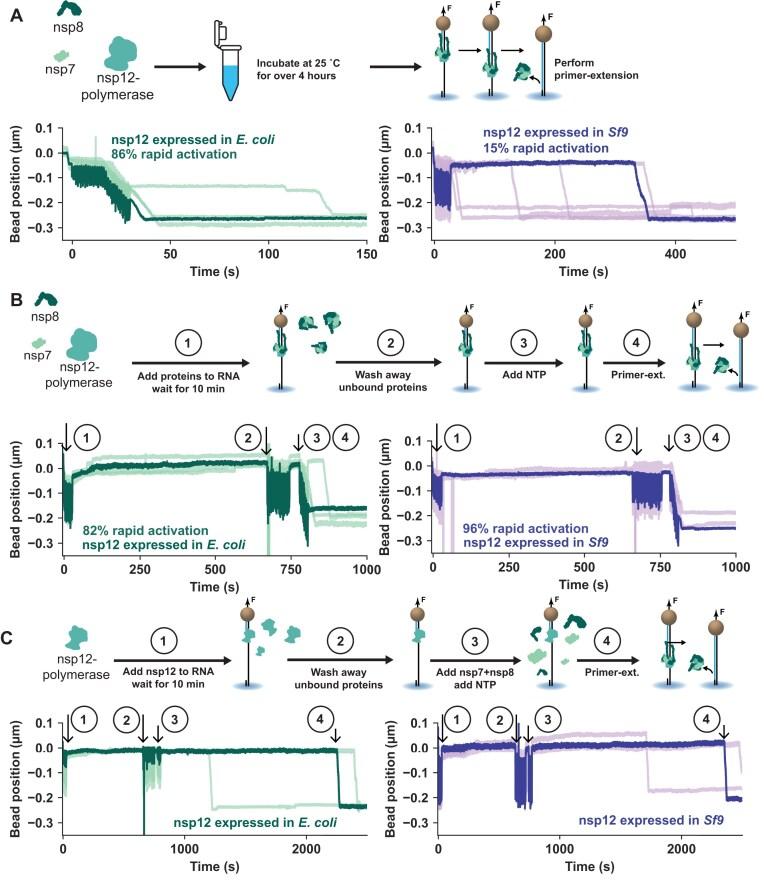
Coronaviruses (CoVs) encode 16 nonstructural proteins (nsps), most of which form the replication-transcription complex (RTC). The RTC contains a core composed of one nsp12 RNA-dependent RNA polymerase (RdRp), two nsp8s, and one nsp7. The core RTC recruits other nsps to synthesize all viral RNAs within the infected cell. While essential for viral replication, the mechanism by which the core RTC assembles into a processive polymerase remains poorly understood. We show that the core RTC preferentially assembles by first having nsp12-polymerase bind to the RNA template, followed by the subsequent association of nsp7 and nsp8. Once assembled on the RNA template, the core RTC requires hundreds of seconds to undergo a conformational change that enables processive elongation. In the absence of RNA, the (apo-)RTC requires several hours to adopt its elongation-competent conformation. We propose that this obligatory activation step facilitates the recruitment of additional nsps essential for efficient viral RNA synthesis and may represent a promising target for therapeutic interventions.
冠状病毒(CoV)编码16种非结构蛋白(nsp),其中大多数形成复制转录复合体(RTC)。RTC包含一个由一个nsp12 RNA依赖性RNA聚合酶(RdRp)、两个nsp8和一个nsp7组成的核心。核心RTC招募其他nsp以在受感染细胞内合成所有病毒RNA。虽然对病毒复制至关重要,但核心RTC组装成一个持续聚合酶的机制仍知之甚少。我们发现,核心RTC优先通过首先让nsp12聚合酶结合到RNA模板上,随后nsp7和nsp8再结合来组装。一旦在RNA模板上组装完成,核心RTC需要数百秒来经历构象变化以实现持续延伸。在没有RNA的情况下,(无配体的)RTC需要数小时才能采用其具备延伸能力的构象。我们提出,这个必需的激活步骤有助于招募对高效病毒RNA合成至关重要的其他nsp,并且可能是治疗干预的一个有前景的靶点。

 Zotero 插件