
心脏再同步治疗和植入式心律转复除颤器在老年心力衰竭患者中的长期疗效
Long-term outcomes of cardiac resynchronization therapy and implantable cardioverter defibrillators in elderly patients with heart failure.
作者信息
Su Yanxiao, Wu Zonglei, Luan Chao, Chen Feifei, Huang Fenglan, Liu Jinqiu
机构信息
The First Affiliated Hospital of Dalian Medical University, 222 Zhongshan Road, Xigang District, Dalian City, Liaoning Province, China.
出版信息
BMC Cardiovasc Disord. 2025 Jun 5;25(1):434. doi: 10.1186/s12872-025-04863-w.
AIMS
We aimed to describe the safety and efficacy of cardiac resynchronization therapy (CRT) and implantable cardioverter defibrillators (ICDs) in elderly patients with heart failure.
METHODS AND RESULTS
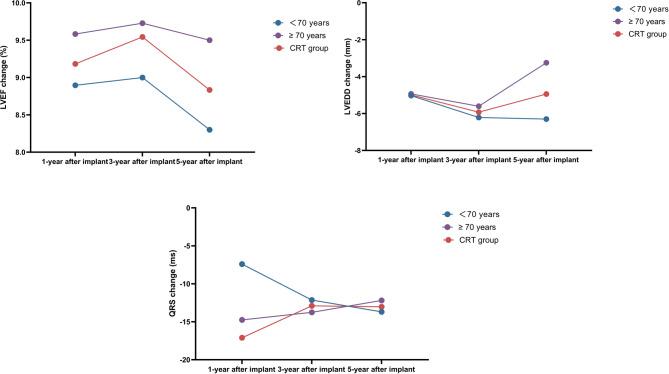
Patients with heart failure who received CRT or ICDs implantation for the first time from 2010 to 2021 were retrospectively studied. 48 of the 115 patients (41.7%) who underwent CRT implantation and 61 of the 174 patients (35.1%) who underwent ICDs implantation were ≥ 70 years old; these patients were defined as "elderly". The incidence of procedure-related complications was did not differ between elderly and young patients. The median follow-up times of the CRT group and ICDs group were 45 (30,74) and 51 (30,79) months, respectively. There was no significant difference in the superresponse rate, response rate, heart failure readmission rate, all-cause death rate, or cardiac death rate between elderly and young patients. The largest changes in LVEF and LVEDD occurred at 3 years after implantation, and the effect of reversing left ventricular remodeling lasted for five years after implantation. In the ICDs group, no significant difference was observed in the correct discharge ratio between elderly and young patients. However, elderly patients exhibited a significantly higher all-cause mortality rate compared to their younger counterparts (31% vs. 18%, P = 0.035). The survival curves diverged after 5 years, yet no statistically significant difference was found in cardiac death rates between the two groups (16% vs. 14%, P = 0.522). The COX regression model suggested that age ≥ 70 years old and chronic kidney disease were independent risk factors for all-cause death (HR = 1.963, 3.165, P = 0.041, 0.003), while LVEF ≤ 20% was an independent risk factor for cardiac death (HR = 3.562, P = 0.004).
CONCLUSION
Implantation of CRT and ICDs in elderly patients with heart failure is safe. Age should not be a criterion for preventing CRT implantation. The prognosis of ICDs implantation in elderly patients is strongly affected by noncardiogenic factors, and the long-term benefit is worse than that in young patients.
目的
我们旨在描述心脏再同步治疗(CRT)和植入式心脏复律除颤器(ICD)在老年心力衰竭患者中的安全性和有效性。
方法与结果
对2010年至2021年首次接受CRT或ICD植入的心力衰竭患者进行回顾性研究。115例接受CRT植入的患者中有48例(41.7%),174例接受ICD植入的患者中有61例(35.1%)年龄≥70岁;这些患者被定义为“老年患者”。老年患者和年轻患者在手术相关并发症的发生率上没有差异。CRT组和ICD组的中位随访时间分别为45(30,74)个月和51(30,79)个月。老年患者和年轻患者在超反应率、反应率、心力衰竭再入院率、全因死亡率或心源性死亡率方面没有显著差异。左心室射血分数(LVEF)和左心室舒张末期内径(LVEDD)的最大变化发生在植入后3年,左心室重构逆转的效果在植入后持续5年。在ICD组中,老年患者和年轻患者在正确放电率方面没有观察到显著差异。然而,老年患者的全因死亡率明显高于年轻患者(31%对18%,P = 0.035)。5年后生存曲线出现分歧,但两组的心源性死亡率没有统计学显著差异(16%对14%,P = 0.522)。COX回归模型表明,年龄≥70岁和慢性肾病是全因死亡的独立危险因素(HR = 1.963,3.165,P = 0.041,0.003),而LVEF≤20%是心源性死亡的独立危险因素(HR = 3.562,P = 0.004)。
结论
老年心力衰竭患者植入CRT和ICD是安全的。年龄不应作为阻止CRT植入的标准。老年患者植入ICD的预后受非心源性因素的强烈影响,长期获益比年轻患者差。




 Zotero 插件