
吸气肌训练对慢性呼吸系统疾病患者的有效性:系统评价概述
Effectiveness of inspiratory muscle training in patients with a chronic respiratory disease: an overview of systematic reviews.
作者信息
Torres-Castro Rodrigo, Caicedo-Trujillo Saul, Gimeno-Santos Elena, Gutiérrez-Arias Ruvistay, Alsina-Restoy Xavier, Vasconcello-Castillo Luis, Seron Pamela, Spruit Martijn A, Blanco Isabel, Vilaró Jordi
机构信息
Department of Pulmonary Medicine, Hospital Clínic, University of Barcelona, Barcelona, Spain.
Fundació de Recerca Clínic Barcelona-Institut d'Investigacions Biomèdiques August Pi i Sunyer (IDIBAPS), Barcelona, Spain.
出版信息
Front Sports Act Living. 2025 May 21;7:1549652. doi: 10.3389/fspor.2025.1549652. eCollection 2025.
INTRODUCTION
There has been inconclusive findings regarding the effectiveness of inspiratory muscle training (IMT) in chronic respiratory diseases (CRDs). Our objective was to determine the effectiveness of IMT on exercise tolerance, maximum respiratory pressure, lung function, symptoms and quality of life in different CRDs.
METHODS
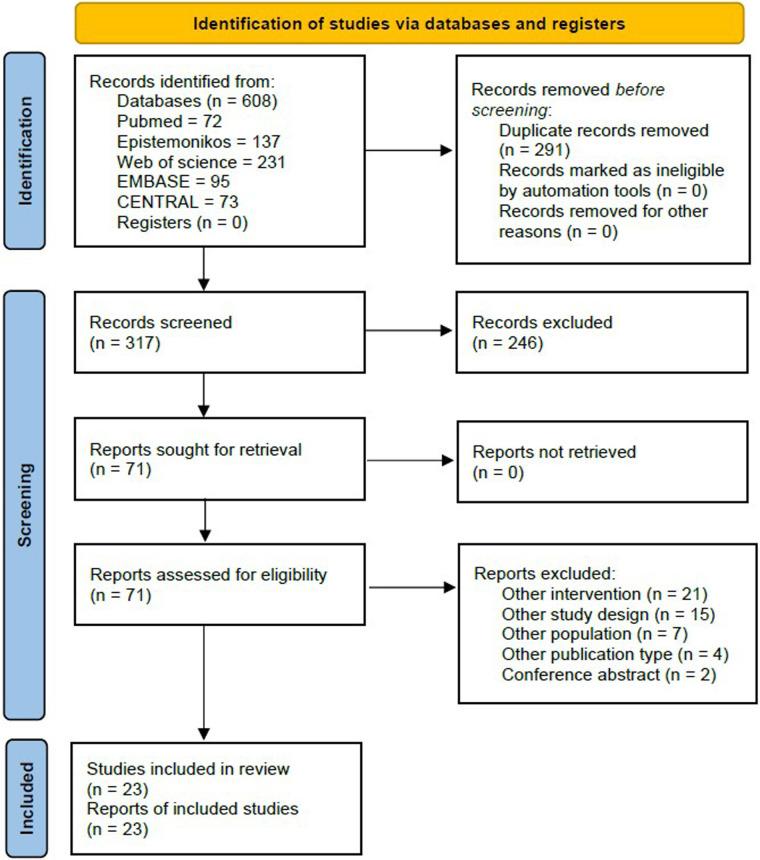
We conducted an overview of systematic reviews (SRs) in adults with CRDs who underwent IMT. We reviewed five databases in March 2025. We chose the most comprehensive SRs to report on the analysed outcomes.
RESULTS
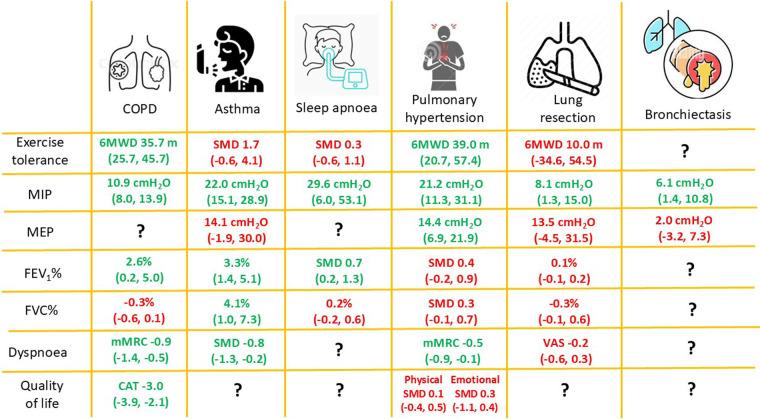
Twenty-three SRs were included. In chronic obstructive pulmonary disease (COPD), IMT increased the six-minute walk distance (6MWD) by 35.7 m (95% CI 25.7, 45.7), maximum inspiratory pressure (MIP) by 10.9 cmHO (95% CI 8.0, 13.9). In asthma, IMT increased the forced expiratory volume in the first second (FEV) by 3.3%pred (95% CI 1.4, 5.1), forced vital capacity (FVC) by 4.1%pred (95% CI 1.0, 7.3), MIP by 21.9 cmHO (95% CI 15.0, 28.8), and dyspnoea was reduced (standard mean difference -0.8, 95% CI -1.3,-0.2). In obstructive sleep apnoea (OSA), IMT increased MIP by 29.6 cmHO (95% CI 6.0, 53.1). In pulmonary hypertension (PH), IMT increased 6MWD by 39.0 m (95% CI 20.7, 57.4), MIP in 21.2 cmHO (95% CI 11.3, 31.1), maximum expiratory pressure by 14.4 cmHO (95% CI 6.9, 21.9), and dyspnoea was reduced by 0.5 (95% CI 0.1, 0.9) in modified Medical Research Council scale. In lung resection (LR), IMT increased MIP by 8.1 cmHO (95% CI 1.3, 14.9). In bronchiectasis, IMT increased MIP by 6.1 cmHO (95% CI 1.4, 10.8). Overall, the most consistent effect of IMT across different CRDs was an increase in MIP.
CONCLUSION
IMT improved several clinically relevant outcomes, including MIP, exercise capacity, and dyspnoea in different CRDs. However, the limited evidence for certain outcomes and populations highlights the need for further high-quality studies.
引言
关于吸气肌训练(IMT)在慢性呼吸系统疾病(CRD)中的有效性,研究结果尚无定论。我们的目的是确定IMT对不同CRD患者的运动耐力、最大呼吸压力、肺功能、症状及生活质量的影响。
方法
我们对接受IMT的成年CRD患者的系统评价(SR)进行了概述。2025年3月,我们检索了五个数据库。我们选择了最全面的SR来报告分析结果。
结果
纳入了23项SR。在慢性阻塞性肺疾病(COPD)中,IMT使6分钟步行距离(6MWD)增加了35.7米(95%CI 25.7,45.7),最大吸气压力(MIP)增加了10.9厘米水柱(95%CI 8.0,13.9)。在哮喘中,IMT使第1秒用力呼气容积(FEV)增加了3.3%预计值(95%CI 1.4,5.1),用力肺活量(FVC)增加了4.1%预计值(95%CI 1.0,7.3),MIP增加了21.9厘米水柱(95%CI 15.0,28.8),呼吸困难减轻(标准化均数差-0.8,95%CI -1.3,-0.2)。在阻塞性睡眠呼吸暂停(OSA)中,IMT使MIP增加了29.6厘米水柱(95%CI 6.0,53.1)。在肺动脉高压(PH)中,IMT使6MWD增加了39.0米(95%CI 20.7,57.4),MIP增加了21.2厘米水柱(95%CI 11.3,31.1),最大呼气压力增加了14.4厘米水柱(95%CI 6.9,21.9),改良医学研究委员会量表中的呼吸困难减轻了0.5(95%CI 0.1,0.9)。在肺切除术(LR)中,IMT使MIP增加了8.1厘米水柱(95%CI 1.3,14.9)。在支气管扩张症中,IMT使MIP增加了6.1厘米水柱(95%CI 1.4,10.8)。总体而言,IMT在不同CRD中最一致的作用是增加MIP。
结论
IMT改善了不同CRD中包括MIP、运动能力和呼吸困难等多项临床相关结局。然而,某些结局和人群的证据有限,这凸显了进一步开展高质量研究的必要性。
 Zotero 插件