
内分泌干扰化学物质对后代大脑发育和行为的代际及跨代影响。
Intergenerational and transgenerational effects of endocrine-disrupting chemicals in the offspring brain development and behavior.
作者信息
Dias Glaecir Roseni Mundstock, Giusti Fabiana Cardoso Vilela, de Novais Cíntia Onofra, de Oliveira Maria Aparecida Lima, Paiva Alexandre Giusti, Kalil-Cutti Bruna, Mahoney Megan M, Graceli Jones Bernardes
机构信息
Postgraduate Program in Endocrinology, Faculty of Medicine, Federal University of Rio de Janeiro, Precision Medicine Research Center, Carlos Chagas Filho Institute of Biophysics, Federal University of Rio de Janeiro, Rio de Janeiro, RJ, Brazil.
Institute of Biomedical Sciences, Federal University of Alfenas, Alfenas, MG, Brazil.
出版信息
Front Endocrinol (Lausanne). 2025 May 21;16:1571689. doi: 10.3389/fendo.2025.1571689. eCollection 2025.
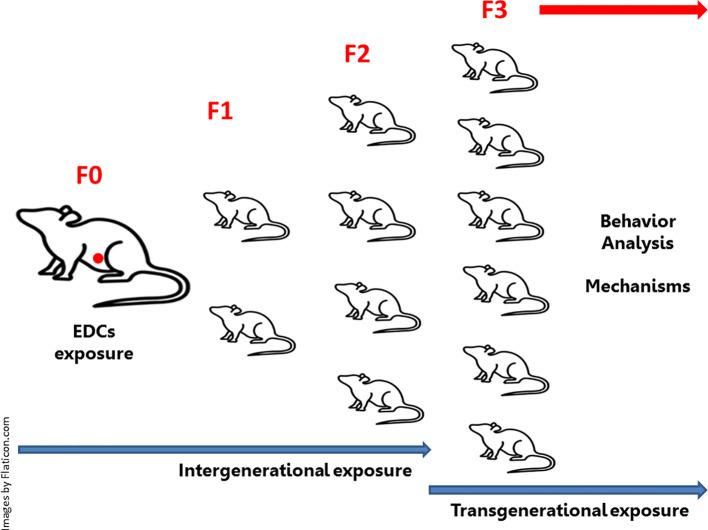
Endocrine-disrupting chemicals (EDCs) are a group of substances that can alter normal body functioning by disrupting the various patterns of hormone secretion and action. Some of these substances are used as plasticizers (e.g., bisphenols and phthalates) and agrochemicals (e.g., vinclozolin). EDC exposure can occur by many routes, including oral by contaminated food and water, through the skin, inhalation, and by placental transfer from mother to fetus or mother to infant (via lactation). The increase in EDCs used by the industry has strongly impacted our health. An increasing number of scientific works have reported the effects of EDCs on cancer development, metabolism, heart disease, and fertility. Most recently, studies on EDCs effects on behavior and the developing brain are raising major concerns related to the formation of sex differences and to the increased prevalence of neuropsychiatric disorders. In this review, we highlight the recent findings of the effects of pre-, peri-, and postnatal exposure to the three well-studied EDCs (i.e., bisphenols (BPA, BPS, BPF, and BPAF), phthalates (DBP, BBP, DEHP, and DiPeP), and vinclozolin (VIN)) on developing brain and behavior across generations in experimental animals.
内分泌干扰化学物质(EDCs)是一类能够通过干扰激素分泌和作用的各种模式来改变正常身体功能的物质。其中一些物质被用作增塑剂(如双酚类和邻苯二甲酸盐)和农用化学品(如乙烯菌核利)。接触EDCs的途径有很多,包括通过受污染的食物和水经口摄入、经皮肤接触、吸入,以及通过胎盘从母亲传给胎儿或母亲通过哺乳传给婴儿。工业上使用的EDCs的增加对我们的健康产生了重大影响。越来越多的科学研究报告了EDCs对癌症发展、新陈代谢、心脏病和生育能力的影响。最近,关于EDCs对行为和发育中的大脑影响的研究引发了人们对性别差异形成以及神经精神疾病患病率上升的重大担忧。在这篇综述中,我们重点介绍了产前、围产期和产后暴露于三种经过充分研究的EDCs(即双酚类(BPA、BPS、BPF和BPAF)、邻苯二甲酸盐(DBP、BBP、DEHP和DiPeP)以及乙烯菌核利(VIN))对实验动物跨代发育中的大脑和行为影响的最新研究结果。

 Zotero 插件