
成年期体重变化与中老年人群体衰弱风险之间的关联:一项来自美国国家健康与营养检查调查(NHANES)的横断面研究
Association between weight change in adulthood and risk of frailty among middle-aged and older adults: a cross-sectional study from NHANES.
作者信息
Li Linsen, Zhan Junkun, Wang Yanjiao, Wang Yi, Li Shuang, Liu Youshuo
机构信息
Department of Geriatrics, Institute of Aging and Age-Related Disease Research, The Second Xiangya Hospital, Central South University, Changsha, Hunan, 410011, China.
出版信息
Aging Clin Exp Res. 2025 Jun 5;37(1):178. doi: 10.1007/s40520-025-03082-9.
BACKGROUND
There is limited research on the relationship between weight changes and the risk of frailty. This study aimed to investigate the association between weight changes throughout adulthood and frailty risk among middle-aged and older adults using data from the National Health and Nutrition Examination Survey (NHANES).
METHODS
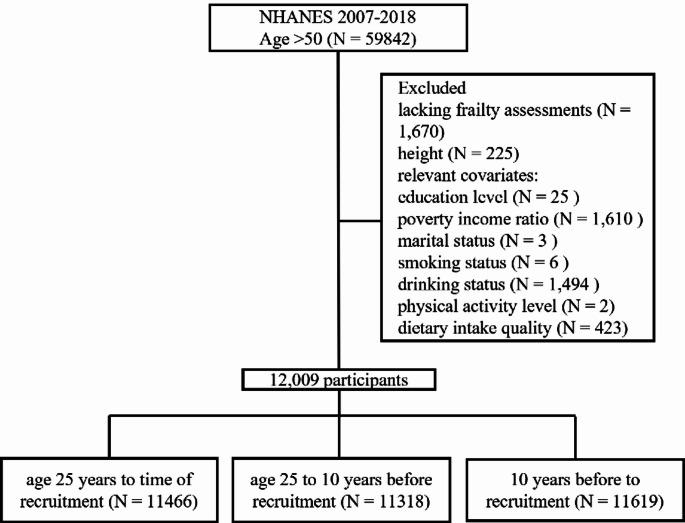
We analyzed data from 12,009 adults aged 50 years and older from the 2007-2018 NHANES. Weighted logistic regression models were used to examine the associations between weight changes and frailty risk. In addition, restricted cubic splines (RCS) were applied to explore potential non-linear relationships.
RESULTS
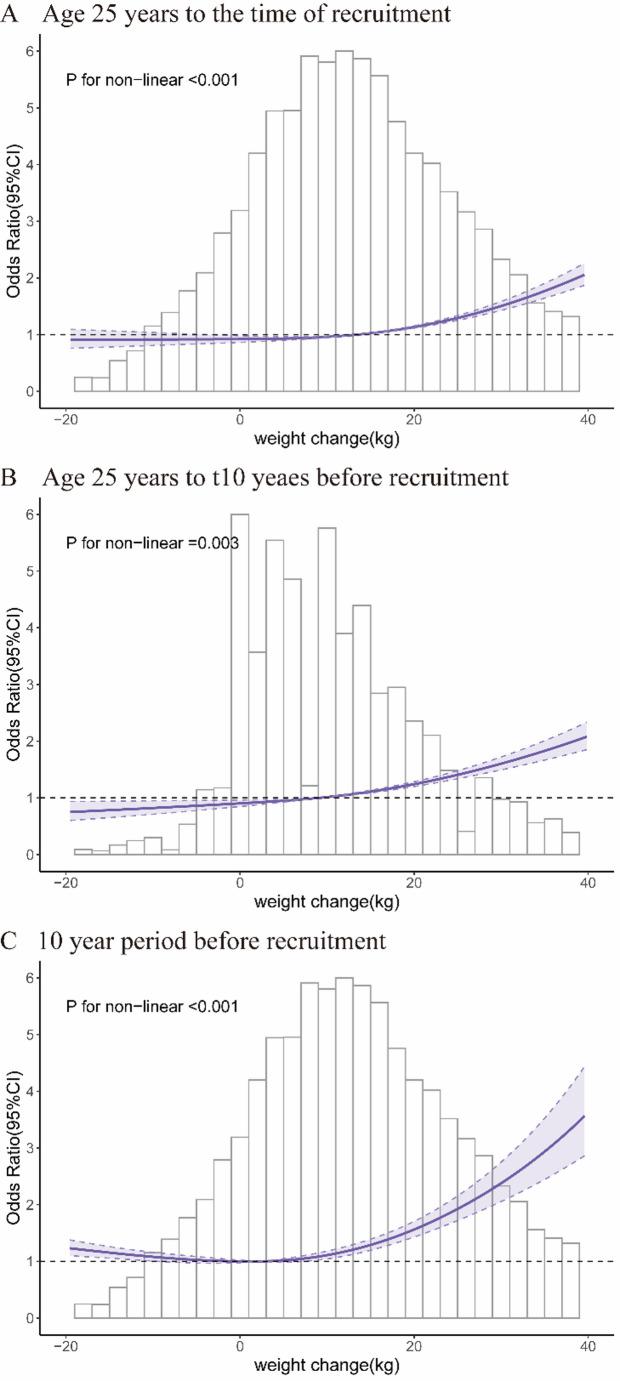
Over the course of adulthood, participants in the categories of maximum overweight, obese to non-obese, non-obese to obese, and stable obese demonstrated a significantly higher risk of frailty compared to the stable normal. The corresponding odds ratios were of 1.28 (95% CI: 1.07, 1.55), 2.50 (95% CI: 1.56, 4.01), 2.57 (95% CI: 2.15, 3.08), and 5.26 (95% CI: 4.03, 6.85), respectively. Additionally, weight loss of ≥ 2.5 kg within the 10 years prior to recruitment was associated with increased frailty risk, with an odds ratio of 1.24 (95% CI: 1.03, 1.50).
CONCLUSION
This study found that patterns of weight change, including maximum overweight, obese to non-obese, non-obese to obese, and stable obesity, were significantly associated with an increased risk of frailty. Weight loss from middle to late adulthood and weight gain throughout adulthood were significant associated with an increased risk of frailty. These findings highlight the importance of maintaining a healthy body weight throughout adulthood.
背景
关于体重变化与衰弱风险之间关系的研究有限。本研究旨在利用美国国家健康与营养检查调查(NHANES)的数据,调查成年期体重变化与中老年人群衰弱风险之间的关联。
方法
我们分析了2007 - 2018年NHANES中12,009名50岁及以上成年人的数据。采用加权逻辑回归模型来检验体重变化与衰弱风险之间的关联。此外,应用受限立方样条(RCS)来探索潜在的非线性关系。
结果
在成年期,最大超重、肥胖至非肥胖、非肥胖至肥胖以及稳定肥胖组的参与者与稳定正常组相比,衰弱风险显著更高。相应的优势比分别为1.28(95%置信区间:1.07, 1.55)、2.50(95%置信区间:1.56, 4.01)、2.57(95%置信区间:2.15, 3.08)和5.26(95%置信区间:4.03, 6.85)。此外,在招募前10年内体重减轻≥2.5千克与衰弱风险增加相关,优势比为1.24(95%置信区间:1.03, 1.50)。
结论
本研究发现,体重变化模式,包括最大超重、肥胖至非肥胖、非肥胖至肥胖以及稳定肥胖,与衰弱风险增加显著相关。成年中期至晚期体重减轻以及成年期体重增加均与衰弱风险增加显著相关。这些发现凸显了成年期保持健康体重的重要性。
 Zotero 插件