
表达TIM3和TIGIT的CD4 T细胞受肾移植影响,并与感染风险相关。
TIM3 and TIGIT-expressing CD4 T cells are impacted by kidney transplantation and associated with risk of infection.
作者信息
Pickering Harry, Sen Subha, Cappelletti Monica, Lum Erik L, Bunnapradist Suphamai, Reed Elaine F, Schaenman Joanna M
机构信息
Department of Pathology and Laboratory Medicine, David Geffen School of Medicine, University of California Los Angeles, Los Angeles, CA, United States.
Division of Nephrology, David Geffen School of Medicine, University of California Los Angeles, Los Angeles, CA, United States.
出版信息
Front Immunol. 2025 May 22;16:1550154. doi: 10.3389/fimmu.2025.1550154. eCollection 2025.
INTRODUCTION
Older kidney transplant patients experience higher rates of infection compared with younger transplant patients suggesting the impact of age-associated immune dysfunction. However, little is known about the impact of immunosuppression including antithymocyte globulin (ATG) induction, as well as whether T cell subtypes can predict risk for infection.
METHODS
We collected blood from 91 patients before and then 3 months after kidney transplantation and analyzed CD4 and CD8 T cell phenotypes to determine the impact of immunosuppression on immune maturation, senescence, and infection.
RESULTS
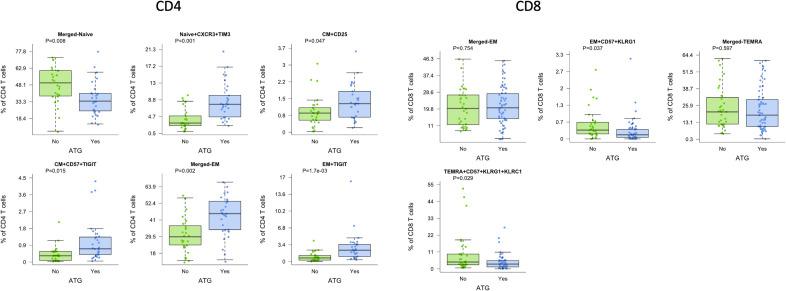
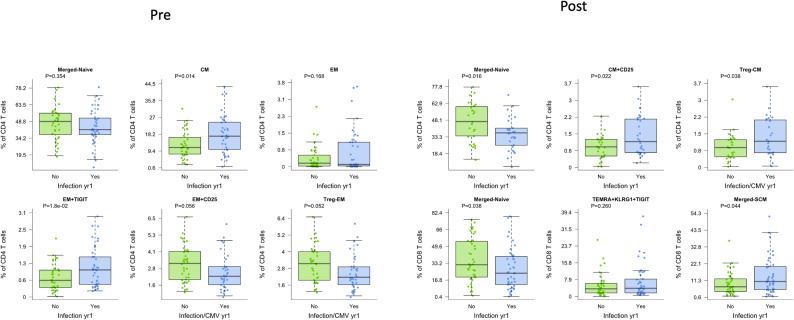
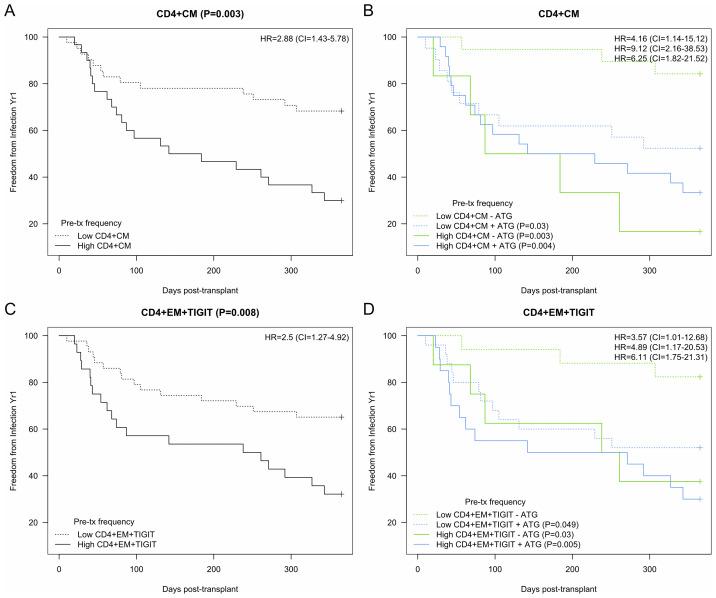
After transplantation the number of naïve T cells decreased overall, while TIM3-expressing naïve and central memory (CM) CD4 T cell frequency increased, with more striking change in patients receiving ATG compared with basiliximab induction. Transplantation also led to increased frequency of TIGIT-expressing effector memory (EM) CD4 T cells and senescent TIGIT and KLRG1-expressing CD8 T cells. Decreased frequencies of naïve CD4 and CD8 T cells (p=0.016 and p=0.038, respectively) and increased frequency of CD4 CM and EM TIGIT+ T cells (p=0.022) were associated with development of infection. A model incorporating increased frequency CD4 EM TIGIT+ T cells and ATG induction was predictive of development of infection after kidney transplantation (HR 3.73, CI 1.08-12.9).
DISCUSSION
Increased frequency of TIM3 and TIGIT markers associated with T cell experience and senescence was a notable phenotypic change associated with transplantation and induction and maintenance immunosuppression. Incorporation of TIGIT expression and induction type into an infection prediction model holds promise for risk stratification and individualization of immunosuppression to decrease risk of adverse outcomes, especially for older patients.
引言
与年轻肾移植患者相比,老年肾移植患者感染率更高,这表明年龄相关免疫功能障碍的影响。然而,关于免疫抑制的影响,包括抗胸腺细胞球蛋白(ATG)诱导,以及T细胞亚群是否能预测感染风险,我们知之甚少。
方法
我们收集了91例患者肾移植前及移植后3个月的血液,分析CD4和CD8 T细胞表型,以确定免疫抑制对免疫成熟、衰老和感染的影响。
结果
移植后,初始T细胞数量总体减少,而表达TIM3的初始和中枢记忆(CM)CD4 T细胞频率增加,与使用巴利昔单抗诱导相比,接受ATG诱导的患者变化更显著。移植还导致表达TIGIT的效应记忆(EM)CD4 T细胞以及衰老的表达TIGIT和KLRG1的CD8 T细胞频率增加。初始CD4和CD8 T细胞频率降低(分别为p=0.016和p=0.038)以及CD4 CM和EM TIGIT+ T细胞频率增加(p=0.022)与感染的发生相关。一个纳入CD4 EM TIGIT+ T细胞频率增加和ATG诱导的模型可预测肾移植后感染的发生(风险比3.73,置信区间1.08 - 12.9)。
讨论
与T细胞经历和衰老相关的TIM3和TIGIT标志物频率增加是与移植以及诱导和维持免疫抑制相关的显著表型变化。将TIGIT表达和诱导类型纳入感染预测模型有望实现风险分层和免疫抑制个体化,以降低不良结局的风险,尤其是对老年患者。


 Zotero 插件