
三级淋巴结构:探索改善卵巢癌免疫治疗的机会
Tertiary lymphoid structures: exploring opportunities to improve immunotherapy in ovarian cancer.
作者信息
Varghese Aaron, Hess Suzanne M, Chilakapati Shanmuga, Conejo-Garcia Jose R, McGray A J Robert, Zsiros Emese
机构信息
Department of Gynecologic Oncology, Roswell Park Comprehensive Cancer Center, Buffalo, NY, United States.
Department of Obstetrics and Gynecology, University of Rochester Medical Center, Rochester, NY, United States.
出版信息
Front Immunol. 2025 May 22;16:1473969. doi: 10.3389/fimmu.2025.1473969. eCollection 2025.
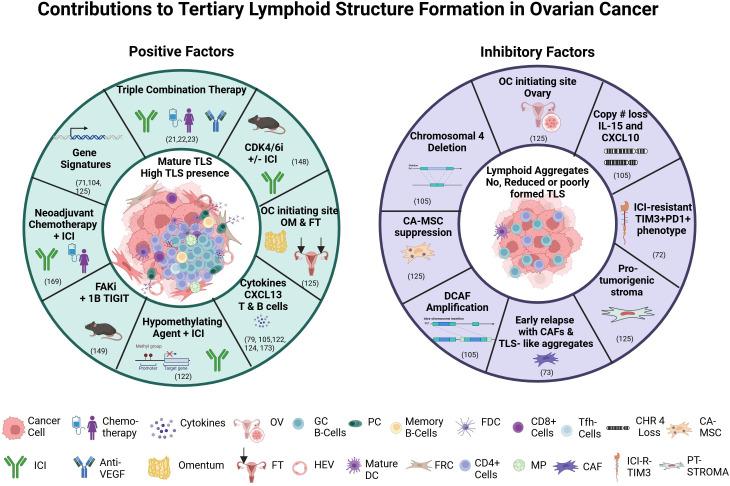
Tertiary lymphoid structures (TLS) are organized ectopic lymphoid clusters of immune cells that develop in non-lymphoid tissue to promote antigen presentation, drive cytotoxic immune responses, and enhance humoral immunity via B cell clonal expansion. Their presence within the tumor microenvironment (TME) correlates with increased patient survival and an improved response to immune checkpoint inhibitors (ICIs), positioning TLS as potential predictive and prognostic biomarkers. Despite the widespread use of ICIs across various cancers, their effectiveness remains limited in gynecological malignancies, including ovarian cancer (OC), a notably challenging disease characterized by poor responses to both single and combination ICI therapies. Interestingly, the infiltration of T cells into the OC TME is linked to enhanced progression-free survival (PFS) and overall survival (OS), yet an immunosuppressive TME frequently impedes therapeutic efficacy, suggesting cell activity within localized immune niches can impact antitumor immunity. This review explores the roles of TLS, their maturity, functionality, identification, and related gene signatures; specific immune cells and cytokines that play a role in TLS formation and antitumor response; and other modifiable elements, including gut microbiota, that may drive improving OC survival by leveraging a TLS-driven antitumor response to bolster immunotherapy outcomes.
三级淋巴结构(TLS)是免疫细胞组成的异位淋巴样聚集体,在非淋巴组织中形成,以促进抗原呈递、驱动细胞毒性免疫反应,并通过B细胞克隆扩增增强体液免疫。它们在肿瘤微环境(TME)中的存在与患者生存率提高和对免疫检查点抑制剂(ICI)的反应改善相关,这使得TLS成为潜在的预测性和预后性生物标志物。尽管ICI在各种癌症中广泛应用,但其在妇科恶性肿瘤中的有效性仍然有限,包括卵巢癌(OC),这是一种特别具有挑战性的疾病,对单一和联合ICI治疗的反应都很差。有趣的是,T细胞浸润到OC TME与无进展生存期(PFS)和总生存期(OS)的提高有关,但免疫抑制性TME常常阻碍治疗效果,这表明局部免疫龛内的细胞活性会影响抗肿瘤免疫。本综述探讨了TLS的作用、其成熟度、功能、识别及相关基因特征;在TLS形成和抗肿瘤反应中起作用的特定免疫细胞和细胞因子;以及其他可调节因素,包括肠道微生物群,它们可能通过利用TLS驱动的抗肿瘤反应来改善OC患者的生存,从而提高免疫治疗效果。

 Zotero 插件