
生物学黎明时期的结构酶学、系统发育学、分化与符号自反性
Structural Enzymology, Phylogenetics, Differentiation, and Symbolic Reflexivity at the Dawn of Biology.
作者信息
Carter Charles W, Tang Guo Qing, Patra Sourav Kumar, Dieckhaus Henry, Kuhlman Brian, Douglas Jordan, Wills Peter R, Bouckaert Remco, Popovic Milena, Ditzler Mark A
机构信息
Department of Biochemistry and Biophysics, University of North Carolina at Chapel Hill, Chapel Hill, NC 27599-7260, USA.
Division of Chemical Biology and Medicinal Chemistry, Eshelman School of Pharmacy, University of North Carolina at Chapel Hill, Chapel Hill, NC, USA.
出版信息
Genome Biol Evol. 2025 May 30;17(6). doi: 10.1093/gbe/evaf095.
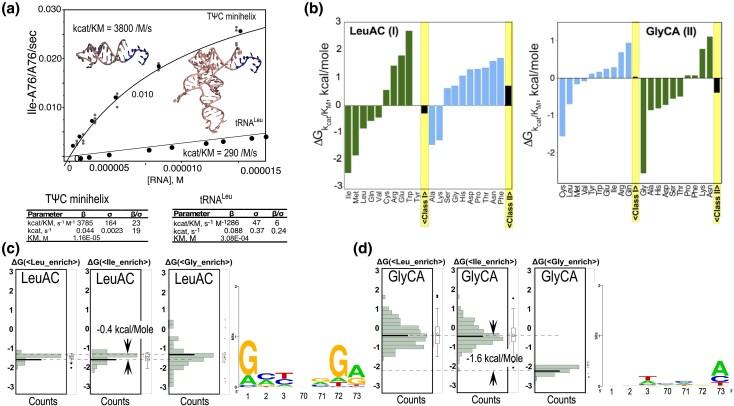
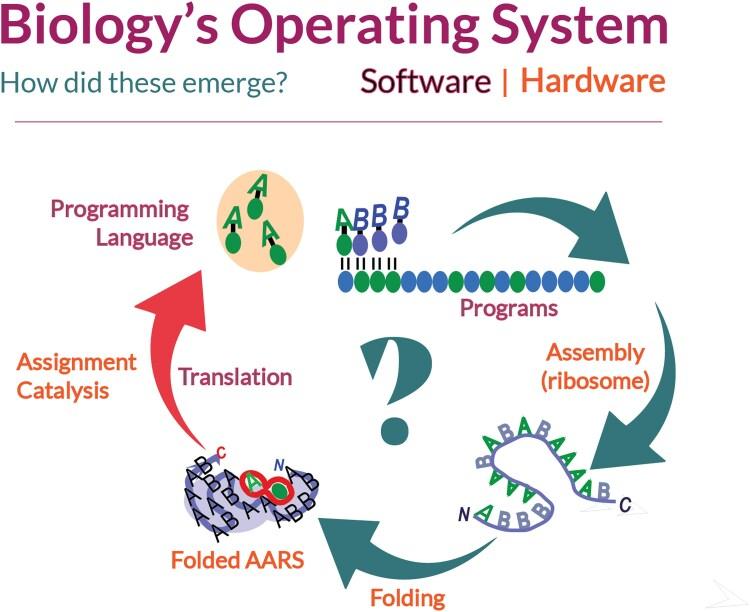
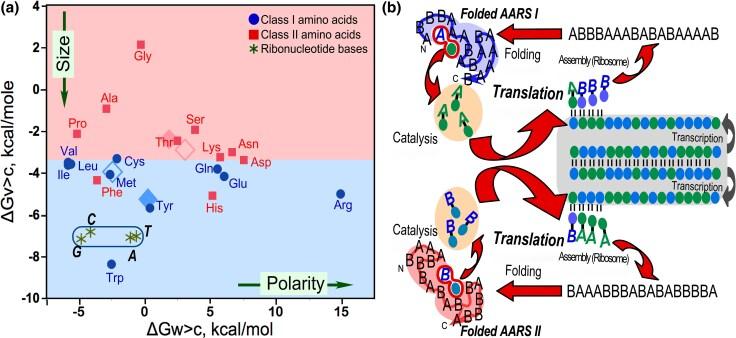
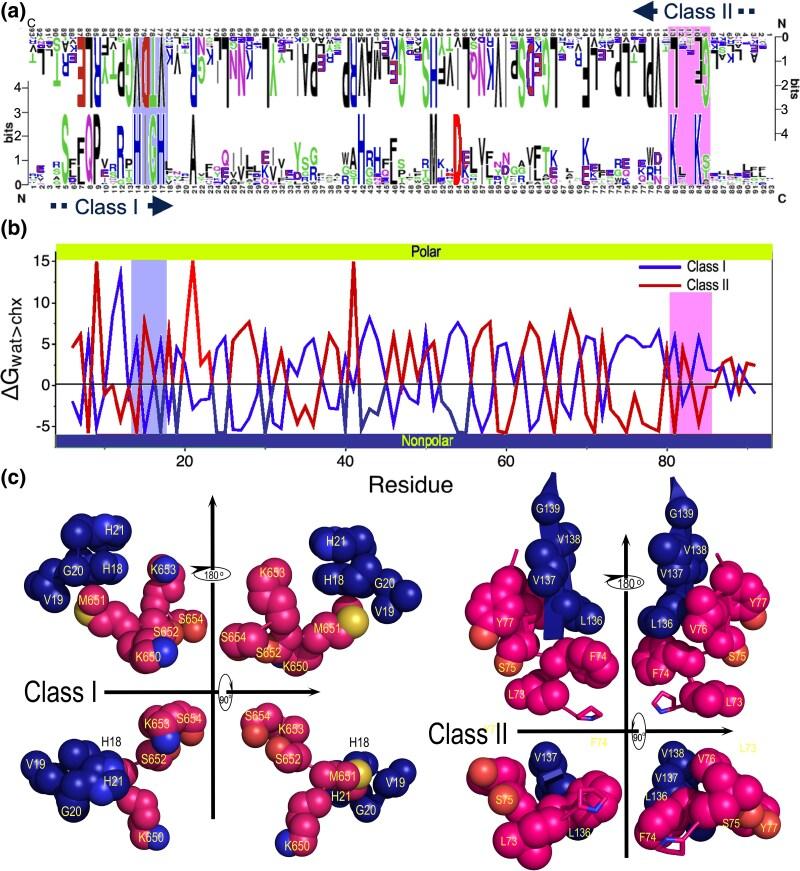
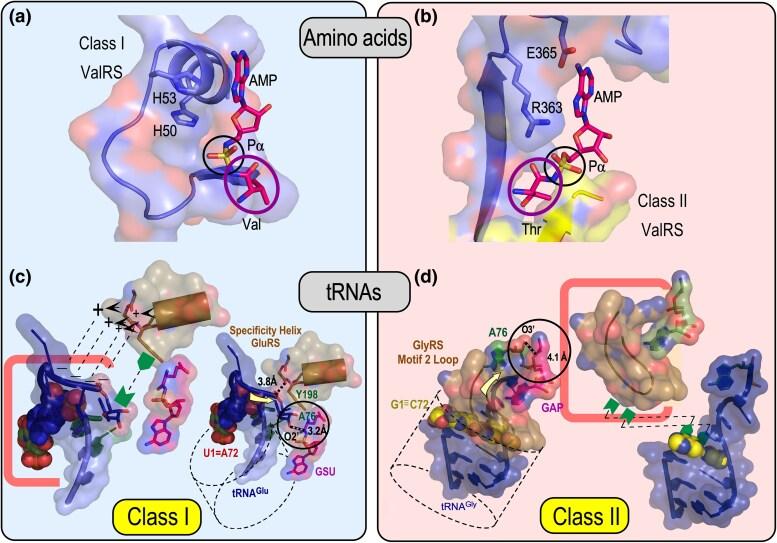
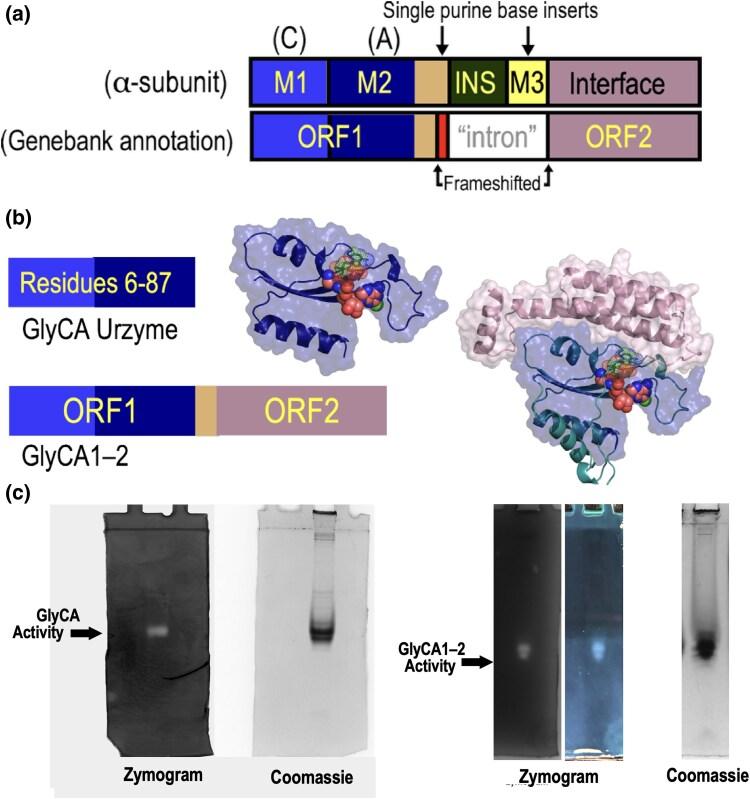
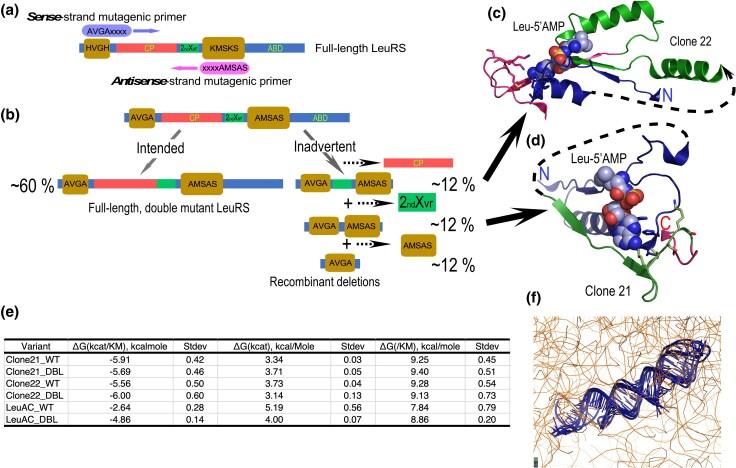
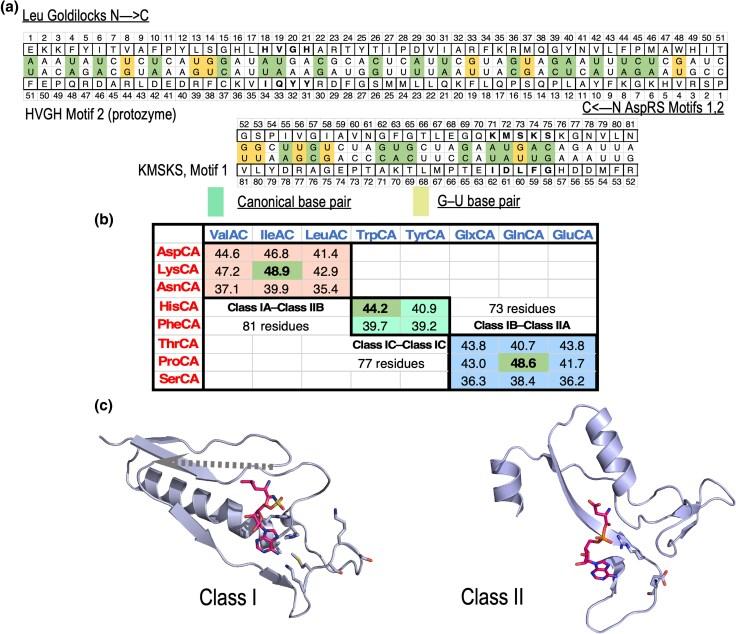
Translation of symbols in one chemical language into another defined genetics. Yet, the co-linearity of codons and amino acids is so commonplace an idea that few even ask how it arose. Readout is done by two distinct sets of proteins, called aminoacyl-tRNA synthetases. Aminoacyl-tRNA synthetases must enforce the rules first used to assemble themselves. To understand the roots of translation, we must experimentally test the structural codes that the earliest aminoacyl-tRNA synthetases used to recognize both amino acid and RNA substrates. We present here new results on five different facets of that problem. (i) The surfaces of structures coded by opposite strands of the same gene have opposite polarities. Core residues in proteins from one strand are surface residues in proteins from the other strand. The complementarity of base pairing thus projects into the proteome. That leads in turn to contrasting amino acid and RNA substrate binding modes. (ii) Escherichia coli reproduces in vivo a nested hierarchy of active excerpts, or "urzymes," similar to those we had designed as models for ancestral aminoacyl-tRNA synthetases. (iii) A third novel deletion produced in vivo and a new Class II urzyme suggest how to design bidirectional urzyme genes. (iv) Codon middle base pairing provides a basis to constrain Class I and II aminoacyl-tRNA synthetase family trees. (v) Aminoacyl-tRNA synthetase urzymes acylate class-specific subsets of an RNA library, showing urzyme RNA substrate specificity for the first time. Four new tree-building tools augment these results to compose a viable platform for experimental study of the origins of genetic coding.
将一种化学语言中的符号翻译成另一种特定的遗传学语言。然而,密码子与氨基酸的共线性是一个如此常见的概念,以至于几乎没有人会问它是如何产生的。解读过程由两组不同的蛋白质完成,即氨酰 - tRNA合成酶。氨酰 - tRNA合成酶必须遵循最初用于组装自身的规则。为了理解翻译的根源,我们必须通过实验来测试最早的氨酰 - tRNA合成酶用于识别氨基酸和RNA底物的结构密码。我们在此展示了关于该问题五个不同方面的新结果。(i)同一基因的互补链编码的结构表面具有相反的极性。一条链上蛋白质的核心残基在另一条链上蛋白质中则为表面残基。碱基配对的互补性因此投射到蛋白质组中。这进而导致氨基酸和RNA底物结合模式的对比。(ii)大肠杆菌在体内再现了一系列嵌套的活性片段,即“原始酶”,类似于我们设计的作为祖先氨酰 - tRNA合成酶模型的那些。(iii)在体内产生的第三个新缺失和一种新的II类原始酶表明了如何设计双向原始酶基因。(iv)密码子中间碱基配对为限制I类和II类氨酰 - tRNA合成酶家族树提供了基础。(v)氨酰 - tRNA合成酶原始酶对RNA文库的特定类别子集进行酰化,首次展示了原始酶的RNA底物特异性。四种新的建树工具增强了这些结果,构成了一个用于遗传编码起源实验研究的可行平台。

 Zotero 插件